Constructions — Important Questions
NIOS · Class 10 · Maths
43 important questions from Constructions for NIOS Class 10 Maths, with answers. Includes multiple choice and numerical questions.
Interactive on Super Tutor
Studying Constructions? Get the full interactive chapter.
Quizzes, flashcards, AI doubt-solver and a step-by-step study plan — built for important questions and more.
Free trial, no card needed.
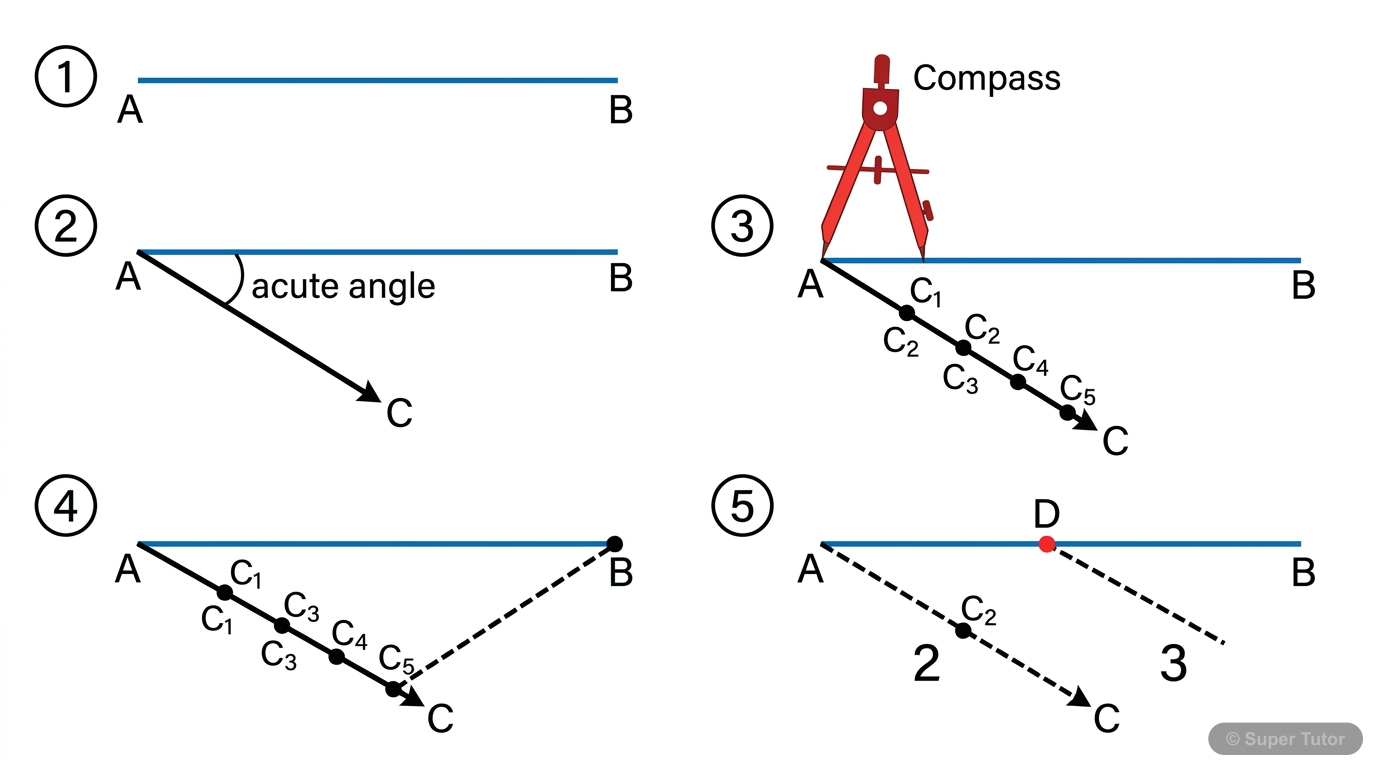
Learn better with visuals Super Tutor pairs illustrations like this with notes and quizzes for Constructions.
Important Questions from Constructions
In RHS construction of a right triangle, which angle should be constructed first?
Show answer
The right angle
Step 1: In RHS (Right angle-Hypotenuse-Side) construction, we have the right angle, hypotenuse length, and one other side. Step 2: First draw the given side, then construct a 90° angle at one end of this side. Step 3: From the other end of the given side, draw an arc with radius equal to the hypotenuse. Step 4: This arc intersects the 90° line to complete the right triangle. The right angle must be constructed first because it defines the perpendicular direction for completing the triangle.
To construct a tangent at a point on a circle, what must be drawn perpendicular to the radius?
Show answer
The tangent line
Step 1: A tangent to a circle is always perpendicular to the radius at the point of tangency. Step 2: To construct a tangent at point P on circle with center O, first join OP. Step 3: At point P, construct a perpendicular line to radius OP. Step 4: This perpendicular line is the required tangent. This works because the tangent touches the circle at exactly one point and makes a 90° angle with the radius at that point.
When constructing a triangle with perimeter and base angles given, why do we use half-angles?
Show answer
Because of the angle bisector property
Step 1: When we draw perpendicular bisectors of sides from the apex to the base, these bisectors create angle bisectors. Step 2: The angle bisector divides the original angle into two equal parts (half-angles). Step 3: By constructing half of each base angle at the ends of the perimeter line, we ensure the perpendicular bisectors meet correctly. Step 4: This geometric property ensures that when we locate the base points using perpendicular bisectors, the final triangle has the required base angles and perimeter.
In SAS triangle construction, what does the 'S' between the two 'A's represent?
Show answer
The included side between the two angles
Step 1: SAS stands for Side-Angle-Side construction method. Step 2: The middle 'S' represents the side that lies between the two given angles. Step 3: This included side is crucial because it connects the two vertices where the given angles are constructed. Step 4: To construct using SAS: draw the included side, then construct the given angles at both ends of this side. The intersection of the angle rays forms the third vertex. The included side is essential for uniquely determining the triangle's shape.
+39 more questions on Constructions (NIOS Class 10 Maths)
Practise AllFrequently Asked Questions
What are the important topics in Constructions for NIOS Class 10 Maths?
How many important questions are there in Constructions?
Sources & Official References
Content is aligned to the official syllabus. Refer to the board website for the latest curriculum.
More resources for Constructions
Practice Quiz
Test yourself with a quick quiz
Revision Notes
Key points for last-minute revision
Formula Sheet
The chapter's formulas in one place
Chapter Summary
Understand the chapter at a glance
Concept Maps
See how topics connect
Study Plan
Step-by-step plan for this chapter
Flashcards
Quick-fire cards for active recall
Syllabus
What topics to cover
For serious students
Get the full Constructions chapter — start free.
Quizzes, flashcards, an AI doubt solver and a study plan for NIOS Class 10 Maths. Free to start, no card needed.