Concurrent Lines — Important Questions
NIOS · Class 10 · Maths
37 important questions from Concurrent Lines for NIOS Class 10 Maths, with answers. Includes multiple choice and numerical questions.
Interactive on Super Tutor
Studying Concurrent Lines? Get the full interactive chapter.
Quizzes, flashcards, AI doubt-solver and a step-by-step study plan — built for important questions and more.
Free trial, no card needed.
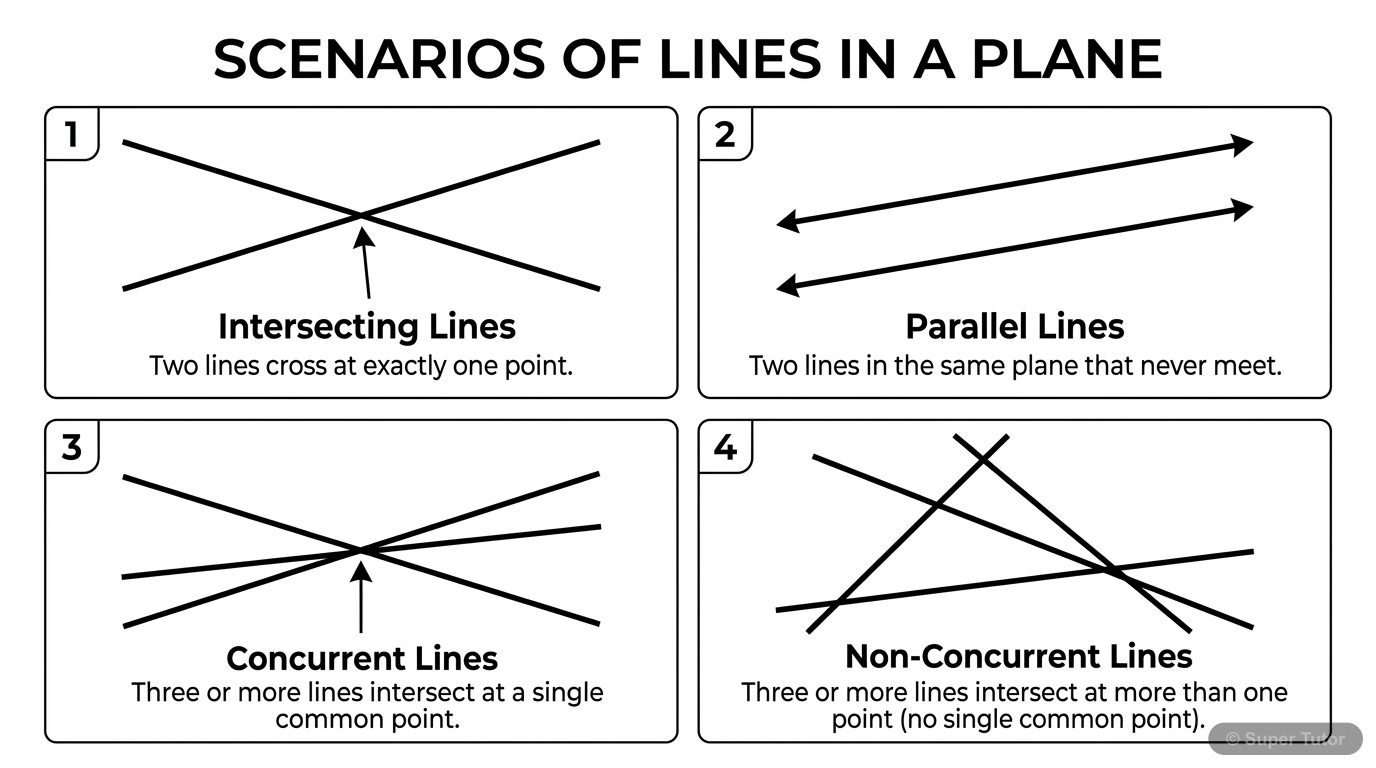
Learn better with visuals Super Tutor pairs illustrations like this with notes and quizzes for Concurrent Lines.
Important Questions from Concurrent Lines
In an equilateral triangle, the distance from the centroid to a vertex is 6 cm. What is the distance from the centroid to the opposite side?
Show answer
3 cm
Step 1: In an equilateral triangle, the centroid divides each median in ratio 2:1. Step 2: The distance from vertex to centroid = 6 cm (given). Step 3: Since AG:GD = 2:1, and AG = 6 cm, we get GD = 6÷2 = 3 cm. Step 4: In an equilateral triangle, the centroid is also the incentre, so the distance to the opposite side equals the inradius. Step 5: Therefore, the distance from centroid to the opposite side = 3 cm.
If the orthocentre of a triangle lies on one of its sides, what type of triangle is it?
Show answer
A right triangle
In a right triangle, the orthocentre lies at the vertex containing the right angle. If the orthocentre lies on one of the sides, that side must meet at the right-angle vertex, so the triangle is right-angled. In acute triangles the orthocentre is inside, and in obtuse triangles it is outside.
In triangle ABC, the three medians are AD, BE, and CF. They meet at point G. Which statement is always true?
Show answer
BG = 2GE
Step 1: Recall that the centroid divides each median in the ratio 2:1. Step 2: This means the distance from vertex to centroid is twice the distance from centroid to midpoint. Step 3: For median BE: BG:GE = 2:1, so BG = 2×GE. Step 4: Similarly, AG = 2×GD and CG = 2×GF. Step 5: Therefore, BG = 2GE is the correct statement reflecting the 2:1 division property.
The incircle of triangle PQR has radius 4 cm. What is the distance from the incentre to each side of the triangle?
Show answer
4 cm
Step 1: Understand that the incentre is the centre of the incircle. Step 2: The incircle touches all three sides of the triangle. Step 3: The radius of the incircle is the perpendicular distance from the incentre to each side. Step 4: Since the incircle radius = 4 cm, the distance from incentre to each side = 4 cm. Step 5: This is because the incentre is equidistant from all three sides of the triangle.
+33 more questions on Concurrent Lines (NIOS Class 10 Maths)
Practise AllFrequently Asked Questions
What are the important topics in Concurrent Lines for NIOS Class 10 Maths?
How many important questions are there in Concurrent Lines?
Sources & Official References
Content is aligned to the official syllabus. Refer to the board website for the latest curriculum.
More resources for Concurrent Lines
Practice Quiz
Test yourself with a quick quiz
Revision Notes
Key points for last-minute revision
Formula Sheet
The chapter's formulas in one place
Chapter Summary
Understand the chapter at a glance
Concept Maps
See how topics connect
Study Plan
Step-by-step plan for this chapter
Flashcards
Quick-fire cards for active recall
Syllabus
What topics to cover
For serious students
Get the full Concurrent Lines chapter — start free.
Quizzes, flashcards, an AI doubt solver and a study plan for NIOS Class 10 Maths. Free to start, no card needed.