Constructions — Flashcards
NIOS · Class 10 · Maths
24 flashcards for Constructions (NIOS Class 10 Maths) to test yourself on key terms and facts. Sample: "Divide line segment AB internally"
Interactive on Super Tutor
Studying Constructions? Get the full interactive chapter.
Quizzes, flashcards, AI doubt-solver and a step-by-step study plan — built for flashcards and more.
Free trial, no card needed.
Learn better with visuals Super Tutor pairs illustrations like this with notes and quizzes for Constructions.
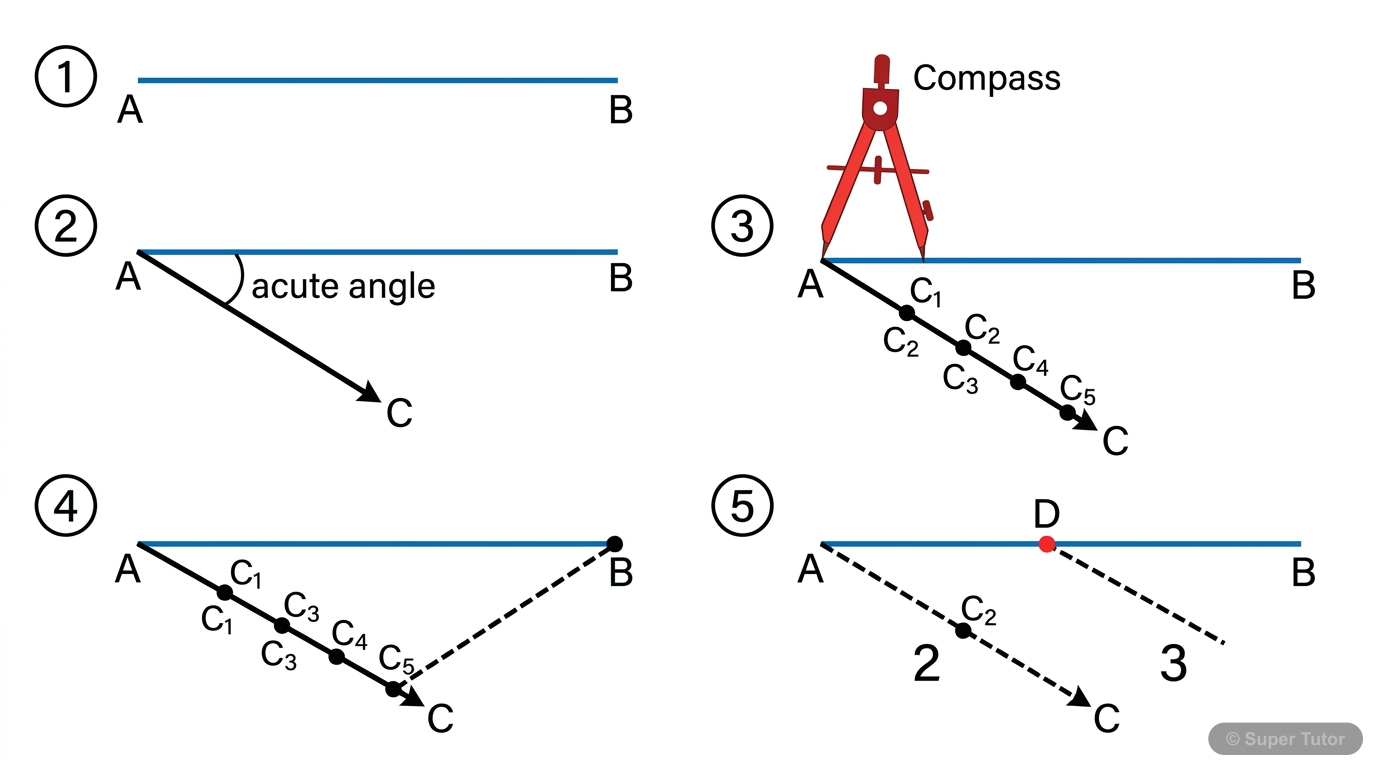
Divide line segment AB internally in the ratio 2:3. How many equal parts are marked on the auxiliary ray, and which point gives the required division?
Answer
Step 1: Draw a ray from A making an acute angle with AB. Step 2: Mark 5 equal points on the ray because 2 + 3 = 5. Step 3: Join the 5th point to B. Step 4: Through the 2nd point, draw a line parallel …
Why are 5 equal points marked on the auxiliary ray in ratio 2:3 division?
Answer
The total number of equal parts is the sum of the ratio terms. For 2:3, total = 2 + 3 = 5. So 5 equal points are marked on the ray, and the 2nd point is used to draw the parallel line. This gives the …
Construct a triangle when three sides are given: AB = 6 cm, AC = 4.8 cm, BC = 5 cm. What is the construction method?
Answer
Step 1: Draw AB = 6 cm. Step 2: With A as centre and radius 4.8 cm, draw an arc. Step 3: With B as centre and radius 5 cm, draw another arc cutting the first arc at C. Step 4: Join AC and BC. Answer: …
Construct a triangle when two sides and the included angle are given: PQ = 5.6 cm, QR = 4.5 cm, and angle PQR = 60°.
Answer
Step 1: Draw PQ = 5.6 cm. Step 2: At Q, construct a 60° angle. Step 3: With Q as centre and radius 4.5 cm, cut the ray at R. Step 4: Join PR. Answer: Triangle PQR is constructed by the SAS method.
Why is the angle at Q used directly in the SAS construction of triangle PQR?
Answer
SAS means two sides and the included angle are given. The included angle lies between the two given sides PQ and QR. So the angle is made at Q, because Q is the common endpoint of both sides. That fix…
Construct a triangle when two angles and the included side are given: angle B = 60°, angle C = 45°, BC = 4.7 cm.
Answer
Step 1: Draw BC = 4.7 cm. Step 2: At B, draw the 60° ray. Step 3: At C, draw the 45° ray. Step 4: Let the rays meet at A. Step 5: Join AB and AC. Answer: Triangle ABC is constructed by the ASA method.
When two angles and a non-included side are given, what extra step is needed before construction?
Answer
The third angle must first be found using the angle sum property of a triangle. Then the triangle can be constructed using the known side and the two angles. This is important when the given side is n…
Construct a right triangle with BC = 3 cm and hypotenuse AC = 5 cm, right angled at B.
Answer
Step 1: Draw BC = 3 cm. Step 2: At B, construct angle CBP = 90°. Step 3: With C as centre and radius 5 cm, draw an arc cutting BP at A. Step 4: Join AC. Answer: Triangle ABC is the required right tria…
+16 more flashcards
Practise AllFrequently Asked Questions
What are the important topics in Constructions for NIOS Class 10 Maths?
How many flashcards are available for Constructions?
How should I revise Constructions for the NIOS Class 10 board exam?
Sources & Official References
Content is aligned to the official syllabus. Refer to the board website for the latest curriculum.
More resources for Constructions
Practice Quiz
Test yourself with a quick quiz
Important Questions
Exam-style questions with answers
Revision Notes
Key points for last-minute revision
Formula Sheet
The chapter's formulas in one place
Chapter Summary
Understand the chapter at a glance
Concept Maps
See how topics connect
Study Plan
Step-by-step plan for this chapter
Syllabus
What topics to cover
For serious students
Get the full Constructions chapter — start free.
Quizzes, flashcards, an AI doubt solver and a study plan for NIOS Class 10 Maths. Free to start, no card needed.