Cell – Structure And Function — Syllabus
NIOS · Class 12 · Biology
What Cell – Structure And Function covers in NIOS Class 12 Biology: 4 topics, for the 2026-27 session. Part of the NIOS Class 12 Biology syllabus.
Interactive on Super Tutor
Studying Cell – Structure And Function? Get the full interactive chapter.
Quizzes, flashcards, AI doubt-solver and a step-by-step study plan — built for syllabus and more.
Free trial, no card needed.
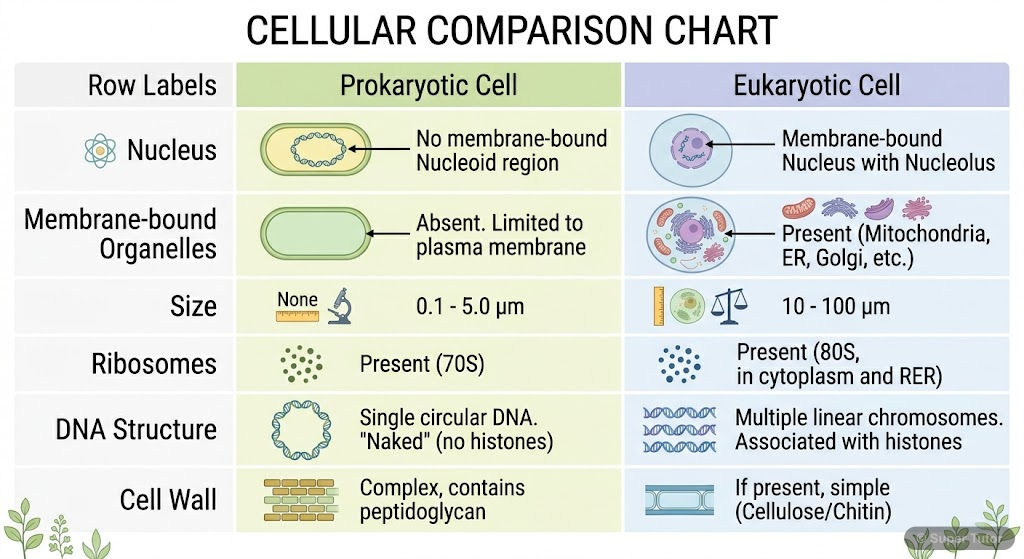
One of 21 illustrations for Cell – Structure And Function in Super Tutor — alongside flashcards, concept maps and practice questions.
See them allTopics in Cell – Structure And Function
1. Discovery of the cell and cell theory
- Robert Hooke in 1665 observed cork under the microscope and named the small compartments cells.
- Anton Van Leeuwenhoek invented the microscope and in 1672 observed bacteria, sperms, and red blood corpuscles.
- Robert Brown in 1831 observed the centrally placed nucleus in cells.
2. Prokaryotic and eukaryotic cells; plant and animal cells
- Bacteria lack defined cell organelles and a well-formed nucleus.
- Prokaryotes have only one chromosome per cell.
- The prokaryotic chromosome is circular and attached to the cell membrane at one point.
3. Plasma membrane and cell wall
- The plasma membrane is the limiting boundary of the cell.
- It is flexible and can fold in or out.
- The fluid mosaic model proposed by Singer and Nicholson in 1972 is widely accepted.
4. Cytoplasm and cell organelles
- The cytoplasm contains organelles that trap and release energy, synthesize and transport materials, help in movement, digest materials, and control cell activities.
- The nucleus is the hereditary organelle and controls all cell activities.
- Mitochondria and chloroplasts are energy-transforming organelles.
Key Concepts
Central concept: Cell as the structural and functional unit of life
Work through every topic in Cell – Structure And Function with notes and quizzes
Start This ChapterFrequently Asked Questions
What are the important topics in Cell – Structure And Function for NIOS Class 12 Biology?
How should I revise Cell – Structure And Function for the NIOS Class 12 board exam?
Sources & Official References
Content is aligned to the official syllabus. Refer to the board website for the latest curriculum.
More resources for Cell – Structure And Function
Practice Quiz
Test yourself with a quick quiz
Important Questions
Exam-style questions with answers
Revision Notes
Key points for last-minute revision
Chapter Summary
Understand the chapter at a glance
Concept Maps
See how topics connect
Study Plan
Step-by-step plan for this chapter
Flashcards
Quick-fire cards for active recall
For serious students
Get the full Cell – Structure And Function chapter — start free.
Quizzes, flashcards, an AI doubt solver and a study plan for NIOS Class 12 Biology. Free to start, no card needed.