Cell – Structure And Function — Important Questions
NIOS · Class 12 · Biology
45 important questions from Cell – Structure And Function for NIOS Class 12 Biology, with answers. Includes multiple choice questions.
Interactive on Super Tutor
Studying Cell – Structure And Function? Get the full interactive chapter.
Quizzes, flashcards, AI doubt-solver and a step-by-step study plan — built for important questions and more.
Free trial, no card needed.
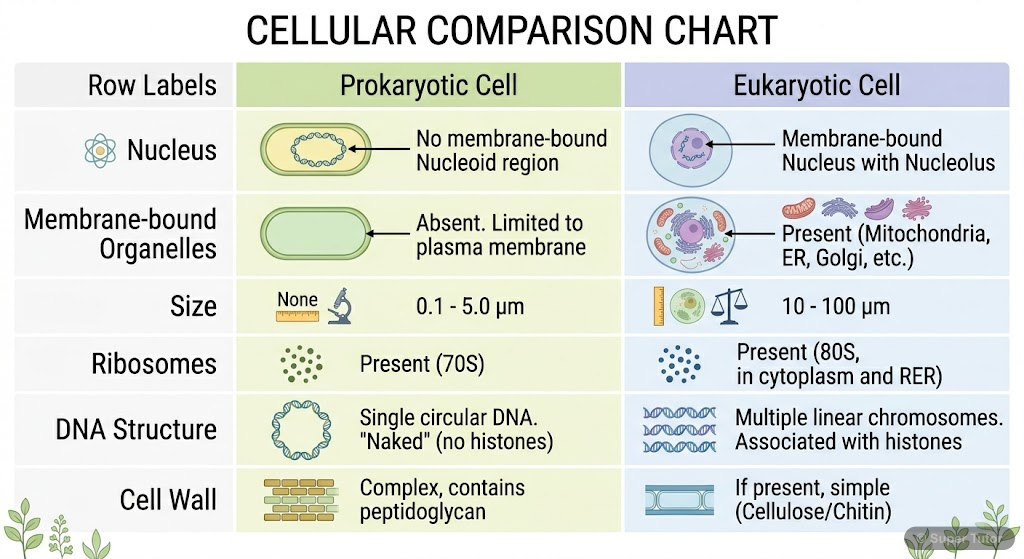
One of 21 illustrations for Cell – Structure And Function in Super Tutor — alongside flashcards, concept maps and practice questions.
Important Questions from Cell – Structure And Function
Which of the following is present in plant cells but NOT in animal cells?
Show answer
Chloroplast
Step 1: Compare plant and animal cells. Step 2: Chloroplasts are found only in green plant cells. They are the site of photosynthesis and contain the green pigment chlorophyll. Step 3: Mitochondria are present in BOTH plant and animal cells for respiration. Step 4: Ribosomes are present in ALL living cells (both prokaryotic and eukaryotic). Step 5: Centrioles are present in animal cells but ABSENT in most plant cells. Therefore, chloroplast is the structure unique to plant cells among the given options.
The movement of water molecules from a region of higher concentration to lower concentration through a semipermeable membrane is called:
Show answer
Osmosis
Step 1: Recall the different types of transport across the cell membrane. Step 2: Osmosis specifically refers to the movement of WATER molecules from a region of higher water concentration to lower water concentration through a semipermeable membrane. Step 3: Diffusion is the movement of any molecule from higher to lower concentration, but it does NOT require a semipermeable membrane. Step 4: Active transport moves molecules AGAINST the concentration gradient and requires energy (ATP). Step 5: Endocytosis is bulk intake of large particles. So the correct answer is Osmosis.
Lysosomes are called 'suicidal bags' because they:
Show answer
Contain enzymes that can digest the cell's own material when damaged.
Step 1: Lysosomes are membrane-bound organelles containing about 40 digestive (hydrolytic) enzymes. Step 2: Under normal conditions, these enzymes digest food, germs, and damaged cell material. Step 3: However, when a cell is old, diseased, or injured, the lysosomal membrane ruptures and the enzymes are released into the cytoplasm. Step 4: These enzymes then digest the cell's own organelles and contents — effectively 'killing' the cell from within. Step 5: This self-destructive ability earns lysosomes the nickname 'suicidal bags'.
In a prokaryotic cell, the ribosomes are of which type?
Show answer
70S
Step 1: Ribosomes are classified by their sedimentation coefficient, measured in Svedberg units (S). Step 2: Prokaryotic cells (like bacteria) have smaller 70S ribosomes. Step 3: Eukaryotic cells (like plant and animal cells) have larger 80S ribosomes. Step 4: The S value refers to how fast the ribosome sediments in an ultracentrifuge — higher S means larger and heavier. Step 5: This difference is important in medicine — many antibiotics target the 70S ribosome of bacteria without harming the 80S ribosomes of human cells.
+41 more questions on Cell – Structure And Function (NIOS Class 12 Biology)
Practise AllFrequently Asked Questions
What are the important topics in Cell – Structure And Function for NIOS Class 12 Biology?
How many important questions are there in Cell – Structure And Function?
Sources & Official References
Content is aligned to the official syllabus. Refer to the board website for the latest curriculum.
More resources for Cell – Structure And Function
For serious students
Get the full Cell – Structure And Function chapter — start free.
Quizzes, flashcards, an AI doubt solver and a study plan for NIOS Class 12 Biology. Free to start, no card needed.