Cell – Structure And Function — Flashcards
NIOS · Class 12 · Biology
26 flashcards for Cell – Structure And Function (NIOS Class 12 Biology) to test yourself on key terms and facts.
Interactive on Super Tutor
Studying Cell – Structure And Function? Get the full interactive chapter.
Quizzes, flashcards, AI doubt-solver and a step-by-step study plan — built for flashcards and more.
Free trial, no card needed.
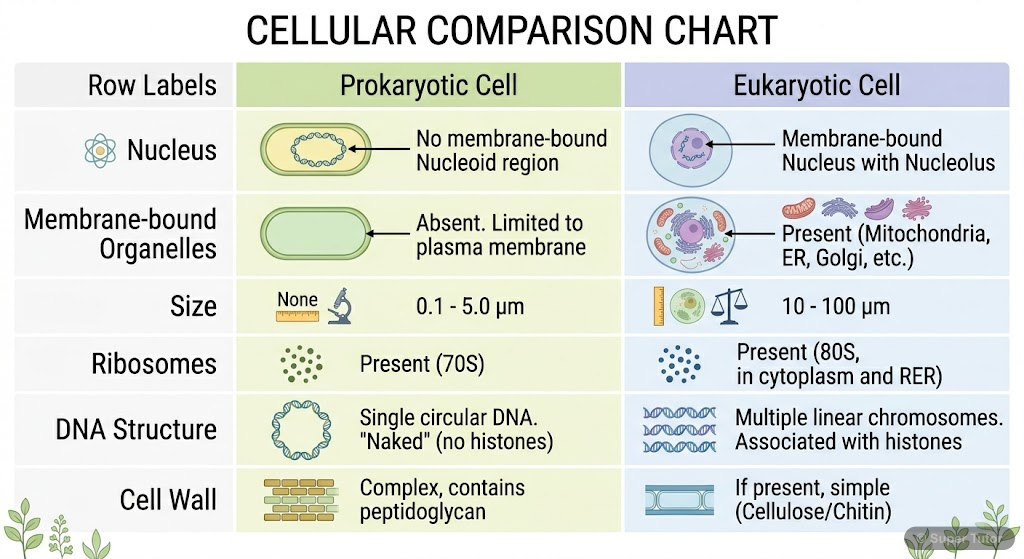
One of 21 illustrations for Cell – Structure And Function in Super Tutor — alongside flashcards, concept maps and practice questions.
What is cell theory, and who proposed it?
Answer
Cell theory was proposed by M.J. Schleiden and Theodore Schwann in 1838. It states three fundamental principles: (1) All organisms are composed of cells, (2) The cell is the structural and functional …
Differentiate between prokaryotic and eukaryotic cells with at least three key differences.
Answer
Prokaryotic cells (bacteria) and eukaryotic cells (animals, plants, fungi) differ in: (1) Nucleus: Prokaryotes lack a defined nucleus; DNA is in a nucleoid region. Eukaryotes have a membrane-bound nuc…
What is the plasma membrane, and what model best explains its structure?
Answer
The plasma membrane (also called cell membrane) is a living, selective boundary that encloses the cell. The Fluid Mosaic Model, proposed by Singer and Nicholson (1972), best explains its structure. Ac…
Compare diffusion, osmosis, and active transport in terms of energy requirement and direction of movement.
Answer
These three transport mechanisms differ significantly: (1) Diffusion: Movement of molecules from high to low concentration. No energy (ATP) required. Passive process. Example: Gas exchange in lungs. (…
What is bulk transport, and how do phagocytosis and pinocytosis differ?
Answer
Bulk transport is the movement of large molecules or substances across the cell membrane through changes in membrane shape. There are two types of endocytosis: (1) Phagocytosis ('cell eating'): The ce…
Describe the structure and functions of the plant cell wall.
Answer
The plant cell wall is the rigid, non-living outermost layer secreted by the cell itself. Structure: (1) Composed mainly of cellulose fibers called microfibrils, which may be thin (1 micron) or very t…
Why is the mitochondrion called the 'powerhouse of the cell'?
Answer
The mitochondrion is called the 'powerhouse of the cell' because it is the primary site of cellular respiration, where energy from food molecules is released and captured in ATP (adenosine triphosphat…
What is the structure of a chloroplast, and where does photosynthesis occur?
Answer
The chloroplast is a double-membraned organelle found in green plant cells. Structure: (1) Outer and inner membranes. (2) Interior contains stacked disc-like structures called thylakoids arranged in s…
+18 more flashcards
Practise AllFrequently Asked Questions
What are the important topics in Cell – Structure And Function for NIOS Class 12 Biology?
How many flashcards are available for Cell – Structure And Function?
How should I revise Cell – Structure And Function for the NIOS Class 12 board exam?
Sources & Official References
Content is aligned to the official syllabus. Refer to the board website for the latest curriculum.
More resources for Cell – Structure And Function
For serious students
Get the full Cell – Structure And Function chapter — start free.
Quizzes, flashcards, an AI doubt solver and a study plan for NIOS Class 12 Biology. Free to start, no card needed.