Cell – Structure And Function — Chapter Summary
NIOS · Class 12 · Biology
Summary of Cell – Structure And Function for NIOS Class 12 Biology. Key concepts: Formulated by Schleiden, Prokaryotic cells and The plasma membrane.
Interactive on Super Tutor
Studying Cell – Structure And Function? Get the full interactive chapter.
Quizzes, flashcards, AI doubt-solver and a step-by-step study plan — built for chapter summary and more.
Free trial, no card needed.
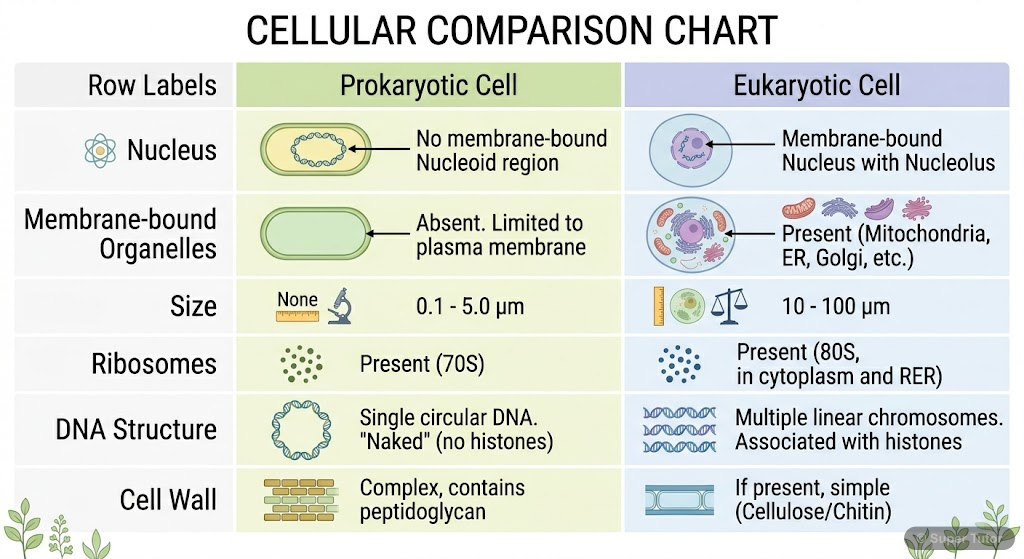
One of 21 illustrations for Cell – Structure And Function in Super Tutor — alongside flashcards, concept maps and practice questions.
Overview
The cell is the fundamental unit of life and the basic structural and functional unit of all living organisms. From tiny bacteria to massive organisms like whales, all life forms are composed of cells. Some organisms like bacteria consist of a single cell, while complex organisms like humans are mad
Key Concepts
Formulated by Schleiden and Schwann
Formulated by Schleiden and Schwann in 1838, cell theory consists of three fundamental principles: (1) All organisms are composed of cells, (2) The ce
Prokaryotic cells (found in bacteria) lack
Prokaryotic cells (found in bacteria) lack a membrane-bound nucleus and organelles. They contain a nucleoid region with DNA, 70S ribosomes, single cir
The plasma membrane
The plasma membrane, described by the Fluid Mosaic Model (Singer & Nicholson, 1972), is composed of a lipid bilayer with embedded proteins. Phospholip
Transport mechanisms include
Transport mechanisms include: (1) Diffusion - movement from high to low concentration without energy, (2) Osmosis - movement of water across semiperme
The cell wall is a non
The cell wall is a non-living, rigid layer present outside the plasma membrane in plant cells. It is composed primarily of cellulose with pectin and l
Learning Objectives
- Justify that the cell is the basic structural and functional unit of all organisms
- List the components of the cell and state the cell theory
- Differentiate between prokaryotic and eukaryotic cells
- Differentiate between plant and animal cells
- Illustrate the structure of plant and animal cells by drawing labelled diagrams
Frequently Asked Questions
What are the important topics in Cell – Structure And Function for NIOS Class 12 Biology?
How should I revise Cell – Structure And Function for the NIOS Class 12 board exam?
Sources & Official References
Content is aligned to the official syllabus. Refer to the board website for the latest curriculum.
More resources for Cell – Structure And Function
For serious students
Get the full Cell – Structure And Function chapter — start free.
Quizzes, flashcards, an AI doubt solver and a study plan for NIOS Class 12 Biology. Free to start, no card needed.