Atomic Structure — Important Questions
NIOS · Class 12 · Chemistry
45 important questions from Atomic Structure for NIOS Class 12 Chemistry, with answers. Includes multiple choice questions.
Interactive on Super Tutor
Studying Atomic Structure? Get the full interactive chapter.
Quizzes, flashcards, AI doubt-solver and a step-by-step study plan — built for important questions and more.
Free trial, no card needed.
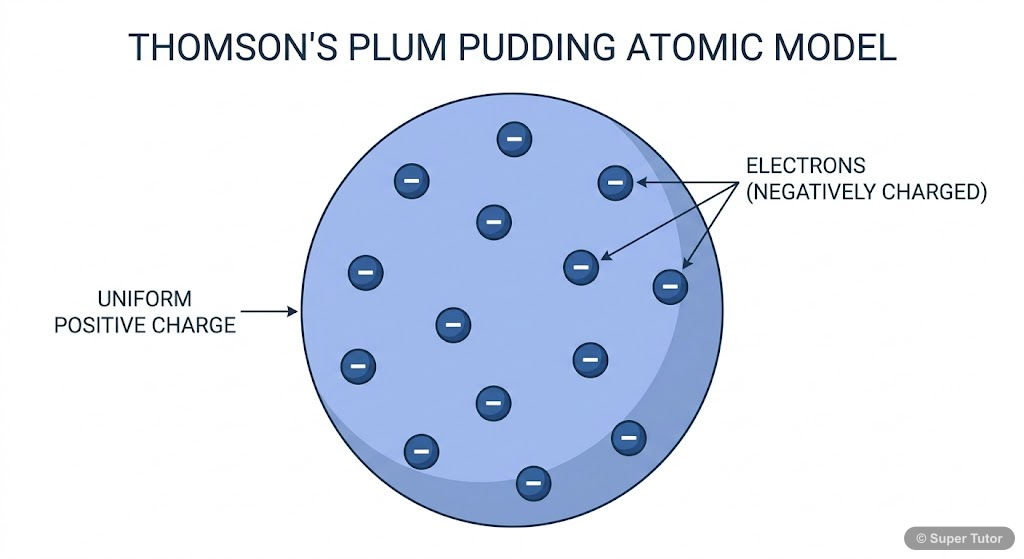
Learn better with visuals Super Tutor pairs illustrations like this with notes and quizzes for Atomic Structure.
Important Questions from Atomic Structure
The actual electronic configuration of Copper (Z = 29) is [Ar] 3d¹⁰ 4s¹ instead of the Aufbau-predicted [Ar] 3d⁹ 4s². Which statement BEST explains this anomaly?
Show answer
A completely filled 3d subshell (3d¹⁰) provides extra stability due to symmetrical distribution of electrons and higher exchange energy.
Step 1: Aufbau principle predicts [Ar] 3d⁹ 4s² for Cu, but the observed configuration is [Ar] 3d¹⁰ 4s¹. Step 2: A completely filled subshell (3d¹⁰) is highly symmetrical. Symmetry in electron distribution lowers the overall energy of the atom, making it more stable. Step 3: Exchange energy — in 3d¹⁰ all orbitals are filled, and the number of possible exchanges between parallel-spin electrons in 3d¹⁰ is greater than in 3d⁹, leading to higher exchange energy stabilisation. Step 4: Option A is wrong — energy ordering of 4s and 3d depends on the element and electron-electron repulsions. Option C i
For the element with atomic number Z = 24 (Chromium), how many unpaired electrons are present in its ground state electronic configuration?
Show answer
6
Step 1: The actual (observed) electronic configuration of Cr (Z=24) is [Ar] 3d⁵ 4s¹ — NOT the Aufbau-predicted [Ar] 3d⁴ 4s² — due to extra stability of half-filled 3d subshell. Step 2: In [Ar] 3d⁵ 4s¹: the 3d subshell has 5 electrons, one in each of the five 3d orbitals (by Hund's rule), all with the same spin — so 5 unpaired electrons. The 4s subshell has 1 electron — also unpaired. Step 3: Total unpaired electrons = 5 (from 3d) + 1 (from 4s) = 6. Step 4: If we mistakenly used [Ar] 3d⁴ 4s², we would get 4 unpaired (3d⁴) + 0 unpaired (4s² paired) = 4 — which is option A, a common wrong answer
In Rutherford's gold foil experiment, approximately 1 in 10,000 alpha particles was deflected back. What does this observation specifically tell us about the nucleus?
Show answer
The nucleus occupies a very small volume relative to the atom but contains most of the atom's mass and all of its positive charge.
Step 1: Most alpha particles (positively charged He²⁺ ions) passed straight through the gold foil without deflection. This means most of the atom is empty space. Step 2: A very small fraction (~1 in 10,000) bounced back. This means they encountered an extremely dense, small region of concentrated positive charge — the nucleus. Step 3: The rarity of large deflections tells us the nucleus is extremely small relative to the atom's size (nucleus ~10⁻¹⁵ m vs atom ~10⁻¹⁰ m). Step 4: Option A is wrong — Thomson's model proposed spread-out positive charge, which Rutherford's experiment disproved. Opti
How many radial (spherical) nodes are present in the 4p orbital?
Show answer
2
Step 1: The formula for the number of radial (spherical) nodes in an orbital is: Radial nodes = n − l − 1. Step 2: For a 4p orbital: n = 4, l = 1 (since p corresponds to l = 1). Step 3: Radial nodes = 4 − 1 − 1 = 2. Step 4: Additionally, the total number of nodes = n − 1 = 3. Out of these, angular (nodal plane) nodes = l = 1. So radial nodes = total nodes − angular nodes = 3 − 1 = 2. This confirms our answer. Common error: students confuse radial nodes with total nodes (n−1 = 3) or angular nodes (l = 1).
+41 more questions on Atomic Structure (NIOS Class 12 Chemistry)
Practise AllFrequently Asked Questions
What are the important topics in Atomic Structure for NIOS Class 12 Chemistry?
How many important questions are there in Atomic Structure?
Sources & Official References
Content is aligned to the official syllabus. Refer to the board website for the latest curriculum.
More resources for Atomic Structure
For serious students
Get the full Atomic Structure chapter — start free.
Quizzes, flashcards, an AI doubt solver and a study plan for NIOS Class 12 Chemistry. Free to start, no card needed.