Atomic Structure — Flashcards
NIOS · Class 12 · Chemistry
30 flashcards for Atomic Structure (NIOS Class 12 Chemistry) to test yourself on key terms and facts. Sample: "What are the three fundamental particles"
Interactive on Super Tutor
Studying Atomic Structure? Get the full interactive chapter.
Quizzes, flashcards, AI doubt-solver and a step-by-step study plan — built for flashcards and more.
Free trial, no card needed.
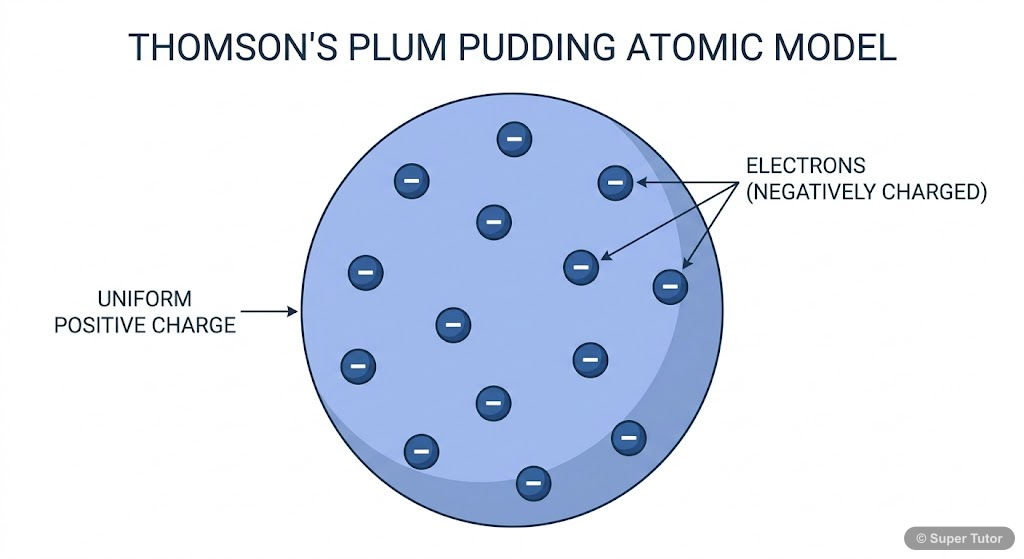
Learn better with visuals Super Tutor pairs illustrations like this with notes and quizzes for Atomic Structure.
What are the three fundamental particles of an atom and their relative charges?
Answer
The three fundamental particles are: 1. Electron (e⁻) - Negative charge (-1) 2. Proton (p⁺) - Positive charge (+1) 3. Neutron (n⁰) - Neutral charge (0) Electrons are approximately 1/1840th the mass o…
Define atomic number (Z) and mass number (A). How are they related to neutrons?
Answer
Atomic Number (Z) = Number of protons in the nucleus = Number of electrons in a neutral atom Mass Number (A) = Total number of protons + neutrons Number of Neutrons = A - Z Example: Oxygen-17 has Z…
Calculate the number of protons, neutrons, and electrons in ₈O¹⁷
Answer
For ₈O¹⁷: Step 1: Identify atomic number (Z) = 8 - Number of protons = 8 - Number of electrons = 8 (in neutral atom) Step 2: Identify mass number (A) = 17 Step 3: Calculate neutrons - Number of neu…
What are isotopes? Give an example of isotopes and explain why they have similar chemical properties.
Answer
Isotopes are atoms of the same element with the same atomic number but different mass numbers (different number of neutrons). Example: Isotopes of hydrogen: - Protium (¹₁H): 1 proton, 0 neutrons - De…
Describe Thomson's model of the atom (Plum Pudding Model). Why was it later rejected?
Answer
Thomson's Model: - Atom consists of a large positively charged mass - Electrons are embedded throughout like plums in a pudding - Electrons can vibrate in this positive sphere Rejection: - Rutherford…
What was Rutherford's α-particle scattering experiment? What were the key observations?
Answer
Rutherford's Experiment: - Fast-moving α-particles (He²⁺ ions) were directed at thin gold foil - A photographic plate detected particles after passing through Key Observations: 1. Most α-particles pa…
Why did Rutherford's nuclear model fail to explain atomic stability?
Answer
According to Maxwell's Theory of Electromagnetic Radiation: - A charged particle undergoing acceleration continuously emits electromagnetic radiation - An orbiting electron is a charged particle unde…
Define electromagnetic radiation and list its characteristic parameters.
Answer
Electromagnetic Radiation: Energy transmitted through space as oscillating electric and magnetic fields perpendicular to each other and to direction of propagation. Travels at speed of light (3.0 × 10…
+22 more flashcards
Practise AllFrequently Asked Questions
What are the important topics in Atomic Structure for NIOS Class 12 Chemistry?
How many flashcards are available for Atomic Structure?
How should I revise Atomic Structure for the NIOS Class 12 board exam?
Sources & Official References
Content is aligned to the official syllabus. Refer to the board website for the latest curriculum.
More resources for Atomic Structure
For serious students
Get the full Atomic Structure chapter — start free.
Quizzes, flashcards, an AI doubt solver and a study plan for NIOS Class 12 Chemistry. Free to start, no card needed.