The Solid State — Important Questions
NIOS · Class 12 · Chemistry
44 important questions from The Solid State for NIOS Class 12 Chemistry, with answers. Includes multiple choice questions.
Interactive on Super Tutor
Studying The Solid State? Get the full interactive chapter.
Quizzes, flashcards, AI doubt-solver and a step-by-step study plan — built for important questions and more.
Free trial, no card needed.
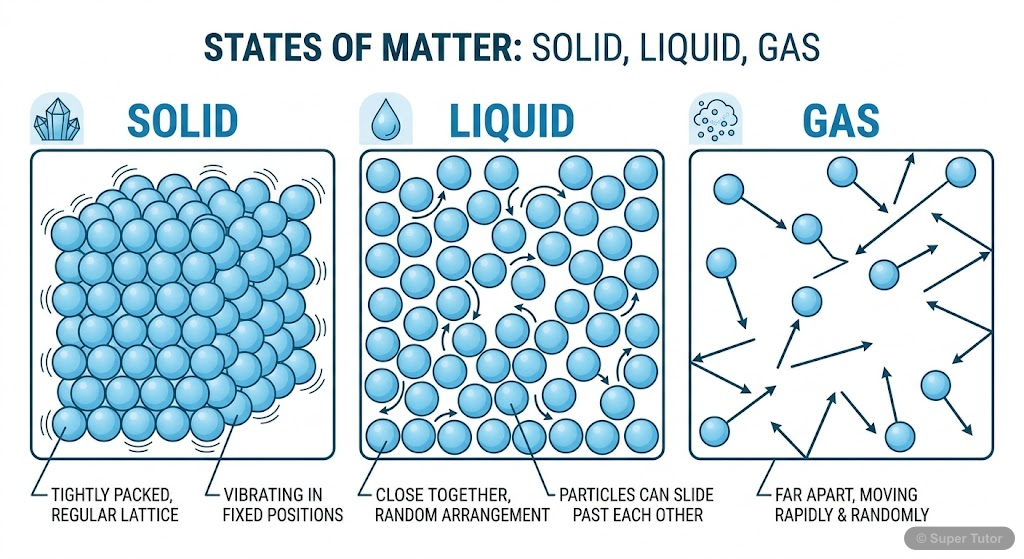
One of 2 illustrations for The Solid State in Super Tutor — alongside flashcards, concept maps and practice questions.
Important Questions from The Solid State
In a body-centered cubic (BCC) unit cell, how many atoms are present per unit cell?
Show answer
2
Step 1: A BCC unit cell has atoms at all 8 corners and 1 atom at the center of the cube. Step 2: Contribution from corner atoms = 8 × (1/8) = 1. Step 3: The atom at the body center is entirely within the unit cell and is not shared with any other unit cell. So its contribution = 1. Step 4: Total atoms per unit cell = 1 (from corners) + 1 (body center) = 2. Step 5: Examples of BCC metals include iron (Fe) and chromium (Cr).
What is the number of atoms per unit cell in a face-centered cubic (FCC) unit cell?
Show answer
4
Step 1: An FCC unit cell has atoms at all 8 corners and at the center of all 6 faces. Step 2: Contribution from corner atoms = 8 × (1/8) = 1. Step 3: Each face-center atom is shared by 2 unit cells, so contribution = 1/2 per face. Step 4: Contribution from face-center atoms = 6 × (1/2) = 3. Step 5: Total atoms per unit cell = 1 + 3 = 4. Copper, gold, and silver crystallize in FCC structure.
Which of the following packing arrangements has the highest packing efficiency?
Show answer
Face centered cubic / CCP (74%)
Step 1: Packing efficiency is the percentage of total space in a unit cell that is actually occupied by atoms. Step 2: Simple cubic packing efficiency = π/6 × 100 = 52.4% (lots of empty space). Step 3: BCC packing efficiency = √3π/8 × 100 = 68% (more efficient). Step 4: FCC (or CCP and HCP) packing efficiency = π/(3√2) × 100 = 74% (most efficient of the three). Step 5: The FCC/CCP arrangement wastes the least space, making it the most efficient packing among cubic lattices.
The formula used to calculate the density of a unit cell is:
Show answer
d = (z × M) / (a³ × Nₐ)
Step 1: Density = Mass / Volume. Step 2: Volume of unit cell = a³ (where a is edge length). Step 3: Mass of unit cell = z × M / Nₐ, where z = number of atoms per unit cell, M = molar mass, Nₐ = Avogadro's number (6.022 × 10²³). Step 4: Combining these: d = (z × M) / (a³ × Nₐ). Step 5: This formula is very useful — if you know the density and molar mass, you can find z and identify the type of cubic unit cell.
+40 more questions on The Solid State (NIOS Class 12 Chemistry)
Practise AllFrequently Asked Questions
What are the important topics in The Solid State for NIOS Class 12 Chemistry?
How many important questions are there in The Solid State?
Sources & Official References
Content is aligned to the official syllabus. Refer to the board website for the latest curriculum.
More resources for The Solid State
For serious students
Get the full The Solid State chapter — start free.
Quizzes, flashcards, an AI doubt solver and a study plan for NIOS Class 12 Chemistry. Free to start, no card needed.