Periodic Table and Periodicity in Properties — Important Questions
NIOS · Class 12 · Chemistry
45 important questions from Periodic Table and Periodicity in Properties for NIOS Class 12 Chemistry, with answers. Includes multiple choice questions.
Interactive on Super Tutor
Studying Periodic Table and Periodicity in Properties? Get the full interactive chapter.
Quizzes, flashcards, AI doubt-solver and a step-by-step study plan — built for important questions and more.
Free trial, no card needed.
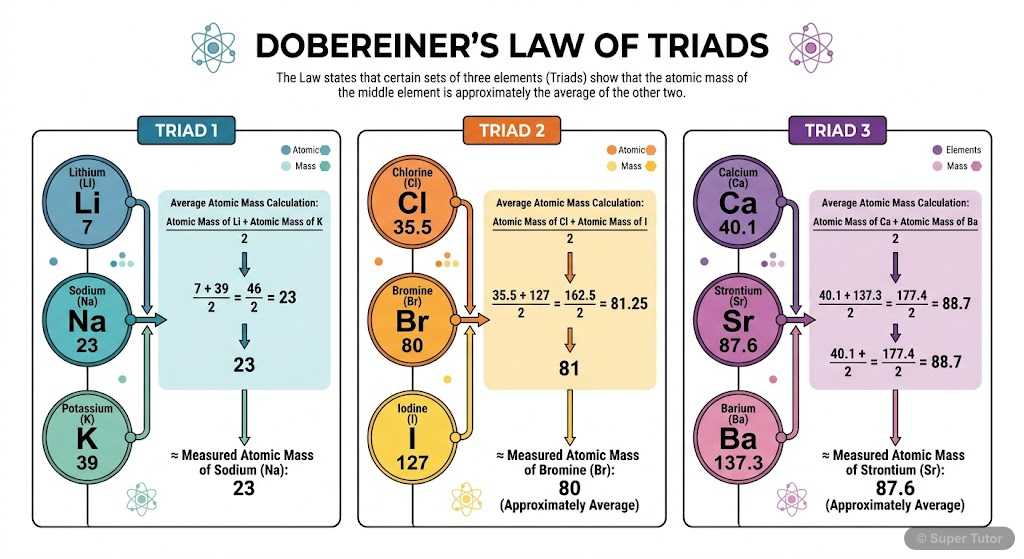
One of 16 illustrations for Periodic Table and Periodicity in Properties in Super Tutor — alongside flashcards, concept maps and practice questions.
Important Questions from Periodic Table and Periodicity in Properties
How does atomic size change as we move from left to right across a period in the periodic table?
Show answer
Atomic size decreases because nuclear charge increases while electrons are added to the same shell.
Step 1: As we move left to right across a period, the atomic number increases, meaning the nuclear charge (number of protons) increases. Step 2: Electrons are added to the SAME outermost shell (same period = same principal quantum number). Step 3: The increased nuclear charge pulls all electrons, especially the outermost ones, closer to the nucleus. Step 4: The shielding effect remains roughly constant within a period because electrons are being added to the same shell. Step 5: Therefore, the effective nuclear charge (Zeff) felt by the outer electrons increases, pulling them inward and reducin
Which of the following correctly compares the sizes of a sodium atom (Na) and its ion (Na⁺)?
Show answer
Na⁺ is smaller than Na because the same nuclear charge acts on fewer electrons.
Step 1: Na has 11 electrons. When Na loses 1 electron to form Na⁺, it has only 10 electrons. Step 2: The nuclear charge remains the same (11 protons) in both Na and Na⁺. Step 3: In Na⁺, the same nuclear charge of +11 now acts on only 10 electrons instead of 11. Step 4: This means each remaining electron experiences a greater pull from the nucleus. Step 5: As a result, the electron cloud contracts and Na⁺ is significantly smaller than Na. (Na radius ≈ 1.86 Å, Na⁺ radius ≈ 1.02 Å). This is a general rule: cations are always smaller than their parent atoms.
The first ionisation enthalpy of oxygen (O) is lower than that of nitrogen (N), even though oxygen has a higher atomic number. What is the best explanation for this anomaly?
Show answer
Nitrogen has a half-filled p-subshell (2p³) which is extra stable, making it harder to remove an electron compared to oxygen (2p⁴).
Step 1: Nitrogen's electronic configuration is 1s² 2s² 2p³. Its p-subshell is exactly half-filled, with one electron in each of the three 2p orbitals. Step 2: Half-filled subshells have extra stability due to symmetrical distribution of electrons and maximum exchange energy. Step 3: Oxygen's configuration is 1s² 2s² 2p⁴. One of the 2p orbitals has a paired electron. Step 4: This paired electron in oxygen experiences inter-electronic repulsion, making it easier (requires less energy) to remove one electron from oxygen. Step 5: Therefore, despite oxygen having a higher nuclear charge, its first
Which of the following sequences correctly shows the increasing order of first ionisation enthalpy?
Show answer
K < Na < Li < He
Step 1: Ionisation enthalpy decreases down a group because atomic size increases, and the outermost electrons are farther from the nucleus and more shielded. Step 2: For Group 1 (alkali metals): Li > Na > K. So the order of increasing IE is K < Na < Li. Step 3: Noble gases have the highest ionisation enthalpies in their respective periods because they have completely filled, very stable electron configurations. Step 4: He has the second highest ionisation enthalpy of all elements (2372 kJ/mol), much higher than Li (520 kJ/mol), Na (496 kJ/mol), or K (419 kJ/mol). Step 5: Therefore the correct
+41 more questions on Periodic Table and Periodicity in Properties (NIOS Class 12 Chemistry)
Practise AllFrequently Asked Questions
What are the important topics in Periodic Table and Periodicity in Properties for NIOS Class 12 Chemistry?
How many important questions are there in Periodic Table and Periodicity in Properties?
Sources & Official References
Content is aligned to the official syllabus. Refer to the board website for the latest curriculum.
More resources for Periodic Table and Periodicity in Properties
For serious students
Get the full Periodic Table and Periodicity in Properties chapter — start free.
Quizzes, flashcards, an AI doubt solver and a study plan for NIOS Class 12 Chemistry. Free to start, no card needed.