Atomic Structure — Chapter Summary
NIOS · Class 12 · Chemistry
Summary of Atomic Structure for NIOS Class 12 Chemistry. Key concepts: All atoms consist of three, Atomic number (Z) is and Isotopes are atoms of the same.
Interactive on Super Tutor
Studying Atomic Structure? Get the full interactive chapter.
Quizzes, flashcards, AI doubt-solver and a step-by-step study plan — built for chapter summary and more.
Free trial, no card needed.
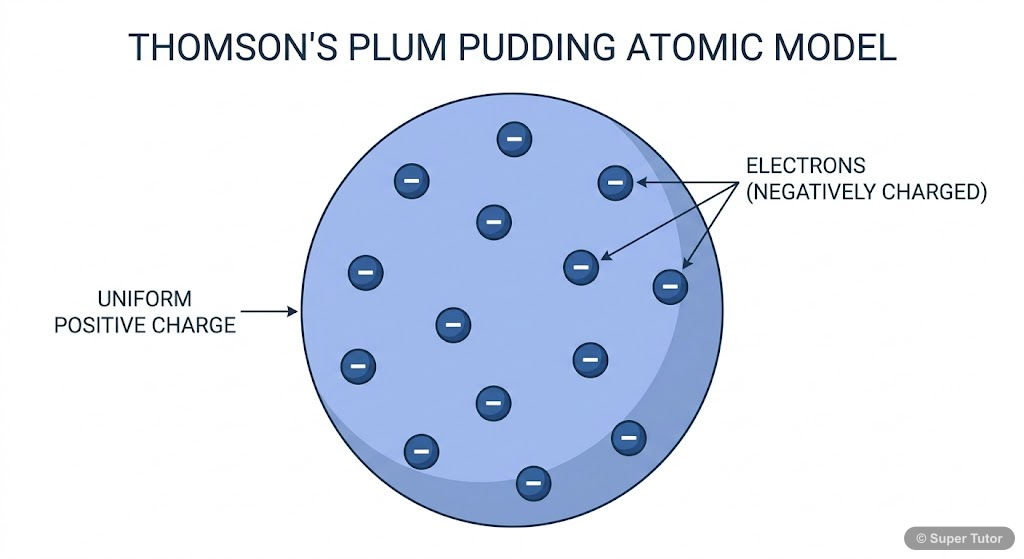
Learn better with visuals Super Tutor pairs illustrations like this with notes and quizzes for Atomic Structure.
Overview
Atomic structure is the foundation of chemistry, explaining how matter is organized at the smallest scale. This chapter explores the internal composition of atoms, their fundamental particles, and the revolutionary models that explain atomic behavior. From Thomson's early plum-pudding model to the m
Key Concepts
All atoms consist of three fundamental
All atoms consist of three fundamental particles: electrons (negatively charged, mass = 9.109 × 10⁻³¹ kg), protons (positively charged, mass = 1.673 ×
Atomic number (Z) is the number
Atomic number (Z) is the number of protons in an atom's nucleus, which also equals the number of electrons in a neutral atom. Mass number (A) is the t
Isotopes are atoms of the same
Isotopes are atoms of the same element with the same atomic number but different mass numbers (different neutron counts). Examples: ¹H, ²H (deuterium)
J
J.J. Thomson proposed that atoms consist of a large positively charged body (the 'pudding') with electrons (the 'plums') scattered throughout it. This
Ernest Rutherford bombarded thin gold foil
Ernest Rutherford bombarded thin gold foil with alpha particles. Most passed straight through, but some deflected at large angles, with about 1 in 10,
Learning Objectives
- Explain atomic number, mass number, isotopes, and isobars with clear definitions and examples
- Identify and describe the three fundamental particles of an atom and their characteristics
- Understand Rutherford's gold foil experiment and its implications for atomic structure
- Define electromagnetic radiation and its characteristic parameters (wavelength, frequency, energy)
- Interpret the line spectrum of hydrogen and explain how it supports atomic models
Frequently Asked Questions
What are the important topics in Atomic Structure for NIOS Class 12 Chemistry?
How should I revise Atomic Structure for the NIOS Class 12 board exam?
Sources & Official References
Content is aligned to the official syllabus. Refer to the board website for the latest curriculum.
More resources for Atomic Structure
For serious students
Get the full Atomic Structure chapter — start free.
Quizzes, flashcards, an AI doubt solver and a study plan for NIOS Class 12 Chemistry. Free to start, no card needed.