Solutions — Syllabus
NIOS · Class 12 · Chemistry
Solutions topics: Components and Concentration, Types of Solutions and Solubility, Henry's Law and Raoult's Law, plus 1 more.
Interactive on Super Tutor
Studying Solutions? Get the full interactive chapter.
Quizzes, flashcards, AI doubt-solver and a step-by-step study plan — built for syllabus and more.
Free trial, no card needed.
Learn better with visuals Super Tutor pairs illustrations like this with notes and quizzes for Solutions.
Get startedTopics in Solutions
1. Components and Concentration of Solutions
- A solution is a homogeneous mixture of two or more substances.
- Solvent is that component of a solution that has the same physical state as the solution itself.
- Solute is the substance that is dissolved in a solvent to form a solution.
2. Types of Solutions and Solubility
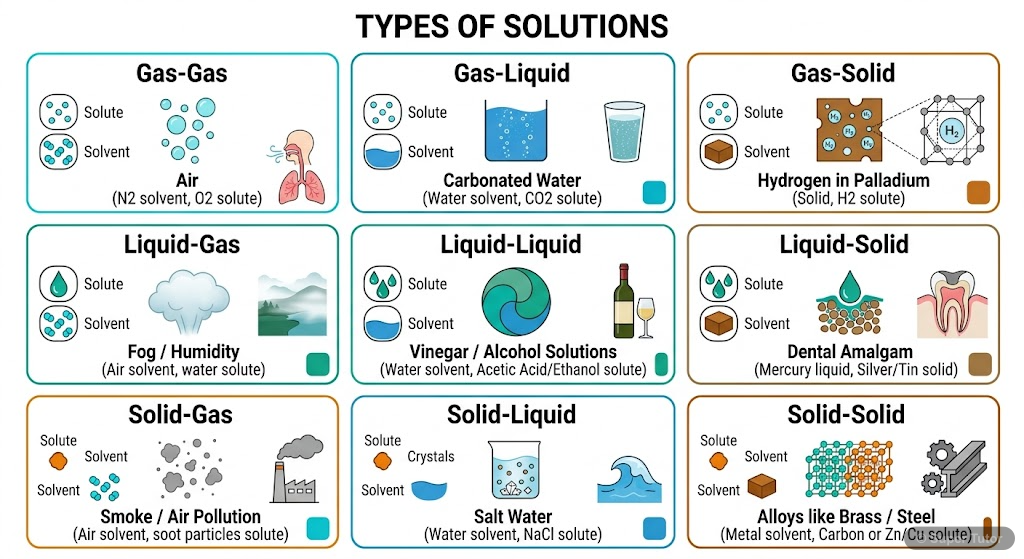
- There are nine possible types of binary solutions depending on the physical state of solute and solvent.
- Generally only three types of solutions are commonly encountered.
- Gas in gas gives air.
3. Henry's Law and Raoult's Law
- Henry's law states that the mass or mole fraction of a gas dissolved in a solvent is directly proportional to the partial pressure of the gas.
- Henry's law is valid only when pressure is not too high, temperature is not too low, and the gas does not dissociate, associate, or react with the solvent.
- Raoult's law states that for a solution of volatile liquids, the partial vapour pressure of each liquid is directly proportional to its mole fraction.
4. Ideal and Non-Ideal Solutions
- Ideal solutions obey Raoult's law and show no change in heat and volume on mixing.
- Non-ideal solutions do not obey Raoult's law and show change in heat and volume on mixing.
- Positive deviation occurs when A-B molecular interactions are weaker than A-A and/or B-B interactions.
Key Concepts
Central concept: Solutions
Work through every topic in Solutions with notes and quizzes
Start This ChapterFrequently Asked Questions
What are the important topics in Solutions for NIOS Class 12 Chemistry?
How should I revise Solutions for the NIOS Class 12 board exam?
Sources & Official References
Content is aligned to the official syllabus. Refer to the board website for the latest curriculum.
More resources for Solutions
Practice Quiz
Test yourself with a quick quiz
Important Questions
Exam-style questions with answers
Revision Notes
Key points for last-minute revision
Formula Sheet
The chapter's formulas in one place
Chapter Summary
Understand the chapter at a glance
Concept Maps
See how topics connect
Study Plan
Step-by-step plan for this chapter
Flashcards
Quick-fire cards for active recall
For serious students
Get the full Solutions chapter — start free.
Quizzes, flashcards, an AI doubt solver and a study plan for NIOS Class 12 Chemistry. Free to start, no card needed.