Chemical Thermodynamics — Syllabus
NIOS · Class 12 · Chemistry
What Chemical Thermodynamics covers in NIOS Class 12 Chemistry: 4 topics, for the 2026-27 session. Part of the NIOS Class 12 Chemistry syllabus.
Interactive on Super Tutor
Studying Chemical Thermodynamics? Get the full interactive chapter.
Quizzes, flashcards, AI doubt-solver and a step-by-step study plan — built for syllabus and more.
Free trial, no card needed.
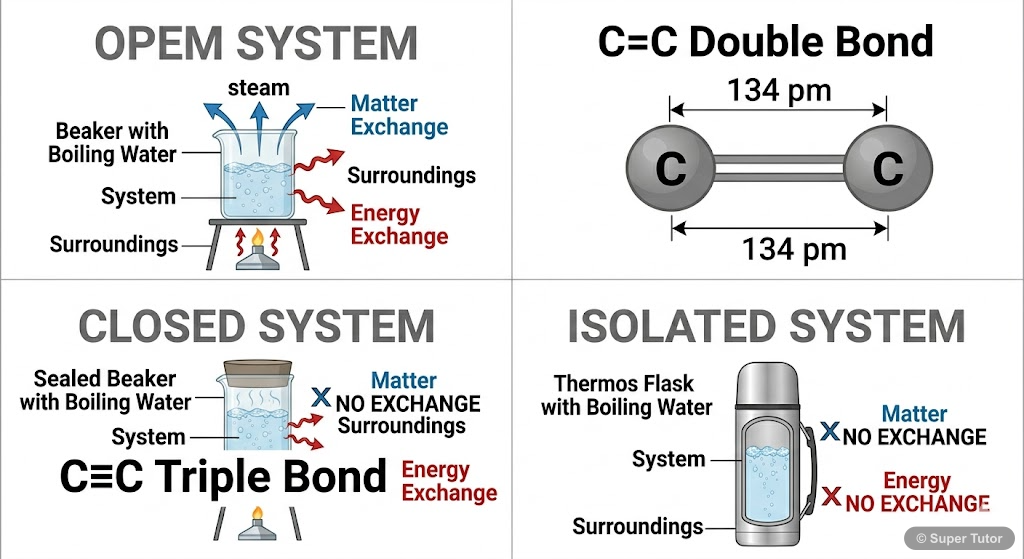
One of 4 illustrations for Chemical Thermodynamics in Super Tutor — alongside flashcards, concept maps and practice questions.
Topics in Chemical Thermodynamics
Basic Terminology in Thermodynamics
- System: The specific part of the universe under study (e.g., reactants and products in a beaker)
- Surroundings: Everything outside the system (e.g., the beaker, lab, atmosphere)
- Isolated System: No exchange of matter OR energy with surroundings (e.g., ideal thermos flask)
Exothermic and Endothermic Reactions
- Exothermic reactions RELEASE heat to surroundings — the system loses energy, so ΔH is NEGATIVE
- Endothermic reactions ABSORB heat from surroundings — the system gains energy, so ΔH is POSITIVE
- Examples of exothermic: Combustion of fuels, neutralization reactions, adding water to quicklime (CaO)
Thermochemical Equations
- Thermochemical equations specify: balanced chemical equation + physical states + ΔH value
- Physical states are represented as: (g) = gas, (l) = liquid, (s) = solid, (aq) = aqueous solution
- Allotropic forms must be specified: C(graphite) or C(diamond)
First Law of Thermodynamics and Internal Energy
- First Law: Energy can neither be created nor destroyed; total energy of universe (or isolated system) is constant
- Mathematical form: ΔU = q + w (IUPAC convention)
- ΔU = change in internal energy, q = heat absorbed BY the system, w = work done ON the system
Key Concepts
Work through every topic in Chemical Thermodynamics with notes and quizzes
Start This ChapterFrequently Asked Questions
What are the important topics in Chemical Thermodynamics for NIOS Class 12 Chemistry?
How should I revise Chemical Thermodynamics for the NIOS Class 12 board exam?
Sources & Official References
Content is aligned to the official syllabus. Refer to the board website for the latest curriculum.
More resources for Chemical Thermodynamics
Practice Quiz
Test yourself with a quick quiz
Important Questions
Exam-style questions with answers
Revision Notes
Key points for last-minute revision
Formula Sheet
The chapter's formulas in one place
Chapter Summary
Understand the chapter at a glance
Concept Maps
See how topics connect
Flashcards
Quick-fire cards for active recall
For serious students
Get the full Chemical Thermodynamics chapter — start free.
Quizzes, flashcards, an AI doubt solver and a study plan for NIOS Class 12 Chemistry. Free to start, no card needed.