Chemical Bonding — Syllabus
NIOS · Class 12 · Chemistry
What Chemical Bonding covers in NIOS Class 12 Chemistry: 4 topics, for the 2026-27 session. Part of the NIOS Class 12 Chemistry syllabus.
Interactive on Super Tutor
Studying Chemical Bonding? Get the full interactive chapter.
Quizzes, flashcards, AI doubt-solver and a step-by-step study plan — built for syllabus and more.
Free trial, no card needed.
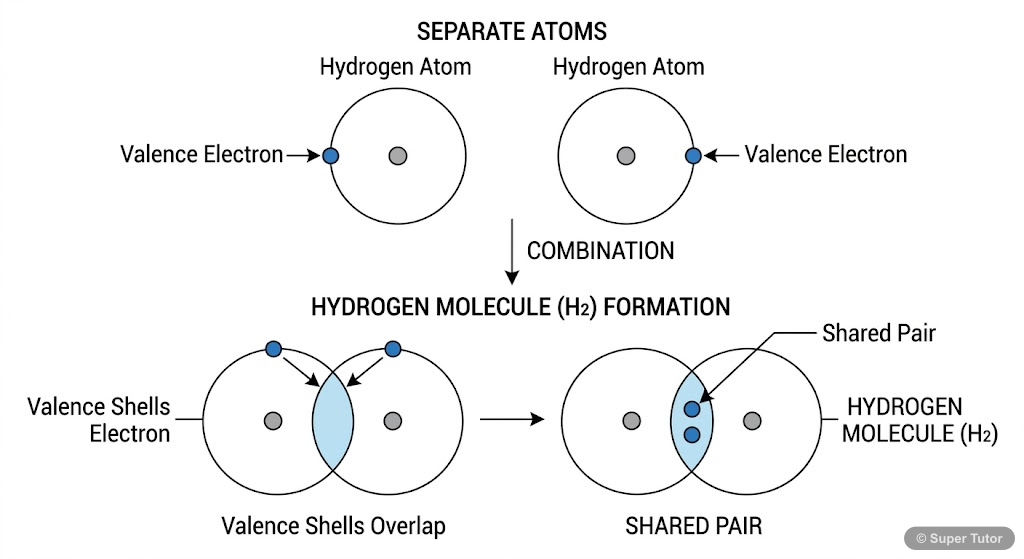
Learn better with visuals Super Tutor pairs illustrations like this with notes and quizzes for Chemical Bonding.
Topics in Chemical Bonding
1. Fundamental Concepts of Chemical Bonding
- Valence electrons are electrons in the outermost shell that participate in bond formation and determine an atom's combining capacity (valency)
- Chemical bond formation is driven by the tendency of atoms to achieve stable electronic configuration (noble gas configuration) with lower total energy
- When two atoms approach each other, the energy of the system decreases if they form a bond, making the combination more stable
2. Ionic or Electrovalent Bonding
- Ionic bonds form through complete electron transfer from one atom to another, creating ions held by electrostatic attraction
- Highly electropositive elements (metals) lose electrons to become cations (positive ions)
- Highly electronegative elements (nonmetals) gain electrons to become anions (negative ions)
3. Covalent Bonding
- Covalent bonds form through sharing of electron pairs between atoms, with each atom contributing one electron to the shared pair
- Lewis structures use dots to represent valence electrons and lines to represent shared electron pairs (bonds)
- Single bond = 1 shared pair; Double bond = 2 shared pairs; Triple bond = 3 shared pairs
4. Bond Polarity and Dipole Moment
- Bond polarity arises from difference in electronegativity between bonded atoms
- Electronegativity difference < 1.7 indicates primarily covalent character; > 1.7 indicates significant ionic character
- Dipole moment (μ) is the product of charge magnitude and distance of separation: μ = Q × r
Key Concepts
Work through every topic in Chemical Bonding with notes and quizzes
Start This ChapterFrequently Asked Questions
What are the important topics in Chemical Bonding for NIOS Class 12 Chemistry?
How should I revise Chemical Bonding for the NIOS Class 12 board exam?
Sources & Official References
Content is aligned to the official syllabus. Refer to the board website for the latest curriculum.
More resources for Chemical Bonding
Practice Quiz
Test yourself with a quick quiz
Important Questions
Exam-style questions with answers
Revision Notes
Key points for last-minute revision
Formula Sheet
The chapter's formulas in one place
Chapter Summary
Understand the chapter at a glance
Concept Maps
See how topics connect
Flashcards
Quick-fire cards for active recall
For serious students
Get the full Chemical Bonding chapter — start free.
Quizzes, flashcards, an AI doubt solver and a study plan for NIOS Class 12 Chemistry. Free to start, no card needed.