Periodic Table and Periodicity in Properties — Syllabus
NIOS · Class 12 · Chemistry
What Periodic Table and Periodicity in Properties covers in NIOS Class 12 Chemistry: 4 topics, for the 2026-27 session.
Interactive on Super Tutor
Studying Periodic Table and Periodicity in Properties? Get the full interactive chapter.
Quizzes, flashcards, AI doubt-solver and a step-by-step study plan — built for syllabus and more.
Free trial, no card needed.
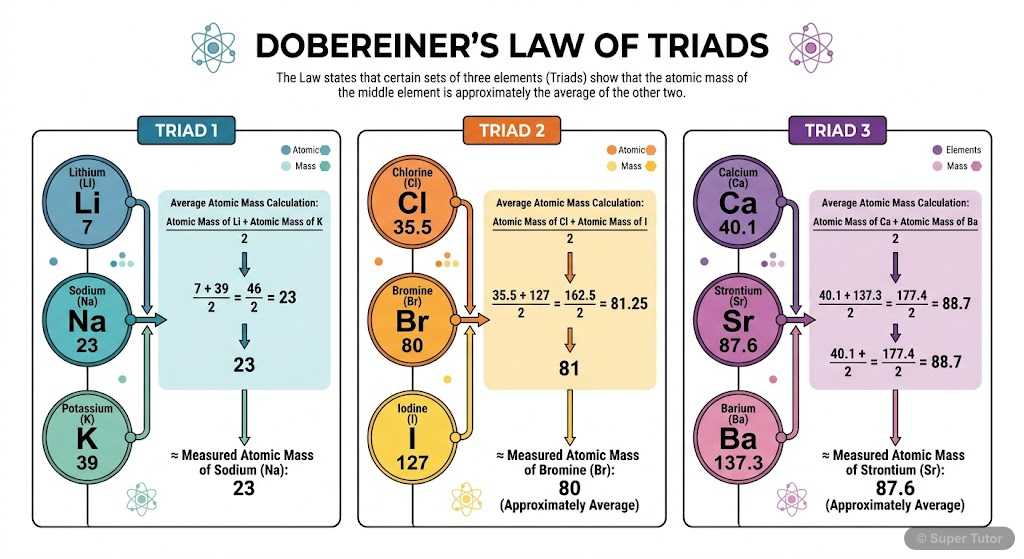
One of 16 illustrations for Periodic Table and Periodicity in Properties in Super Tutor — alongside flashcards, concept maps and practice questions.
Topics in Periodic Table and Periodicity in Properties
Early Attempts at Classification of Elements
- Dobereiner's Triads (1817): Elements grouped in sets of three where the atomic weight of the middle element is approximately the arithmetic mean of the other two. Example: Li (6.94), Na (22.99), K (39
- Limitation of Dobereiner's Triads: Could only classify a few elements; insufficient data on atomic weights at that time.
- Newlands' Law of Octaves (1863): Elements arranged in increasing order of atomic weights; every eighth element had similar properties to the first — like musical octaves (sa, re, ga...). Example: Li a
Mendeleev's Periodic Table
- Mendeleev (1869) arranged elements in increasing order of atomic weights and grouped elements with similar chemical properties in the same vertical column (group).
- Mendeleev's Periodic Law: 'The properties of elements are periodic functions of their atomic weights.'
- Mendeleev's table had 8 groups (I to VIII) and several periods.
Modern Periodic Law and Long Form of the Periodic Table
- Moseley (1913) discovered that atomic number (number of protons) is the fundamental property of an element, not atomic weight. He changed the basis of the periodic table.
- Modern Periodic Law: 'The properties of elements are periodic functions of their atomic numbers.'
- This solved all the defects of Mendeleev's table — isotopes got the same place (same atomic number), and anomalous pairs like Co-Ni were correctly arranged.
IUPAC Nomenclature for Elements with Atomic Number > 100
- For elements with atomic number greater than 100 (and specifically used for > 103), IUPAC (1994/1997) developed a systematic naming system to avoid naming disputes.
- Numerical roots used: 0=nil, 1=un, 2=bi, 3=tri, 4=quad, 5=pent, 6=hex, 7=sept, 8=oct, 9=enn.
- Rule: Write the roots for each digit of the atomic number in order, then add 'ium' at the end.
Key Concepts
Work through every topic in Periodic Table and Periodicity in Properties with notes and quizzes
Start This ChapterFrequently Asked Questions
What are the important topics in Periodic Table and Periodicity in Properties for NIOS Class 12 Chemistry?
How should I revise Periodic Table and Periodicity in Properties for the NIOS Class 12 board exam?
Sources & Official References
Content is aligned to the official syllabus. Refer to the board website for the latest curriculum.
More resources for Periodic Table and Periodicity in Properties
For serious students
Get the full Periodic Table and Periodicity in Properties chapter — start free.
Quizzes, flashcards, an AI doubt solver and a study plan for NIOS Class 12 Chemistry. Free to start, no card needed.