Complex Numbers — Chapter Summary
NIOS · Class 12 · Mathematics
Summary of Complex Numbers for NIOS Class 12 Mathematics. Key concepts: The imaginary unit i is, A complex number is expressed and The conjugate of z =.
Interactive on Super Tutor
Studying Complex Numbers? Get the full interactive chapter.
Quizzes, flashcards, AI doubt-solver and a step-by-step study plan — built for chapter summary and more.
Free trial, no card needed.
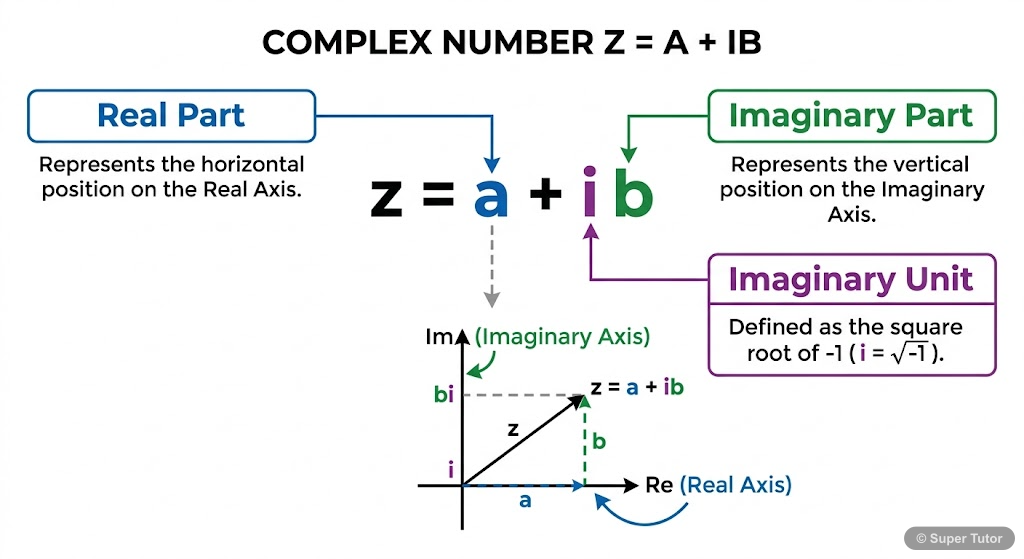
Learn better with visuals Super Tutor pairs illustrations like this with notes and quizzes for Complex Numbers.
Overview
Complex numbers extend the real number system to solve equations that have no real solutions, such as x² + 1 = 0. They are written in the form z = a + bi, where a and b are real numbers and i = √(-1) is the imaginary unit. This chapter explores the properties, operations, and geometric representatio
Key Concepts
The imaginary unit i is defined
The imaginary unit i is defined as i = √(-1), which means i² = -1. This fundamental definition allows us to represent square roots of negative numbers
A complex number is expressed as
A complex number is expressed as z = a + bi, where a is the real part (Re(z) = a) and b is the imaginary part (Im(z) = b). Both a and b are real numbe
The conjugate of z =
The conjugate of z = a + bi is z̄ = a - bi. It's obtained by changing the sign of the imaginary part. For example, if z = 3 + 4i, then z̄ = 3 - 4i. Pr
The modulus of z =
The modulus of z = a + bi is |z| = √(a² + b²). It represents the distance of the complex number from the origin in the Argand Plane. For example, |3 +
The argument θ of z =
The argument θ of z = a + bi is the angle that the line OP (where P is the point representing z) makes with the positive x-axis. It's calculated as θ
Learning Objectives
- Understand the need for extending real numbers to complex numbers
- Define complex numbers and identify their real and imaginary parts
- Perform algebraic operations (addition, subtraction, multiplication, division) on complex numbers
- Find conjugates, modulus, and arguments of complex numbers
- Represent complex numbers in the Argand Plane and polar form
Frequently Asked Questions
What are the important topics in Complex Numbers for NIOS Class 12 Mathematics?
How should I revise Complex Numbers for the NIOS Class 12 board exam?
Sources & Official References
Content is aligned to the official syllabus. Refer to the board website for the latest curriculum.
More resources for Complex Numbers
For serious students
Get the full Complex Numbers chapter — start free.
Quizzes, flashcards, an AI doubt solver and a study plan for NIOS Class 12 Mathematics. Free to start, no card needed.