Sets — Chapter Summary
NIOS · Class 12 · Mathematics
Summary of Sets for NIOS Class 12 Mathematics. Key concepts: A set is a well, In Roster form and In Set. Part of the NIOS Class 12 Mathematics syllabus.
Interactive on Super Tutor
Studying Sets? Get the full interactive chapter.
Quizzes, flashcards, AI doubt-solver and a step-by-step study plan — built for chapter summary and more.
Free trial, no card needed.
Learn better with visuals Super Tutor pairs illustrations like this with notes and quizzes for Sets.
Overview
Sets form the foundation of modern mathematics. A set is a well-defined collection of distinct objects, introduced by German mathematician George Cantor. In this chapter, we explore the fundamental concepts of set theory including different types of sets, operations on sets, and their representation
Key Concepts
A set is a well
A set is a well-defined collection of distinct objects. The word 'well-defined' means that for any given object, we can clearly determine whether it b
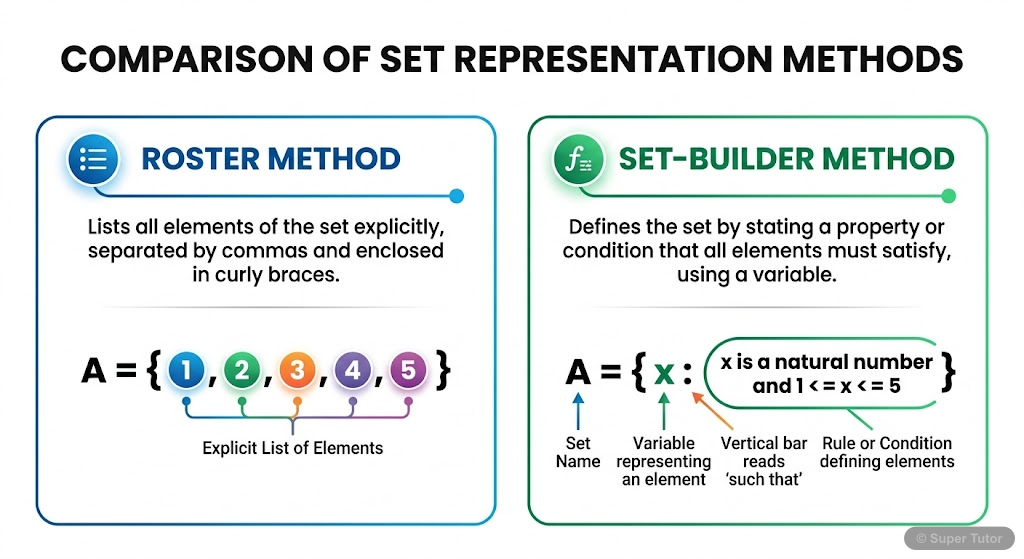
In Roster form
In Roster form, all elements of a set are listed explicitly, separated by commas, and enclosed in curly brackets. For example: V = {a, e, i, o, u} rep
In Set
In Set-builder form, elements are represented by a common property rather than being listed explicitly. The general format is: A = {x : property of x}
A finite set is one where
A finite set is one where the number of elements can be counted and is finite. For example, the set of students in your school is finite. An infinite
An empty set or null set
An empty set or null set is a set that contains no elements. It is denoted by the symbol ∅ or {}. For example, A = {x : x ∈ ℝ and x² + 1 = 0} is an em
Learning Objectives
- Define a set and represent it in different forms (Roster form and Set-builder form)
- Classify different types of sets: finite, infinite, empty, singleton, equal, equivalent, and disjoint sets
- Understand and apply the concept of subsets and proper subsets
- Calculate the number of subsets and power sets of a given set
- Identify and work with intervals as subsets of real numbers
Frequently Asked Questions
What are the important topics in Sets for NIOS Class 12 Mathematics?
How should I revise Sets for the NIOS Class 12 board exam?
Sources & Official References
Content is aligned to the official syllabus. Refer to the board website for the latest curriculum.
More resources for Sets
For serious students
Get the full Sets chapter — start free.
Quizzes, flashcards, an AI doubt solver and a study plan for NIOS Class 12 Mathematics. Free to start, no card needed.