Life Processes — Important Questions
Punjab Board · Class 10 · Science
44 important questions from Life Processes for Punjab Board Class 10 Science, with answers. Includes multiple choice questions.
Interactive on Super Tutor
Studying Life Processes? Get the full interactive chapter.
Quizzes, flashcards, AI doubt-solver and a step-by-step study plan — built for important questions and more.
Free trial, no card needed.
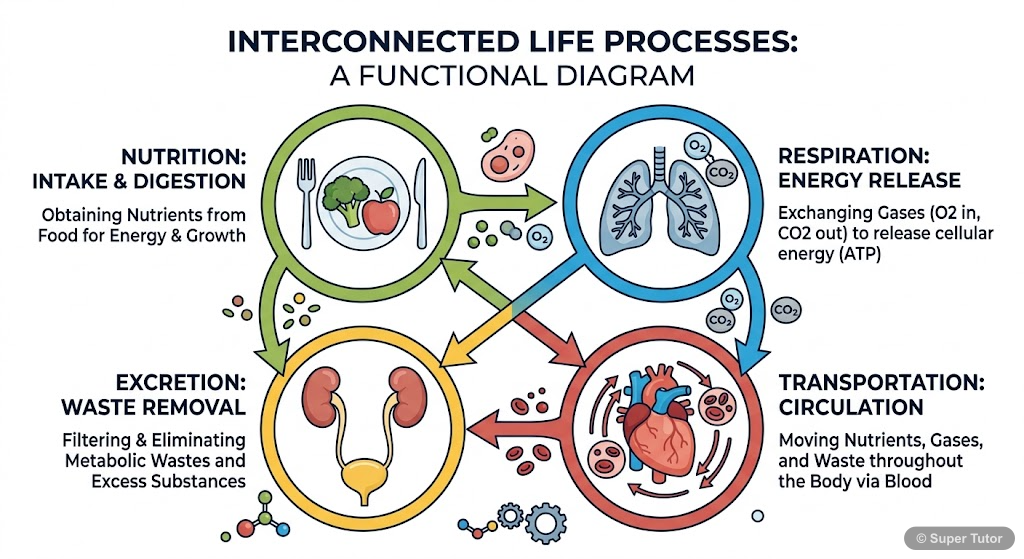
One of 17 illustrations for Life Processes in Super Tutor — alongside flashcards, concept maps and practice questions.
Important Questions from Life Processes
Which type of respiration produces lactic acid in human muscle cells during sudden vigorous exercise?
Show answer
Anaerobic respiration
Step 1: During sudden vigorous exercise, muscles need a lot of energy very quickly. Step 2: The supply of oxygen to muscle cells becomes insufficient at that moment. Step 3: In the absence of sufficient oxygen, muscle cells switch to anaerobic respiration. Step 4: In this process, pyruvate is converted to lactic acid (instead of CO₂ and water). Step 5: The build-up of lactic acid in muscles causes the painful cramps we feel after exercise. Note: Fermentation also involves anaerobic respiration but happens in yeast and produces ethanol, not lactic acid.
What is the respiratory pigment found in human red blood cells that carries oxygen?
Show answer
Haemoglobin
Step 1: Oxygen absorbed in the lungs needs to be transported to all cells of the body through blood. Step 2: Simple diffusion cannot carry enough oxygen for the entire body, so a special pigment is needed. Step 3: This respiratory pigment is called haemoglobin and is found in the red blood corpuscles (RBCs). Step 4: Haemoglobin has a very high affinity (attraction) for oxygen, allowing it to carry large amounts efficiently. Step 5: Chlorophyll is a pigment in plants for photosynthesis; plasma is the liquid part of blood; insulin is a hormone — none of these carry oxygen.
Which organ in the human body produces bile juice?
Show answer
Liver
Step 1: When food from the stomach enters the small intestine, it needs to be processed further. Step 2: Fats in the food exist as large globules that are difficult for enzymes to work on. Step 3: Bile juice, produced by the liver, is secreted into the small intestine to help with fat digestion. Step 4: Bile salts break large fat globules into smaller ones — this is called emulsification, similar to how soap removes oily dirt. Step 5: The pancreas produces pancreatic juice (not bile); the stomach produces gastric juice; the small intestine produces intestinal juice.
The tiny balloon-like structures in human lungs where gas exchange takes place are called:
Show answer
Alveoli
Step 1: Air enters the lungs through the nostrils, throat, and windpipe (trachea). Step 2: Inside the lungs, the passage divides into smaller and smaller tubes. Step 3: These tubes finally end in tiny balloon-like structures called alveoli (singular: alveolus). Step 4: The walls of alveoli are very thin and surrounded by blood capillaries, making them ideal for gas exchange — oxygen enters blood and carbon dioxide leaves. Step 5: Nephrons are filtration units in kidneys; villi are in the small intestine for food absorption; stomata are pores in plant leaves — all are wrong for lung gas exchang
+40 more questions on Life Processes (Punjab Board Class 10 Science)
Practise AllFrequently Asked Questions
What are the important topics in Life Processes for Punjab Board Class 10 Science?
How many important questions are there in Life Processes?
Sources & Official References
Content is aligned to the official syllabus. Refer to the board website for the latest curriculum.
More resources for Life Processes
For serious students
Get the full Life Processes chapter — start free.
Quizzes, flashcards, an AI doubt solver and a study plan for Punjab Board Class 10 Science. Free to start, no card needed.