Metals and Non-metals — Important Questions
Punjab Board · Class 10 · Science
45 important questions from Metals and Non-metals for Punjab Board Class 10 Science, with answers. Includes multiple choice questions.
Interactive on Super Tutor
Studying Metals and Non-metals? Get the full interactive chapter.
Quizzes, flashcards, AI doubt-solver and a step-by-step study plan — built for important questions and more.
Free trial, no card needed.
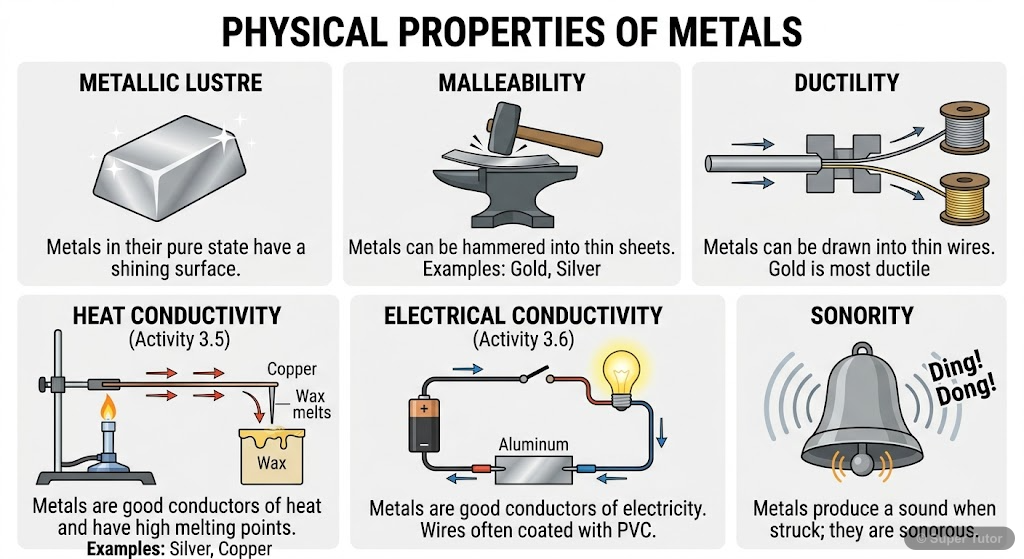
One of 17 illustrations for Metals and Non-metals in Super Tutor — alongside flashcards, concept maps and practice questions.
Important Questions from Metals and Non-metals
The correct order of reactivity of metals with water, from most reactive to least reactive, is:
Show answer
Na > Ca > Mg > Al
Step 1: Sodium (Na) is the most reactive — it reacts violently with cold water, producing so much heat that the hydrogen gas immediately catches fire. Step 2: Calcium (Ca) reacts with cold water but less vigorously than sodium. The hydrogen doesn't catch fire. Calcium floats due to hydrogen bubbles sticking to it. Step 3: Magnesium (Mg) does NOT react with cold water but reacts slowly with hot water. Step 4: Aluminium (Al) does not react with cold or hot water but reacts with steam to form Al₂O₃ + H₂. Step 5: This matches the order in the reactivity series: Na > Ca > Mg > Al, confirming that h
Hydrogen gas is NOT evolved when a metal reacts with dilute nitric acid (HNO₃) because:
Show answer
HNO₃ is a strong oxidising agent that oxidises H₂ to water
Step 1: Normally, when metals react with dilute acids, hydrogen gas is produced — Metal + Acid → Salt + H₂. Step 2: However, HNO₃ (nitric acid) is a strong oxidising agent, not just an acid. Step 3: Any hydrogen (H₂) produced in the reaction is immediately oxidised by HNO₃ to form water (H₂O). Step 4: HNO₃ itself gets reduced to nitrogen oxides (N₂O, NO, or NO₂) instead of releasing hydrogen. Step 5: Exception: Magnesium (Mg) and Manganese (Mn) react with very dilute HNO₃ to produce some H₂ gas. Option A is wrong because HNO₃ is actually a strong acid.
In the reactivity series, which of the following is the correct arrangement from most reactive to least reactive?
Show answer
K > Na > Ca > Mg > Al > Zn > Fe > Pb > Cu > Ag > Au
Step 1: The reactivity series (activity series) lists metals from most reactive to least reactive. Step 2: The top metals — K, Na, Ca — are alkali and alkaline earth metals that react even with cold water violently. Step 3: The middle metals — Mg, Al, Zn, Fe, Pb — react with acids and steam but not with cold water. Step 4: The bottom metals — Cu, Hg, Ag, Au — are least reactive and are often found in nature in free state. Step 5: A useful mnemonic to remember: 'King Naughty Cats Munch All Zinc Food Pretty Cheerfully Having Silver Gold'. Option D is the reverse order (least to most reactive).
A metal X displaces metal Y from its salt solution. This means:
Show answer
X is more reactive than Y
Step 1: A displacement reaction occurs when a more reactive element displaces a less reactive element from its compound. Step 2: The general rule: Metal A + Salt solution of B → Salt solution of A + Metal B — this happens ONLY if A is more reactive than B. Step 3: For example, iron (Fe) displaces copper from copper sulphate solution: Fe + CuSO₄ → FeSO₄ + Cu. This tells us Fe is more reactive than Cu. Step 4: So if X displaces Y, it means X is MORE reactive than Y. Step 5: Option A is the most common misconception — students confuse the two. Always remember: the displacing metal is more reactiv
+41 more questions on Metals and Non-metals (Punjab Board Class 10 Science)
Practise AllFrequently Asked Questions
What are the important topics in Metals and Non-metals for Punjab Board Class 10 Science?
How many important questions are there in Metals and Non-metals?
Sources & Official References
Content is aligned to the official syllabus. Refer to the board website for the latest curriculum.
More resources for Metals and Non-metals
For serious students
Get the full Metals and Non-metals chapter — start free.
Quizzes, flashcards, an AI doubt solver and a study plan for Punjab Board Class 10 Science. Free to start, no card needed.