Chemical Reactions and Equations — Important Questions
Punjab Board · Class 10 · Science
45 important questions from Chemical Reactions and Equations for Punjab Board Class 10 Science, with answers. Includes multiple choice questions.
Interactive on Super Tutor
Studying Chemical Reactions and Equations? Get the full interactive chapter.
Quizzes, flashcards, AI doubt-solver and a step-by-step study plan — built for important questions and more.
Free trial, no card needed.
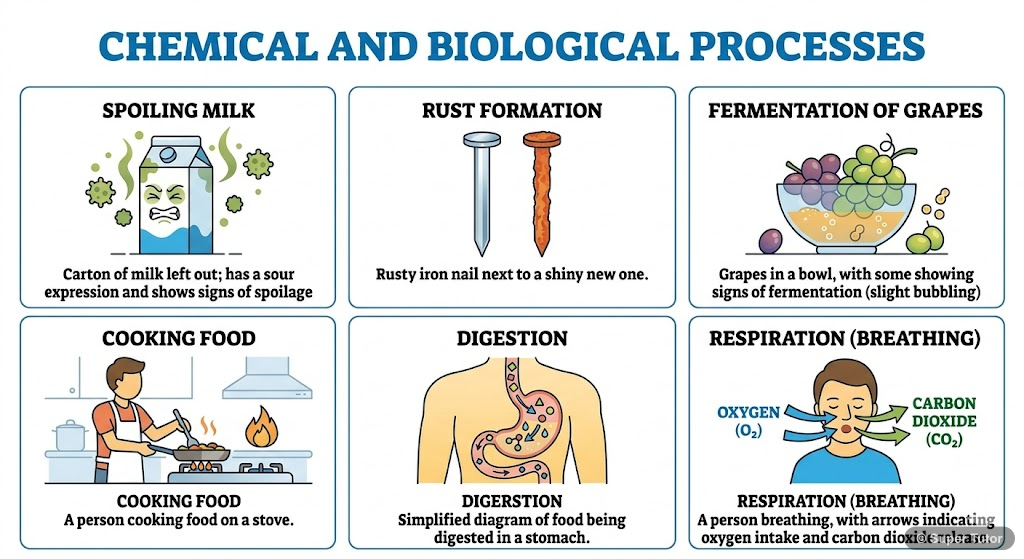
One of 23 illustrations for Chemical Reactions and Equations in Super Tutor — alongside flashcards, concept maps and practice questions.
Important Questions from Chemical Reactions and Equations
During the electrolysis of water (with dilute H₂SO₄), gas is collected at both electrodes. The ratio of the volume of gas at the cathode to the volume at the anode is 2:1. Which gas is collected at the cathode and why is its volume double?
Show answer
Hydrogen; because water has two hydrogen atoms for every one oxygen atom
Step 1: The balanced equation for electrolysis of water is: 2H₂O → 2H₂ + O₂. Step 2: From this equation, 2 moles of H₂ are produced for every 1 mole of O₂. So the volume ratio of H₂ : O₂ = 2 : 1. Step 3: The cathode is the negative electrode where reduction occurs — H⁺ ions gain electrons to form H₂ gas. Step 4: The reason for double volume is purely due to the molecular formula of water (H₂O) — 2 hydrogen atoms per 1 oxygen atom, giving twice as many H₂ molecules. Step 5: Option A is wrong — cathode produces hydrogen, not oxygen. Option C gives the right substance but the WRONG reason — the v
In the reaction: Na₂SO₄(aq) + BaCl₂(aq) → BaSO₄(s) + 2NaCl(aq), a white precipitate is formed. Which ion combination causes the precipitate, and what type of reaction is this?
Show answer
Ba²⁺ and SO₄²⁻ form BaSO₄ precipitate; double displacement (precipitation) reaction
Step 1: In this reaction, two ionic compounds (Na₂SO₄ and BaCl₂) react by exchanging their ions — this is a double displacement reaction. Step 2: Na⁺ pairs with Cl⁻ to form NaCl (soluble, stays in solution) and Ba²⁺ pairs with SO₄²⁻ to form BaSO₄ (insoluble, forms a white precipitate). Step 3: BaSO₄ is the white precipitate because it is insoluble in water. NaCl is soluble and remains dissolved. Step 4: Since a precipitate is formed, this is also called a precipitation reaction. Step 5: All other options incorrectly identify the ions forming the precipitate or the reaction type. NaCl is always
Chips manufacturers flush bags of chips with nitrogen gas before sealing. Which scientific principle is being applied here and why is nitrogen specifically used?
Show answer
Nitrogen prevents oxidation (rancidity) of chips; nitrogen is an inert/unreactive gas
Step 1: Chips contain fats and oils. When fats/oils react with oxygen in air, they get oxidised and become rancid — this means their taste and smell change unpleasantly. Step 2: To prevent this oxidation (rancidity), chips manufacturers remove oxygen from the packet by replacing it with nitrogen gas. Step 3: Nitrogen is used because it is chemically inert — it does not react with fats, oils, or the food itself, so it doesn't affect taste or quality. Step 4: The nitrogen acts as a 'shield' by eliminating the oxygen that would cause oxidation. Step 5: Option A is wrong — nitrogen doesn't prevent
A magnesium ribbon is burnt in oxygen to produce magnesium oxide. The balanced equation is: 2Mg + O₂ → 2MgO. Which of the following correctly identifies the type(s) of reaction occurring?
Show answer
A combination reaction and also an oxidation reaction (Mg is oxidised)
Step 1: Two substances (Mg and O₂) combine to form one single product (MgO) — this is the definition of a combination reaction. Step 2: Magnesium (Mg) gains oxygen to form MgO — gaining oxygen means it is OXIDISED. So this is also an oxidation reaction. Step 3: Heat and brilliant white light are released during this reaction, making it exothermic. Step 4: This reaction has two labels: combination + oxidation. Both are correct simultaneously. Step 5: Option A is wrong — decomposition reactions break ONE compound into multiple products, which is the opposite. Option C is wrong — no element repla
+41 more questions on Chemical Reactions and Equations (Punjab Board Class 10 Science)
Practise AllFrequently Asked Questions
What are the important topics in Chemical Reactions and Equations for Punjab Board Class 10 Science?
How many important questions are there in Chemical Reactions and Equations?
Sources & Official References
Content is aligned to the official syllabus. Refer to the board website for the latest curriculum.
More resources for Chemical Reactions and Equations
For serious students
Get the full Chemical Reactions and Equations chapter — start free.
Quizzes, flashcards, an AI doubt solver and a study plan for Punjab Board Class 10 Science. Free to start, no card needed.