Acids, Bases and Salts — Important Questions
Punjab Board · Class 10 · Science
45 important questions from Acids, Bases and Salts for Punjab Board Class 10 Science, with answers. Includes multiple choice questions.
Interactive on Super Tutor
Studying Acids, Bases and Salts? Get the full interactive chapter.
Quizzes, flashcards, AI doubt-solver and a step-by-step study plan — built for important questions and more.
Free trial, no card needed.
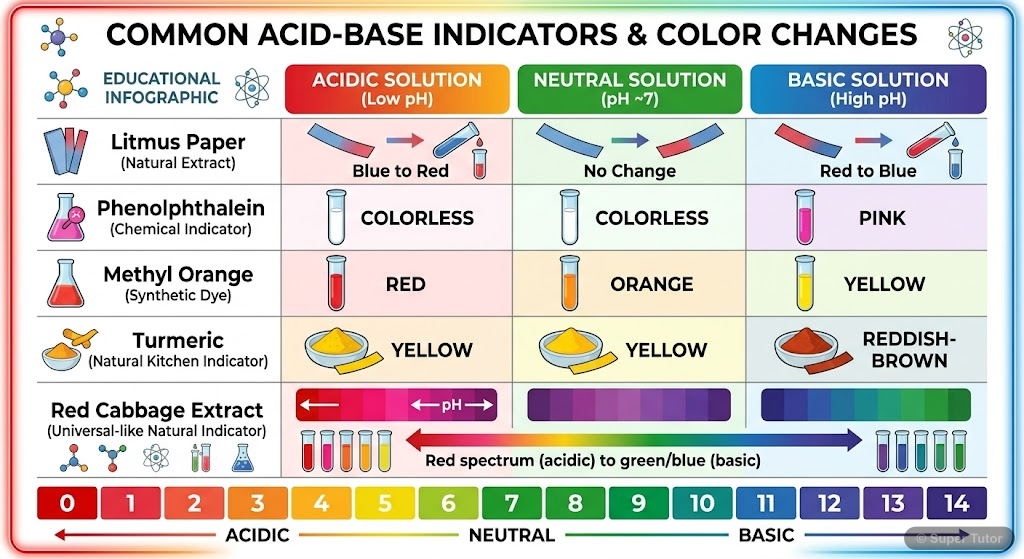
One of 14 illustrations for Acids, Bases and Salts in Super Tutor — alongside flashcards, concept maps and practice questions.
Important Questions from Acids, Bases and Salts
Which ion is responsible for the acidic nature of all acids in aqueous solution?
Show answer
H⁺ (H₃O⁺) ion
Step 1: All acids, when dissolved in water, produce hydrogen ions (H⁺). Step 2: Since H⁺ ions cannot exist alone, they combine with water molecules to form hydronium ions: H⁺ + H₂O → H₃O⁺. Step 3: It is this H⁺(aq) or H₃O⁺ ion that is responsible for all the characteristic properties of acids — sour taste, turning blue litmus red, reacting with metals, etc. Step 4: OH⁻ ions are produced by bases, not acids. Step 5: Cl⁻ is the anion in HCl specifically; not all acids have chloride ions.
A student performs a neutralisation reaction by adding dilute HCl to NaOH solution containing phenolphthalein. What colour change will the student observe when the acid exactly neutralises the base?
Show answer
Pink to colourless
Step 1: NaOH is a base. When phenolphthalein is added to a base, it turns pink. Step 2: As HCl (acid) is added drop by drop to the NaOH solution, the acid starts neutralising the base. Step 3: The neutralisation reaction is: NaOH + HCl → NaCl + H₂O. Step 4: When the acid exactly neutralises the base, the solution becomes neutral (pH = 7). Phenolphthalein is colourless in neutral and acidic solutions. Step 5: So the colour changes from pink (basic) to colourless (neutral), indicating the end point of neutralisation.
The chemical name of baking soda is:
Show answer
Sodium hydrogencarbonate
Step 1: Baking soda is a common kitchen ingredient used to make food soft and fluffy. Step 2: Its chemical name is sodium hydrogencarbonate and its chemical formula is NaHCO₃. Step 3: When heated, it decomposes: 2NaHCO₃ → Na₂CO₃ + H₂O + CO₂. The CO₂ released makes the food rise and become spongy. Step 4: Sodium carbonate (Na₂CO₃) is washing soda, a different compound. Sodium hydroxide (NaOH) is caustic soda. Step 5: Sodium chloride (NaCl) is common salt — used for flavour, not for making food fluffy.
Which process is used to manufacture sodium hydroxide from brine (aqueous NaCl solution)?
Show answer
Chlor-alkali process
Step 1: When electricity is passed through brine (aqueous NaCl), it decomposes — this is called electrolysis. Step 2: The reaction is: 2NaCl(aq) + 2H₂O(l) → 2NaOH(aq) + Cl₂(g) + H₂(g). Step 3: The name 'chlor-alkali' comes from the two products — 'chlor' for chlorine and 'alkali' for sodium hydroxide (NaOH). Step 4: The Haber process makes ammonia, the Contact process makes sulphuric acid, and the Solvay process makes sodium carbonate. Step 5: All three products of the chlor-alkali process (NaOH, Cl₂, H₂) are industrially very important.
+41 more questions on Acids, Bases and Salts (Punjab Board Class 10 Science)
Practise AllFrequently Asked Questions
What are the important topics in Acids, Bases and Salts for Punjab Board Class 10 Science?
How many important questions are there in Acids, Bases and Salts?
Sources & Official References
Content is aligned to the official syllabus. Refer to the board website for the latest curriculum.
More resources for Acids, Bases and Salts
For serious students
Get the full Acids, Bases and Salts chapter — start free.
Quizzes, flashcards, an AI doubt solver and a study plan for Punjab Board Class 10 Science. Free to start, no card needed.