Carbon and its Compounds — Practice Quiz
Punjab Board · Class 10 · Science
Try a 4-question quiz on Carbon and its Compounds for Punjab Board Class 10 Science: tap an answer to check it and see why.
Interactive on Super Tutor
Studying Carbon and its Compounds? Get the full interactive chapter.
Quizzes, flashcards, AI doubt-solver and a step-by-step study plan — built for practice quiz and more.
Free trial, no card needed.
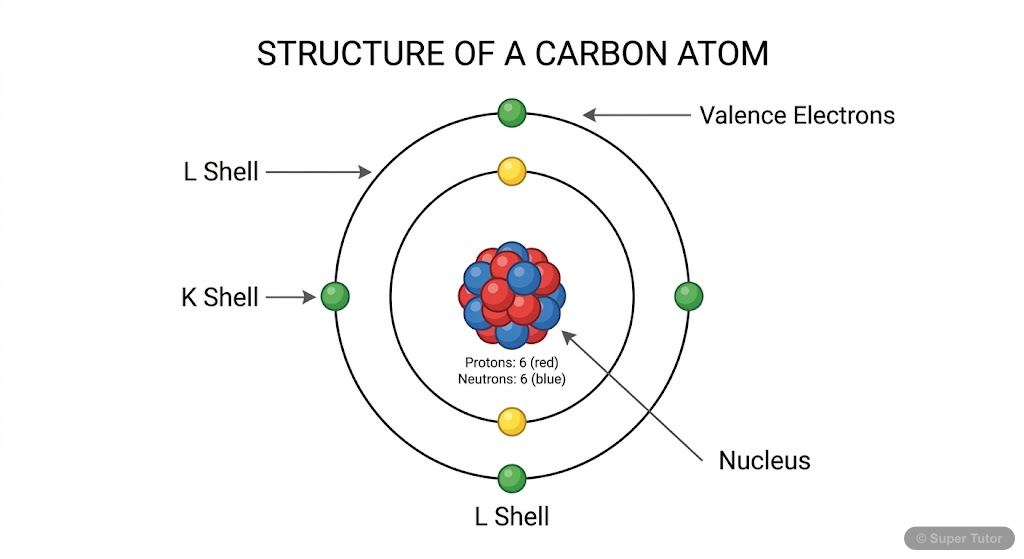
One of 22 illustrations for Carbon and its Compounds in Super Tutor — alongside flashcards, concept maps and practice questions.
Quick Quiz: Carbon and its Compounds
0/4Tap an answer to check it instantly. No sign-up needed for these 4.
Carbon cannot form C⁴⁺ cation easily. Which of the following best explains this?
In diamond, each carbon atom is bonded to four other carbon atoms, yet diamond does not conduct electricity. In graphite, each carbon is bonded to only three others, yet graphite conducts electricity. What is the best explanation for graphite's conductivity?
Ethyne (C₂H₂) is an unsaturated hydrocarbon. What type of bond exists between the two carbon atoms in ethyne, and how many electrons are shared between them?
A compound has the molecular formula C₅H₁₂. How many structural isomers are possible for this compound?
Sample Questions
Which of the following compounds belongs to the same homologous series as CH₃COOH?
Show answer
C₃H₇COOH
Step 1: CH₃COOH is ethanoic acid — it belongs to the carboxylic acid series (–COOH functional group). Step 2: A homologous series consists of compounds with the same functional group, differing by a –CH₂– unit each time. Step 3: CH₃COOH (2 carbons), C₂H₅COOH (3 carbons), C₃H₇COOH (4 carbons) — each differs by –CH₂– and all have –COOH. Step 4: C₃H₇COOH (butanoic acid) has the –COOH functional group and differs from CH₃COOH by two –CH₂– units, still making it part of the same series. Step 5: C₂H₅OH is an alcohol (–OH group), HCHO is an aldehyde (–CHO), and CH₃CHO is also an aldehyde — none share
When ethanol is treated with excess hot concentrated sulphuric acid at 443 K, what is the main organic product formed?
Show answer
Ethene
Step 1: Ethanol (CH₃CH₂OH) undergoes dehydration when heated with excess hot concentrated H₂SO₄ at 443 K. Step 2: Dehydration means removal of water (H₂O) from the molecule. Step 3: When –OH and –H are removed from adjacent carbon atoms in ethanol, water is eliminated and a double bond forms between the two carbon atoms. Step 4: The product is ethene (CH₂=CH₂), an unsaturated hydrocarbon. The reaction is: CH₃CH₂OH → CH₂=CH₂ + H₂O. Step 5: H₂SO₄ acts as a dehydrating agent here, not an oxidising agent. Ethane (option A) would require reduction, not dehydration. Ethanoic acid (option B) forms wh
The general formula for alkynes is CₙH₂ₙ₋₂. What is the molecular formula of the third member of the alkyne series?
Show answer
C₃H₄
Step 1: Alkynes have a triple bond between carbon atoms and follow the general formula CₙH₂ₙ₋₂. Step 2: The first alkyne is ethyne: n=2, formula = C₂H₂₍₂₎₋₂ = C₂H₂. Step 3: The second alkyne: n=3, formula = C₃H₂₍₃₎₋₂ = C₃H₄ (propyne). Step 4: Wait — let us recount: first member is n=2 (ethyne, C₂H₂), second member is n=3 (propyne, C₃H₄), third member is n=4 (butyne, C₄H₆). Step 5: So the third member has n=4: formula = C₄H₂₍₄₎₋₂ = C₄H₆. However, if the series starts counting from the FIRST possible alkyne (n=2, ethyne), the third member is n=4 (C₄H₆). But if we consider propyne (C₃H₄) as the t
Alkaline KMnO₄ is used to oxidise ethanol to ethanoic acid. In this reaction, what role does alkaline KMnO₄ play?
Show answer
Oxidising agent, because it adds oxygen to ethanol
Step 1: Oxidation of an organic compound involves addition of oxygen or removal of hydrogen. Step 2: In this reaction, ethanol (CH₃CH₂OH) is converted to ethanoic acid (CH₃COOH). Step 3: Comparing the two: ethanol has the –OH group, while ethanoic acid has the –COOH group. The carbon has gained an extra oxygen atom — this is oxidation. Step 4: Since alkaline KMnO₄ provides the oxygen for this oxidation, it acts as an oxidising agent. Step 5: KMnO₄ itself is reduced in the process (it loses oxygen/gains electrons), which is why the purple colour of KMnO₄ disappears initially. A reducing agent d
+41 more questions on Carbon and its Compounds (Punjab Board Class 10 Science)
Practise AllFrequently Asked Questions
What are the important topics in Carbon and its Compounds for Punjab Board Class 10 Science?
How many practice questions are there for Carbon and its Compounds?
Sources & Official References
Content is aligned to the official syllabus. Refer to the board website for the latest curriculum.
More resources for Carbon and its Compounds
For serious students
Get the full Carbon and its Compounds chapter — start free.
Quizzes, flashcards, an AI doubt solver and a study plan for Punjab Board Class 10 Science. Free to start, no card needed.