Carbon and its Compounds — Flashcards
Punjab Board · Class 10 · Science
40 flashcards for Carbon and its Compounds (Punjab Board Class 10 Science) to test yourself on key terms and facts.
Interactive on Super Tutor
Studying Carbon and its Compounds? Get the full interactive chapter.
Quizzes, flashcards, AI doubt-solver and a step-by-step study plan — built for flashcards and more.
Free trial, no card needed.
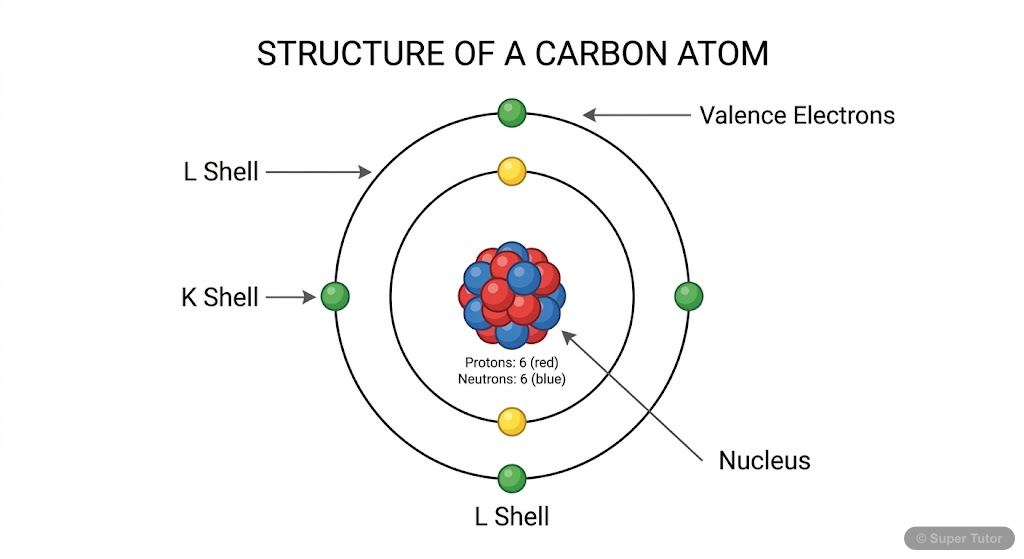
One of 22 illustrations for Carbon and its Compounds in Super Tutor — alongside flashcards, concept maps and practice questions.
Why does carbon form covalent bonds instead of ionic bonds?
Answer
Carbon has 4 valence electrons and needs 4 more to achieve noble gas configuration. If it tried to gain 4 electrons, forming C⁴⁻ would be unstable because a nucleus with 6 protons cannot hold 10 elect…
What is the electron dot structure of methane (CH₄), and how does it show covalent bonding?
Answer
In methane, carbon shares one electron with each of four hydrogen atoms. The electron dot structure shows: C atom in center with 4 pairs of dots (electrons) - each pair shared with one H atom. This gi…
Calculate the number of covalent bonds in an oxygen molecule (O₂). Each oxygen atom has 6 valence electrons.
Answer
Each oxygen atom needs 2 more electrons to complete its octet (8 electrons needed, has 6). When two oxygen atoms bond, they must share 2 pairs of electrons (4 electrons total) to satisfy both atoms. T…
Why do carbon compounds have low melting and boiling points compared to ionic compounds?
Answer
Covalently bonded carbon compounds have strong bonds within molecules but weak intermolecular forces (van der Waals forces) between molecules. In contrast, ionic compounds have strong electrostatic at…
What are the two key properties of carbon that lead to the formation of millions of carbon compounds?
Answer
1) Tetravalency: Carbon has 4 valence electrons and can form 4 covalent bonds with atoms of other elements or other carbon atoms. This allows it to bond with oxygen, hydrogen, nitrogen, halogens, and …
How do diamond and graphite differ in structure, and why does this cause different properties?
Answer
Diamond: Each carbon atom is bonded to 4 other carbon atoms in a rigid 3D tetrahedral structure. This creates a very strong, hard structure. Graphite: Each carbon atom bonds to 3 others in the same pl…
What is a saturated hydrocarbon? Give one example with its formula and structure.
Answer
A saturated hydrocarbon is a compound containing only carbon and hydrogen atoms with single bonds between all carbon atoms. Example: Propane (C₃H₈) has structure H-C-C-C-H with all C-C bonds being sin…
What is an unsaturated hydrocarbon? Draw the structure of ethene (C₂H₄) and identify the type of bond between carbons.
Answer
An unsaturated hydrocarbon contains one or more double or triple bonds between carbon atoms. Ethene (C₂H₄): H₂C=CH₂ - contains a double bond (C=C) between the two carbons. Each carbon has only 3 other…
+32 more flashcards
Practise AllFrequently Asked Questions
What are the important topics in Carbon and its Compounds for Punjab Board Class 10 Science?
How many flashcards are available for Carbon and its Compounds?
How should I revise Carbon and its Compounds for the Punjab Board Class 10 board exam?
Sources & Official References
Content is aligned to the official syllabus. Refer to the board website for the latest curriculum.
More resources for Carbon and its Compounds
For serious students
Get the full Carbon and its Compounds chapter — start free.
Quizzes, flashcards, an AI doubt solver and a study plan for Punjab Board Class 10 Science. Free to start, no card needed.