Chapter 4 of 5
Concept Maps
Carbon and its Compounds — Concept Maps
Punjab Board · Class 10 · Science
3 concept maps of Carbon and its Compounds for Punjab Board Class 10 Science, each also written out as a text outline.
45 questions40 flashcards5 concepts
Interactive on Super Tutor
Studying Carbon and its Compounds? Get the full interactive chapter.
Quizzes, flashcards, AI doubt-solver and a step-by-step study plan — built for concept maps and more.
Free trial, no card needed.
Super Tutor
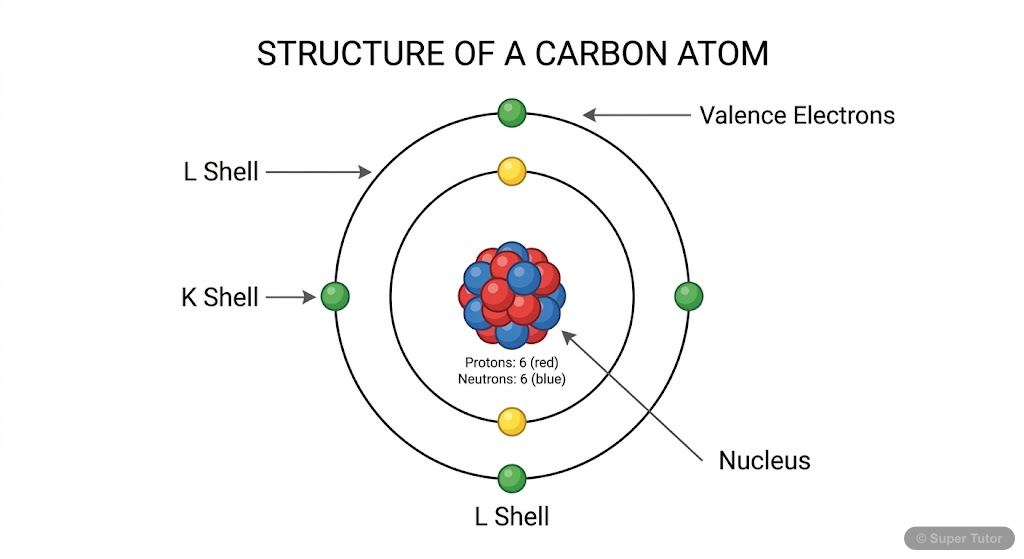
One of 22 illustrations for Carbon and its Compounds in Super Tutor — alongside flashcards, concept maps and practice questions.
3 Concept Maps
Mind map showing carbon's electronic configuration and how it relates to its valency and bonding capability
The map in words
- Carbon Atomic Number 6
- Electronic Configuration
- K shell: 2 electrons
- L shell: 4 electrons
- Valence Electrons
- 4 valence electrons
- Needs 4 more for octet
- Stability
- Forms 4 bonds
- Strong covalent bonds
- Result
- Tetravalent element
- Forms diverse compounds
- Electronic Configuration
Flowchart showing the process of covalent bond formation and its consequences on molecular properties
The map in words
- Two atoms approach
- Each atom has valence electrons
- Can they achieve noble gas config?
- Yes: Share electron pairs
- Single, Double, or Triple Bonds form
- Stable covalent molecule
- Low melting/boiling points Poor conductors
- Stable covalent molecule
- Single, Double, or Triple Bonds form
- No: May form different bonds
- Yes: Share electron pairs
- Can they achieve noble gas config?
- Each atom has valence electrons
Mind map comparing the three main allotropes of carbon, their structures, and properties
The map in words
- Allotropes of Carbon
- Diamond
- 3D rigid structure
- Each C bonded to 4 C
- Hardest substance
- Transparent
- Insulator
- Graphite
- Layered structure
- Each C bonded to 3 C
- Soft and slippery
- Good conductor
- Opaque
- Fullerenes
- C-60 shape
- Football-like structure
- Molecular structure
- Research applications
- Diamond
Explore these maps interactively
Explore DiagramsFrequently Asked Questions
What are the important topics in Carbon and its Compounds for Punjab Board Class 10 Science?
Key topics in Carbon and its Compounds include 1 Bonding in Carbon – The Covalent Bond, 2 Versatile Nature of Carbon, 2.5 Nomenclature of Carbon Compounds, 3 Chemical Properties of Carbon Compounds. Study these first, then practise questions on each for the Punjab Board Class 10 board exam.
What do the concept maps for Carbon and its Compounds show?
The 3 maps show how the ideas in Carbon and its Compounds connect: Mind map showing carbon's electronic configuration and how it relates to its valency and bonding capability; Flowchart showing the process of covalent bond formation and its consequences on molecular properties. Each map is also written out as an outline on this page.
How should I revise Carbon and its Compounds for the Punjab Board Class 10 board exam?
Learn the core ideas first, then work through the 45 practice questions on Carbon and its Compounds. Revise definitions regularly and use flashcards for quick recall before the exam.
Sources & Official References
Content is aligned to the official syllabus. Refer to the board website for the latest curriculum.
More resources for Carbon and its Compounds
For serious students
Get the full Carbon and its Compounds chapter — start free.
Quizzes, flashcards, an AI doubt solver and a study plan for Punjab Board Class 10 Science. Free to start, no card needed.