Carbon and its Compounds — Chapter Summary
Punjab Board · Class 10 · Science
Summary of Carbon and its Compounds for Punjab Board Class 10 Science. Part of the Punjab Board Class 10 Science syllabus.
Interactive on Super Tutor
Studying Carbon and its Compounds? Get the full interactive chapter.
Quizzes, flashcards, AI doubt-solver and a step-by-step study plan — built for chapter summary and more.
Free trial, no card needed.
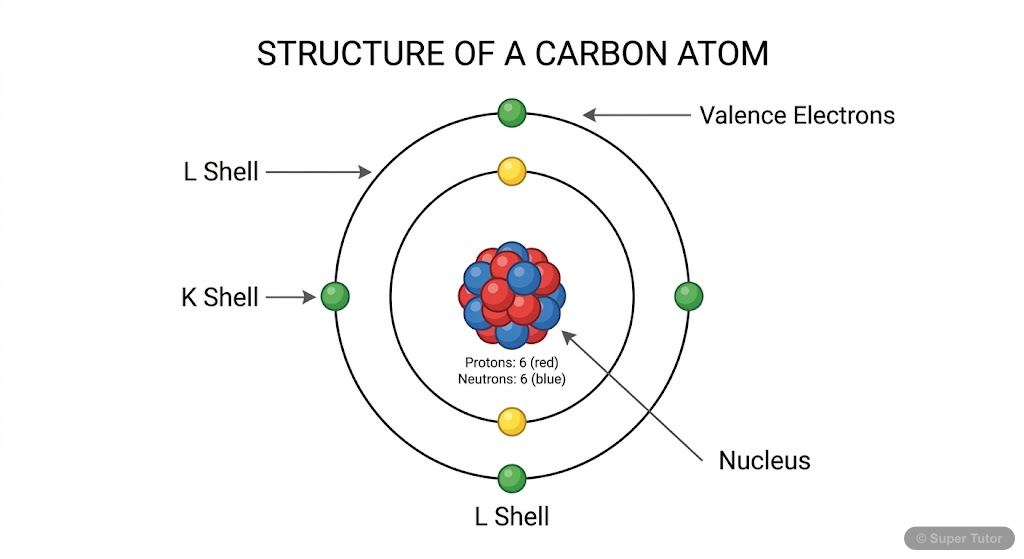
One of 22 illustrations for Carbon and its Compounds in Super Tutor — alongside flashcards, concept maps and practice questions.
Overview
Carbon is one of the most important and versatile elements on Earth. Despite making up only 0.02% of Earth's crust and 0.03% of the atmosphere, carbon forms the basis of all living organisms and countless compounds used in daily life. This chapter explores why carbon is so special, how it bonds with
Key Concepts
Covalent bonds form when atoms share
Covalent bonds form when atoms share pairs of electrons to achieve noble gas configuration. Unlike ionic bonds that transfer electrons, covalent bonds
Allotropes are different forms of
Allotropes are different forms of the same element with different physical properties but similar chemical properties. Carbon has several important al
Catenation is carbon's unique ability
Catenation is carbon's unique ability to form strong bonds with other carbon atoms, creating long chains, branched chains, and ring structures. This p
Saturated compounds contain only single bonds
Saturated compounds contain only single bonds between carbon atoms (like alkanes: methane CH₄, ethane C₂H₆, propane C₃H₈). They follow the general for
Structural isomers are compounds with
Structural isomers are compounds with the same molecular formula but different structural arrangements. For example, butane (C₄H₁₀) has two isomers: s
Learning Objectives
- Understand covalent bonding and how it differs from ionic bonding
- Learn about carbon's unique ability to form chains (catenation) and multiple bonds
- Classify carbon compounds as saturated and unsaturated hydrocarbons
- Understand the concept of functional groups and homologous series
- Learn the nomenclature system for naming organic compounds
Frequently Asked Questions
What are the important topics in Carbon and its Compounds for Punjab Board Class 10 Science?
How should I revise Carbon and its Compounds for the Punjab Board Class 10 board exam?
Sources & Official References
Content is aligned to the official syllabus. Refer to the board website for the latest curriculum.
More resources for Carbon and its Compounds
For serious students
Get the full Carbon and its Compounds chapter — start free.
Quizzes, flashcards, an AI doubt solver and a study plan for Punjab Board Class 10 Science. Free to start, no card needed.