Animal Kingdom — Chapter Summary
Punjab Board · Class 11 · Biology
Summary of Animal Kingdom for Punjab Board Class 11 Biology. Part of the Punjab Board Class 11 Biology syllabus.
Interactive on Super Tutor
Studying Animal Kingdom? Get the full interactive chapter.
Quizzes, flashcards, AI doubt-solver and a step-by-step study plan — built for chapter summary and more.
Free trial, no card needed.
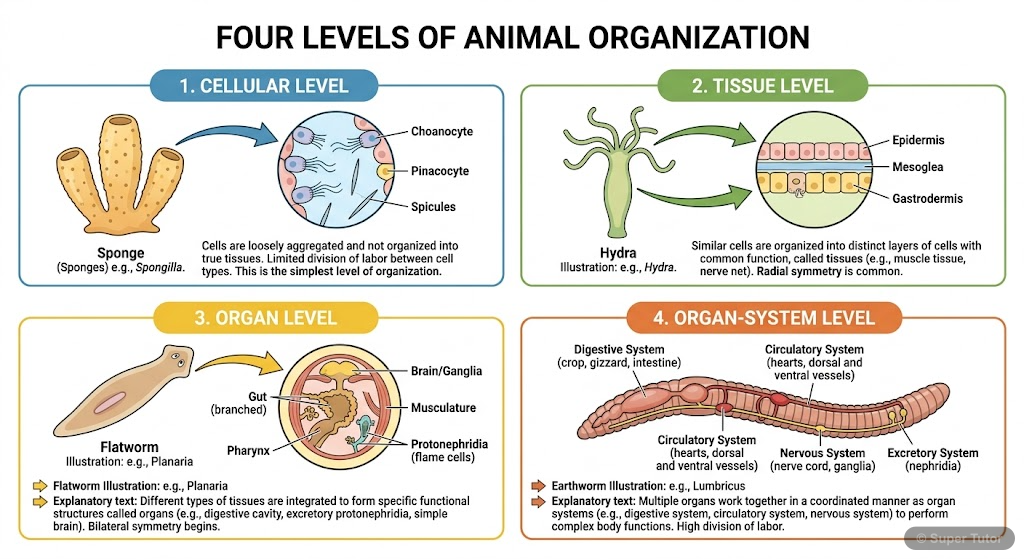
Learn better with visuals Super Tutor pairs illustrations like this with notes and quizzes for Animal Kingdom.
Overview
The Animal Kingdom is one of the most diverse and fascinating groups of living organisms on Earth. With over a million described species exhibiting incredible variety in form, structure, and behavior, scientists have developed a systematic approach to classify animals based on fundamental features.
Key Concepts
Animals exhibit different levels of cellular
Animals exhibit different levels of cellular organization. Sponges show cellular level organization where cells are arranged as loose aggregates. Coel
Animals can be classified based on
Animals can be classified based on how their bodies are arranged symmetrically. Asymmetrical animals (like sponges) have no plane of symmetry. Radiall
The coelom is a body cavity
The coelom is a body cavity lined by mesoderm (a tissue layer). Coelomate animals have a true coelom completely lined by mesodermal tissue, providing
Segmentation is the division of
Segmentation is the division of the body into repeating units called segments or metameres. Each segment contains similar structures and organs. This
The notochord is a flexible
The notochord is a flexible, rod-like structure derived from mesoderm that forms along the dorsal (back) side of the embryo during development. In cho
Learning Objectives
- Understand the fundamental features used for animal classification such as body organization levels, symmetry, coelom types, and segmentation
- Learn about the characteristics and examples of major animal phyla including Porifera, Cnidaria, Platyhelminthes, Annelida, Arthropoda, and Mollusca
- Understand the distinguishing features of vertebrate classes including fish, amphibians, reptiles, birds, and mammals
- Recognize the importance of notochord in differentiating chordates from non-chordates
- Analyze the relationship between body structure and lifestyle in different animal groups
Frequently Asked Questions
What are the important topics in Animal Kingdom for Punjab Board Class 11 Biology?
How should I revise Animal Kingdom for Class 11 exams?
Sources & Official References
Content is aligned to the official syllabus. Refer to the board website for the latest curriculum.
More resources for Animal Kingdom
For serious students
Get the full Animal Kingdom chapter — start free.
Quizzes, flashcards, an AI doubt solver and a study plan for Punjab Board Class 11 Biology. Free to start, no card needed.