Morphology of Flowering Plants — Chapter Summary
Punjab Board · Class 11 · Biology
Summary of Morphology of Flowering Plants for Punjab Board Class 11 Biology. Part of the Punjab Board Class 11 Biology syllabus.
Interactive on Super Tutor
Studying Morphology of Flowering Plants? Get the full interactive chapter.
Quizzes, flashcards, AI doubt-solver and a step-by-step study plan — built for chapter summary and more.
Free trial, no card needed.
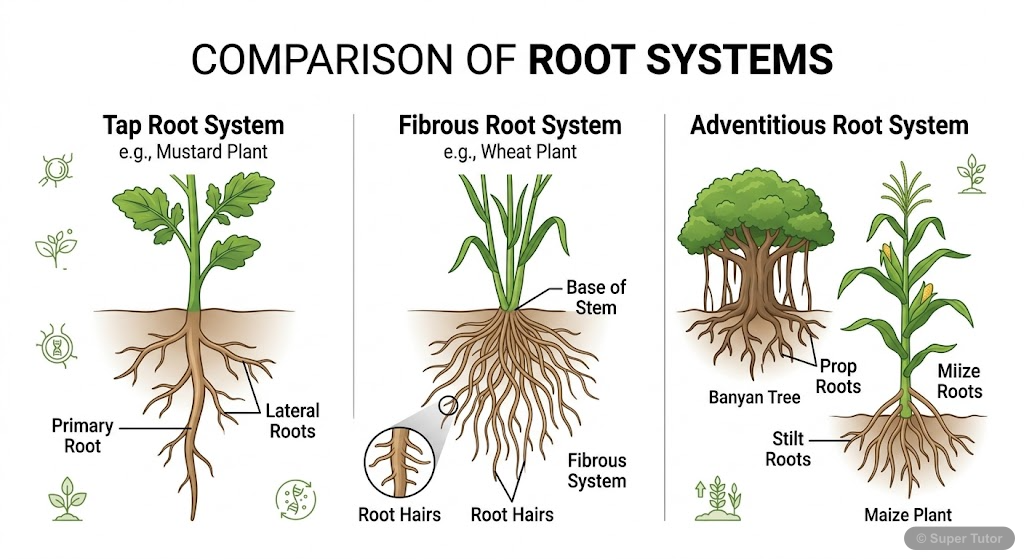
One of 16 illustrations for Morphology of Flowering Plants in Super Tutor — alongside flashcards, concept maps and practice questions.
Overview
Morphology is the study of the external structure and form of plants. Flowering plants, or angiosperms, display an incredible diversity in their shapes, sizes, and structures. However, despite this variation, all flowering plants share a common basic organization: they have roots below ground and sh
Key Concepts
Plants develop two main types
Plants develop two main types of root systems. In dicotyledonous plants (dicots) like mustard, the primary root continues to grow, forming a tap root
The root tip contains distinct regions
The root tip contains distinct regions, each with specific functions. The root cap protects the meristematic cells as the root pushes through soil. Th
The stem is the ascending part
The stem is the ascending part of the shoot system that develops from the plumule of the embryo. Stems bear nodes (where leaves attach) and internodes
A typical leaf consists of three
A typical leaf consists of three main parts: (1) Leaf base—the point of attachment to the stem, sometimes with stipules (small leaf-like structures);
Venation refers to the arrangement
Venation refers to the arrangement of veins and veinlets in the leaf blade. In reticulate venation, veins form a network pattern and is characteristic
Learning Objectives
- Understand the structure and types of root systems and their functions
- Learn the features that distinguish stems from other plant parts and their variations
- Analyze leaf structure, arrangement, and adaptations for photosynthesis
- Comprehend flower organization and recognize different floral arrangements
- Identify the components of fruits and seeds and their developmental significance
Frequently Asked Questions
What are the important topics in Morphology of Flowering Plants for Punjab Board Class 11 Biology?
How should I revise Morphology of Flowering Plants for Class 11 exams?
Sources & Official References
Content is aligned to the official syllabus. Refer to the board website for the latest curriculum.
More resources for Morphology of Flowering Plants
For serious students
Get the full Morphology of Flowering Plants chapter — start free.
Quizzes, flashcards, an AI doubt solver and a study plan for Punjab Board Class 11 Biology. Free to start, no card needed.