Animal Kingdom — Important Questions
Punjab Board · Class 11 · Biology
45 important questions from Animal Kingdom for Punjab Board Class 11 Biology, with answers. Includes multiple choice questions.
Interactive on Super Tutor
Studying Animal Kingdom? Get the full interactive chapter.
Quizzes, flashcards, AI doubt-solver and a step-by-step study plan — built for important questions and more.
Free trial, no card needed.
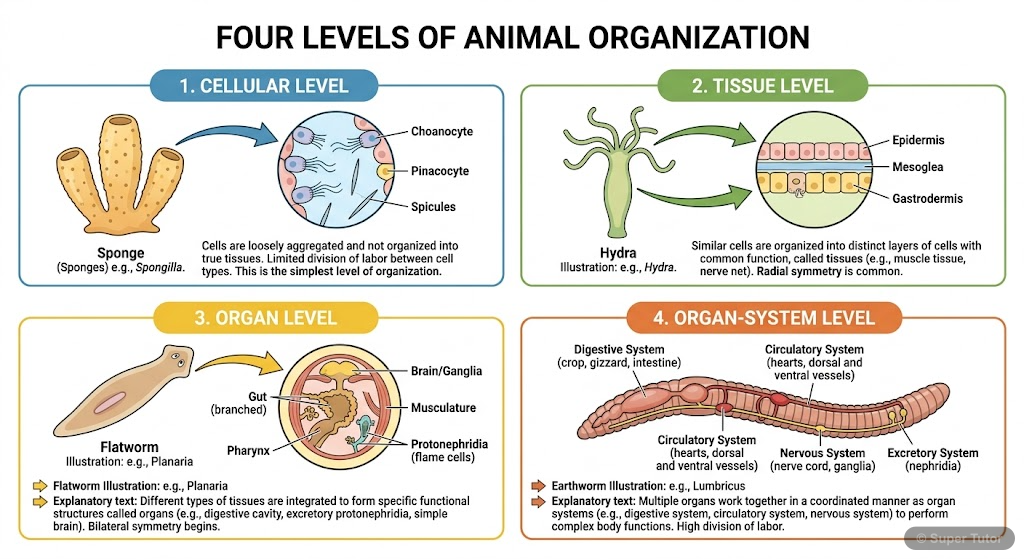
Learn better with visuals Super Tutor pairs illustrations like this with notes and quizzes for Animal Kingdom.
Important Questions from Animal Kingdom
The excretory organ/structure in Arthropoda is:
Show answer
Malpighian tubules
Step 1: Each phylum has specific excretory organs — a key comparative fact tested in exams. Step 2: NEPHRIDIA are the excretory organs of ANNELIDA (earthworms, Nereis). They also help in osmoregulation. Step 3: FLAME CELLS are specialized excretory cells found in PLATYHELMINTHES (flatworms like tapeworm, liver fluke). Step 4: MALPIGHIAN TUBULES are the excretory organs specific to ARTHROPODA (insects, spiders, etc.). Step 5: PROBOSCIS GLAND is the excretory organ of HEMICHORDATA (Balanoglossus). Each wrong option corresponds to a different phylum's excretory structure, making this a high-diffi
In the subphylum Urochordata, where is the notochord present?
Show answer
Only in the larval tail region
Step 1: Phylum Chordata has three subphyla — Urochordata (Tunicata), Cephalochordata, and Vertebrata. Step 2: A critical comparison: In UROCHORDATA (e.g., Ascidia, Salpa), the notochord is present ONLY in the LARVAL TAIL. It disappears in the adult. Step 3: In CEPHALOCHORDATA (e.g., Branchiostoma/Amphioxus), the notochord extends from HEAD TO TAIL and is PERSISTENT throughout life. Step 4: In VERTEBRATA, notochord is present during embryonic period but is later replaced by the vertebral column. Step 5: Option A describes Cephalochordata, not Urochordata. Options C and D are entirely incorrect
Which of the following features CORRECTLY distinguishes Chondrichthyes from Osteichthyes?
Show answer
Chondrichthyes lack an air bladder and must swim constantly; Osteichthyes have an air bladder for buoyancy
Step 1: This question tests comparative knowledge of two fish classes. Step 2: CHONDRICHTHYES (cartilaginous fish like sharks) have SEPARATE GILL SLITS with NO OPERCULUM. OSTEICHTHYES (bony fish) have gills COVERED by an OPERCULUM. So Option A is REVERSED — it is incorrect. Step 3: CHONDRICHTHYES LACK an air bladder, so they must continuously swim to avoid sinking. OSTEICHTHYES possess an AIR BLADDER that regulates buoyancy. This makes Option B CORRECT. Step 4: Chondrichthyes are MARINE; Osteichthyes can be marine OR freshwater. Option C is completely wrong. Step 5: PLACOID SCALES belong to Ch
An animal specimen shows: bilateral symmetry, triploblastic organization, pseudocoelom, complete alimentary canal with muscular pharynx, and separate sexes. Which phylum does it belong to?
Show answer
Aschelminthes
Step 1: Analyze each feature systematically to identify the phylum. Step 2: BILATERAL SYMMETRY and TRIPLOBLASTIC organization are common to many phyla, so these alone don't narrow it down. Step 3: KEY FEATURE — PSEUDOCOELOM: The body cavity is NOT lined by mesoderm. This immediately rules out Annelida (true coelomate) and Hemichordata (true coelomate). Platyhelminthes is ACOELOMATE (no body cavity). Step 4: COMPLETE ALIMENTARY CANAL (mouth AND anus): Platyhelminthes has an INCOMPLETE digestive system (only one opening). This further eliminates Platyhelminthes. Step 5: ASCHELMINTHES (roundworms
+41 more questions on Animal Kingdom (Punjab Board Class 11 Biology)
Practise AllFrequently Asked Questions
What are the important topics in Animal Kingdom for Punjab Board Class 11 Biology?
How many important questions are there in Animal Kingdom?
Sources & Official References
Content is aligned to the official syllabus. Refer to the board website for the latest curriculum.
More resources for Animal Kingdom
For serious students
Get the full Animal Kingdom chapter — start free.
Quizzes, flashcards, an AI doubt solver and a study plan for Punjab Board Class 11 Biology. Free to start, no card needed.