Morphology of Flowering Plants — Important Questions
Punjab Board · Class 11 · Biology
45 important questions from Morphology of Flowering Plants for Punjab Board Class 11 Biology, with answers. Includes multiple choice questions.
Interactive on Super Tutor
Studying Morphology of Flowering Plants? Get the full interactive chapter.
Quizzes, flashcards, AI doubt-solver and a step-by-step study plan — built for important questions and more.
Free trial, no card needed.
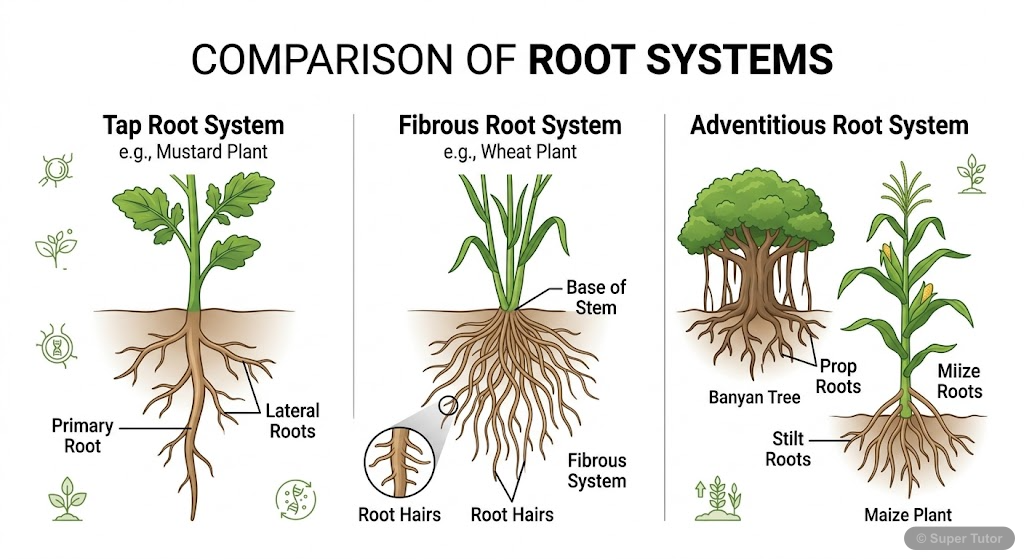
One of 16 illustrations for Morphology of Flowering Plants in Super Tutor — alongside flashcards, concept maps and practice questions.
Important Questions from Morphology of Flowering Plants
The region of the stem where leaves are attached is called:
Show answer
Node
Step 1: The stem is divided into segments separated by points where leaves are attached. Step 2: The point on the stem where a leaf is born (attached) is called a node. Step 3: The portion of the stem between two nodes is called an internode. Step 4: The axil is the angle between the leaf and the stem (where axillary buds are found). Step 5: The petiole is the stalk of the leaf itself, not a part of the stem. Therefore, the correct answer is node.
Which type of venation is found in the leaves of most dicotyledonous plants?
Show answer
Reticulate venation
Step 1: Venation refers to the arrangement of veins in the leaf blade (lamina). Step 2: In reticulate venation, the veinlets form a net-like or mesh-like network. Step 3: In parallel venation, the veins run side by side parallel to each other (seen in monocots like grass, wheat). Step 4: Reticulate venation is the characteristic feature of most dicotyledonous plants. Step 5: Unicostate and multicostate are subcategories of reticulate venation but are not the basic answer expected here. The simple answer is reticulate venation.
In which type of phyllotaxy does a single leaf arise at each node in an alternate manner?
Show answer
Alternate phyllotaxy
Step 1: Phyllotaxy is the pattern of leaf arrangement on the stem. Step 2: In alternate phyllotaxy, ONE leaf arises at each node, and consecutive leaves alternate from one side to the other. Examples: China rose, mustard, sunflower. Step 3: In opposite phyllotaxy, TWO leaves arise at each node opposite each other. Examples: Calotropis, guava. Step 4: In whorled phyllotaxy, MORE THAN TWO leaves arise at each node, forming a whorl. Example: Alstonia. Step 5: Decussate is a type of opposite phyllotaxy and is not one of the three main types. The correct answer is alternate phyllotaxy.
A flower that can be divided into two equal halves in ANY radial plane is called:
Show answer
Actinomorphic
Step 1: Flowers are classified based on the number of planes that divide them into equal halves. Step 2: Actinomorphic means the flower has radial symmetry — it can be divided into two equal halves by ANY radial plane passing through the centre. Examples: mustard, datura, chilli. Step 3: Zygomorphic means bilateral symmetry — it can be divided into two equal halves by only ONE particular vertical plane. Examples: pea, gulmohur, bean. Step 4: Asymmetric means the flower CANNOT be divided into two equal halves by any plane. Example: canna. Step 5: Unisexual refers to the sex of the flower (havin
+41 more questions on Morphology of Flowering Plants (Punjab Board Class 11 Biology)
Practise AllFrequently Asked Questions
What are the important topics in Morphology of Flowering Plants for Punjab Board Class 11 Biology?
How many important questions are there in Morphology of Flowering Plants?
Sources & Official References
Content is aligned to the official syllabus. Refer to the board website for the latest curriculum.
More resources for Morphology of Flowering Plants
For serious students
Get the full Morphology of Flowering Plants chapter — start free.
Quizzes, flashcards, an AI doubt solver and a study plan for Punjab Board Class 11 Biology. Free to start, no card needed.