Chapter 2 of 5
Revision Notes
Structure of Atom — Revision Notes
Punjab Board · Class 11 · Chemistry
Structure of Atom revision notes for Punjab Board Class 11 Chemistry: 4 topics in quick points. Part of the Punjab Board Class 11 Chemistry syllabus.
45 questions34 flashcards2 formulas & key relations5 concepts
Interactive on Super Tutor
Studying Structure of Atom? Get the full interactive chapter.
Quizzes, flashcards, AI doubt-solver and a step-by-step study plan — built for revision notes and more.
Free trial, no card needed.
Super Tutor
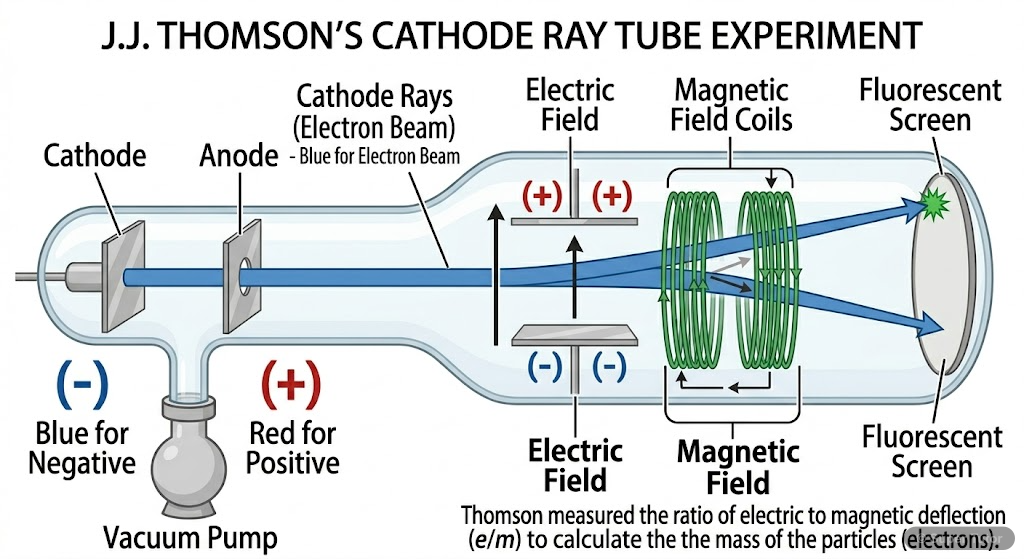
Learn better with visuals Super Tutor pairs illustrations like this with notes and quizzes for Structure of Atom.
Key Topics to Revise
1
Discovery of Sub-Atomic Particles
- Cathode ray experiments by Faraday and others showed that electricity has a particulate nature.
- Cathode rays travel from cathode to anode, are deflected by electric and magnetic fields, and consist of negatively charged particles called electrons.
- Cathode rays are independent of the electrode material and gas used – proving electrons are universal constituents of all atoms.
2
Atomic Models – Thomson, Rutherford, and Their Drawbacks
- Thomson Model (1898): Atom is a uniform sphere of positive charge with electrons embedded in it – like a plum pudding or watermelon with seeds.
- Thomson's model could explain electrical neutrality but was disproved by Rutherford's alpha-particle scattering experiment.
- Rutherford's Alpha Scattering Experiment: Alpha particles from a radioactive source were fired at a thin gold foil (~100 nm thick).
3
Electromagnetic Radiation and Planck's Quantum Theory
- Electromagnetic radiation is produced when a charged particle accelerates – consists of oscillating electric and magnetic fields perpendicular to each other and to the direction of propagation.
- EM radiation travels through vacuum at speed of light c = 3.0 × 10⁸ m/s.
- Key properties: wavelength (λ), frequency (ν), wavenumber (ν̄).
4
Atomic Spectra and Bohr's Model of Hydrogen Atom
- White light through a prism gives continuous spectrum (all wavelengths). Atomic emission gives line spectrum (discrete wavelengths).
- Each element has a unique line spectrum – used as a 'fingerprint' to identify elements (e.g., He discovered in the Sun spectroscopically).
- Hydrogen spectrum: Balmer series (visible, n₁=2, n₂=3,4,5...), Lyman (UV, n₁=1), Paschen (IR, n₁=3), Brackett (IR, n₁=4), Pfund (IR, n₁=5).
Get complete notes with diagrams and examples
Full NotesKey Concepts
Atoms consist of three fundamental particlesProposed in 1898Based on alpha particle scattering experimentsAtomic number (Z) = numberIsotopes are atoms of same element
Frequently Asked Questions
What are the important topics in Structure of Atom for Punjab Board Class 11 Chemistry?
Key topics in Structure of Atom include Discovery of Sub-Atomic Particles, Atomic Models – Thomson, Rutherford, and Their Drawbacks, Electromagnetic Radiation and Planck's Quantum Theory, Atomic Spectra and Bohr's Model of Hydrogen Atom. Study these first, then practise questions on each for Class 11 exams.
How should I revise Structure of Atom for Class 11 exams?
Learn the core ideas first, then work through the 45 practice questions on Structure of Atom. Revise definitions regularly and use flashcards for quick recall before the exam.
Sources & Official References
Content is aligned to the official syllabus. Refer to the board website for the latest curriculum.
More resources for Structure of Atom
For serious students
Get the full Structure of Atom chapter — start free.
Quizzes, flashcards, an AI doubt solver and a study plan for Punjab Board Class 11 Chemistry. Free to start, no card needed.