Classification of Elements and Periodicity in Properties — Revision Notes
Punjab Board · Class 11 · Chemistry
Classification of Elements and Periodicity in Properties revision notes for Punjab Board Class 11 Chemistry: 4 topics in quick points.
Interactive on Super Tutor
Studying Classification of Elements and Periodicity in Properties? Get the full interactive chapter.
Quizzes, flashcards, AI doubt-solver and a step-by-step study plan — built for revision notes and more.
Free trial, no card needed.
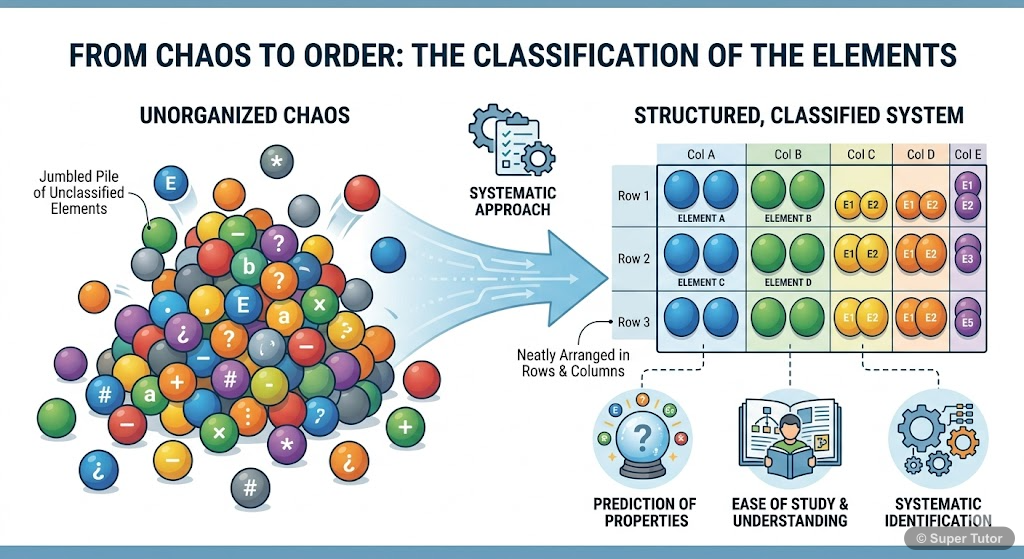
Learn better with visuals Super Tutor pairs illustrations like this with notes and quizzes for Classification of Elements and Periodicity in Properties.
Key Topics to Revise
Historical Development of the Periodic Table
- In 1800, only 31 elements were known; today 118 elements have been discovered.
- Johann Döbereiner (1829): Law of Triads – groups of three elements where the middle element's atomic weight is roughly the average of the other two, and its properties are intermediate. Examples: Li-N
- A.E.B. de Chancourtois (1862): Arranged elements in order of increasing atomic weights on a cylinder (helical arrangement).
Modern Periodic Table – Structure and Organisation
- The modern Periodic Table (long form) has 7 horizontal rows called Periods and 18 vertical columns called Groups.
- Groups are numbered 1 to 18 as per IUPAC 1984 recommendation (replacing IA–VIIA, VIII, IB–VIIB, 0).
- Period number = highest principal quantum number (n) of elements in that period.
IUPAC Nomenclature of Elements with Z > 100
- IUPAC provides a systematic temporary naming system for newly discovered elements with Z > 100.
- Numerical roots are used: 0=nil, 1=un, 2=bi, 3=tri, 4=quad, 5=pent, 6=hex, 7=sept, 8=oct, 9=enn.
- The suffix 'ium' is added at the end of the combined roots.
Electronic Configurations and Blocks of Elements
- The position of an element in the Periodic Table directly reflects the quantum numbers of the last orbital filled.
- s-Block Elements: Groups 1 and 2 (ns¹ and ns²). Alkali metals and Alkaline earth metals. Highly reactive metals. Low ionization enthalpies. React vigorously with water. Example: Na, K, Mg, Ca.
- p-Block Elements: Groups 13 to 18 (ns²np¹ to ns²np⁶). Includes metals, non-metals, and metalloids. Noble gases have completely filled orbitals (ns²np⁶) – very low reactivity.
Get complete notes with diagrams and examples
Full NotesKey Concepts
Frequently Asked Questions
What are the important topics in Classification of Elements and Periodicity in Properties for Punjab Board Class 11 Chemistry?
How should I revise Classification of Elements and Periodicity in Properties for Class 11 exams?
Sources & Official References
Content is aligned to the official syllabus. Refer to the board website for the latest curriculum.
More resources for Classification of Elements and Periodicity in Properties
For serious students
Get the full Classification of Elements and Periodicity in Properties chapter — start free.
Quizzes, flashcards, an AI doubt solver and a study plan for Punjab Board Class 11 Chemistry. Free to start, no card needed.