Chapter 4 of 5
Concept Maps
The d-and f-Block Elements — Concept Maps
Punjab Board · Class 12 · Chemistry
3 concept maps of The d-and f-Block Elements for Punjab Board Class 12 Chemistry, each also written out as a text outline.
45 questions35 flashcards5 concepts
Interactive on Super Tutor
Studying The d-and f-Block Elements? Get the full interactive chapter.
Quizzes, flashcards, AI doubt-solver and a step-by-step study plan — built for concept maps and more.
Free trial, no card needed.
Super Tutor
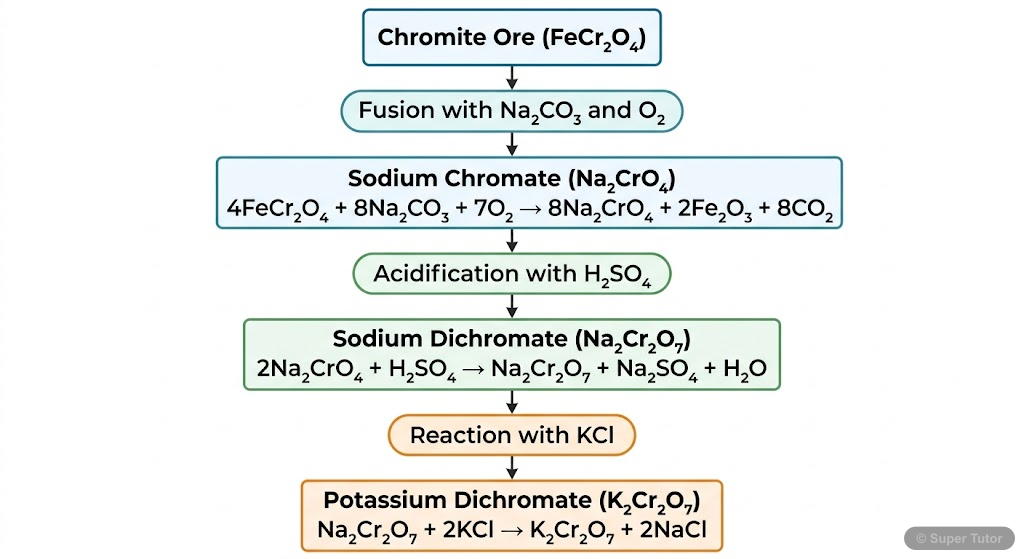
One of 4 illustrations for The d-and f-Block Elements in Super Tutor — alongside flashcards, concept maps and practice questions.
3 Concept Maps
d-Block and f-Block Elements: Comprehensive Overview
The map in words
- d and f-Block Elements
- d-Block Elements
- Position in Periodic Table
- Groups 3-12
- Between s and p-blocks
- Electronic Configuration
- (n-1)d1-10 ns1-2
- Anomalies Cr Cu
- General Characteristics
- High melting/boiling points
- Hard and dense
- Variable oxidation states
- Colored ions
- Magnetic properties
- First Transition Series
- Sc to Zn
- Physical properties
- Ionization trends
- Electrode potentials
- Important Compounds
- K2Cr2O7
- Preparation
- Redox reactions
- Strong oxidizer
- KMnO4
- Preparation
- Reduction products
- Oxidation reactions
- K2Cr2O7
- Position in Periodic Table
- f-Block Elements
- Lanthanoids
- Electronic configuration
- 4f orbitals filled
- +3 oxidation state
- Lanthanoid contraction
- Colored ions
- Applications
- Actinoids
- Electronic configuration
- 5f orbitals filled
- Wide oxidation states
- Radioactive
- Actinoid contraction
- Inner Transition Elements
- 14 elements each
- Similar properties
- Lanthanoid vs Actinoid
- Ions and sizes
- Lanthanoids
- d-Block Elements
Complete Overview of d- and f-Block Elements
The map in words
- d and f Block Elements
- d-Block Transition Metals
- Position in Periodic Table
- Groups 3 to 12
- 4 Series: 3d 4d 5d 6d
- Electronic Configuration
- General: n-1 d1-10 ns1-2
- Exceptions
- Cr: 3d5 4s1
- Cu: 3d10 4s1
- Physical Properties
- High melting point
- High enthalpy of atomisation
- Lanthanoid contraction effect on radii
- Chemical Properties
- Variable Oxidation States
- Coloured Ions d-d transition
- Magnetic Properties spin-only formula
- Complex Formation
- Catalytic Activity
- Interstitial Compounds
- Alloy Formation
- Important Compounds
- K2Cr2O7 Potassium Dichromate
- Chromate to Dichromate equilibrium
- Strong oxidising agent
- Primary Standard
- KMnO4 Potassium Permanganate
- Purple black crystals
- Oxidises in 3 media
- NOT a primary standard
- K2Cr2O7 Potassium Dichromate
- Position in Periodic Table
- f-Block Inner Transition Metals
- Lanthanoids Ce to Lu
- Configuration: 4f1-14 5d0-1 6s2
- Ln3+ most stable
- Lanthanoid Contraction
- Cause: poor 4f shielding
- Effect: Zr and Hf same size
- Special oxidation states
- Ce4+ f0 oxidant
- Eu2+ f7 reductant
- Uses: Mischmetall alloy
- Actinoids Th to Lr
- All radioactive
- 5f electrons participate in bonding
- Wide oxidation states +3 to +7
- Actinoid Contraction
- Greater than lanthanoid contraction
- Early actinoids like d-block
- Later actinoids like lanthanoids
- Lanthanoids Ce to Lu
- d-Block Transition Metals
D-Block Elements: Properties and Characteristics
The map in words
- D-Block Elements
- Physical Properties
- High melting points
- High boiling points
- Hard and durable
- Metallic luster
- Good conductors
- Electronic Configuration
- (n-1)d¹⁻¹⁰ns¹⁻²
- Exception: Cr, Cu
- Variable d-electrons
- Available orbitals
- Chemical Properties
- Variable oxidation states
- Form colored ions
- Complex formation
- Catalytic activity
- Paramagnetic behavior
- Oxidation States
- +2 to +7 range
- Differs by unity
- Maximum near Mn
- Stabilized by O and F
- Size and Trends
- Decrease in series
- Similar within group
- Lanthanoid contraction
- Affects 5d series
- Ionization Energy
- Increase across series
- Irregular pattern
- d⁵ stability breaks
- Exchange energy effect
- Applications
- Steel production
- Catalysts
- Pigments
- Batteries
- Alloys
- Physical Properties
Explore these maps interactively
Explore DiagramsFrequently Asked Questions
What are the important topics in The d-and f-Block Elements for Punjab Board Class 12 Chemistry?
Key topics in The d-and f-Block Elements include Position in the Periodic Table and Electronic Configurations, General Physical Properties of 3d Transition Metals, Ionisation Enthalpies, Oxidation States of Transition Metals. Study these first, then practise questions on each for the Punjab Board Class 12 board exam.
What do the concept maps for The d-and f-Block Elements show?
The 3 maps show how the ideas in The d-and f-Block Elements connect: d-Block and f-Block Elements: Comprehensive Overview; Complete Overview of d- and f-Block Elements. Each map is also written out as an outline on this page.
How should I revise The d-and f-Block Elements for the Punjab Board Class 12 board exam?
Learn the core ideas first, then work through the 45 practice questions on The d-and f-Block Elements. Revise definitions regularly and use flashcards for quick recall before the exam.
Sources & Official References
Content is aligned to the official syllabus. Refer to the board website for the latest curriculum.
More resources for The d-and f-Block Elements
For serious students
Get the full The d-and f-Block Elements chapter — start free.
Quizzes, flashcards, an AI doubt solver and a study plan for Punjab Board Class 12 Chemistry. Free to start, no card needed.