The d-and f-Block Elements — Chapter Summary
Punjab Board · Class 12 · Chemistry
Summary of The d-and f-Block Elements for Punjab Board Class 12 Chemistry. Key concepts: D, General formula for d and Transition metals are defined.
Interactive on Super Tutor
Studying The d-and f-Block Elements? Get the full interactive chapter.
Quizzes, flashcards, AI doubt-solver and a step-by-step study plan — built for chapter summary and more.
Free trial, no card needed.
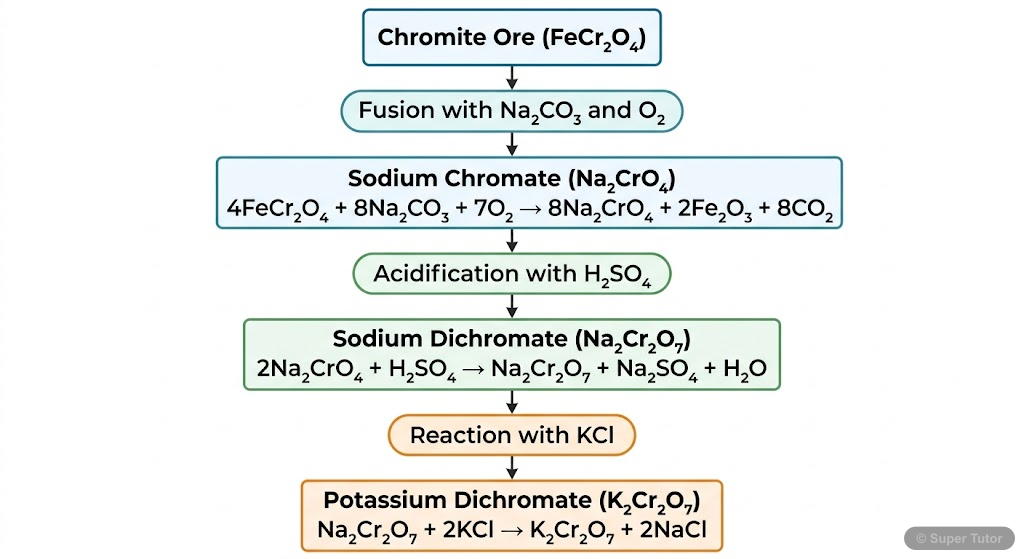
One of 4 illustrations for The d-and f-Block Elements in Super Tutor — alongside flashcards, concept maps and practice questions.
Overview
The d- and f-block elements represent a fascinating and diverse group of elements in the periodic table that exhibit unique chemical properties. These elements, known as transition metals and inner transition metals respectively, play crucial roles in chemistry, industry, and everyday life. From iro
Key Concepts
D
D-block elements occupy Groups 3-12 and are flanked between s- and p-blocks. Four series of transition metals exist: 3d (Sc to Zn), 4d (Y to Cd), 5d (
General formula for d
General formula for d-block: (n-1)d¹⁻¹⁰ns¹⁻². Notable exceptions include Cr ([Ar]3d⁵4s¹) and Cu ([Ar]3d¹⁰4s¹) due to extra stability of half-filled an
Transition metals are defined as metals
Transition metals are defined as metals with incomplete d-subshells in their neutral atoms or in their common oxidation states. This excludes Zn, Cd,
Transition metals show high melting
Transition metals show high melting and boiling points with maxima around the middle of each series (d⁵ or d⁶ configuration). Enthalpies of atomizatio
Within a series
Within a series, atomic and ionic radii decrease with increasing atomic number (increased nuclear charge, minimal shielding from d-electrons). Between
Learning Objectives
- Understand the positions of d- and f-block elements in the periodic table and their organization into series
- Learn the electronic configurations of transition elements and inner transition elements with special emphasis on filling patterns
- Appreciate the relative stability of various oxidation states using electrode potential values and thermochemical data
- Describe the preparation, properties, structures and uses of important compounds like K₂Cr₂O₇ and KMnO₄
- Understand general characteristics of d- and f-block elements including trends in physical and chemical properties
Frequently Asked Questions
What are the important topics in The d-and f-Block Elements for Punjab Board Class 12 Chemistry?
How should I revise The d-and f-Block Elements for the Punjab Board Class 12 board exam?
Sources & Official References
Content is aligned to the official syllabus. Refer to the board website for the latest curriculum.
More resources for The d-and f-Block Elements
For serious students
Get the full The d-and f-Block Elements chapter — start free.
Quizzes, flashcards, an AI doubt solver and a study plan for Punjab Board Class 12 Chemistry. Free to start, no card needed.