The d-and f-Block Elements — Syllabus
Punjab Board · Class 12 · Chemistry
What The d-and f-Block Elements covers in Punjab Board Class 12 Chemistry: 4 topics, for the 2026-27 session. Topics include Position in the Periodic.
Interactive on Super Tutor
Studying The d-and f-Block Elements? Get the full interactive chapter.
Quizzes, flashcards, AI doubt-solver and a step-by-step study plan — built for syllabus and more.
Free trial, no card needed.
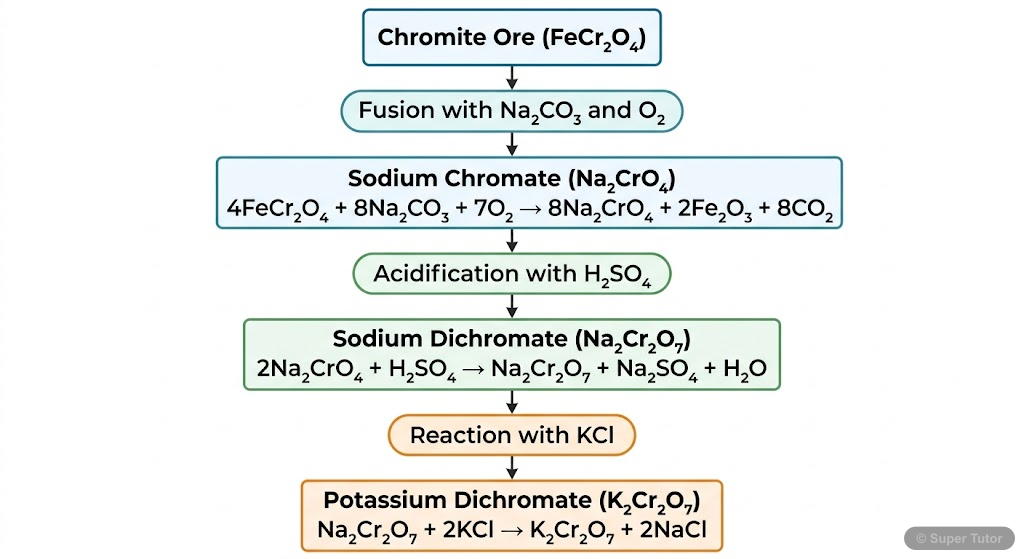
One of 4 illustrations for The d-and f-Block Elements in Super Tutor — alongside flashcards, concept maps and practice questions.
Topics in The d-and f-Block Elements
Position in the Periodic Table and Electronic Configurations
- The d-block occupies Groups 3–12 in the periodic table, placed between s-block and p-block.
- There are four series of transition metals: 3d (Sc to Zn), 4d (Y to Cd), 5d (La and Hf to Hg), and 6d (Ac and Rf to Cn).
- General electronic configuration: (n-1)d^(1-10) ns^(1-2), where n is the principal quantum number of the outermost shell.
General Physical Properties of 3d Transition Metals
- All transition metals are hard, strong, ductile, malleable and have high thermal and electrical conductivity (typical metallic properties).
- Exceptions to typical metallic structure: Zn, Cd, Hg, Mn.
- High melting and boiling points: attributed to strong interatomic bonding involving both ns and (n-1)d electrons. More unpaired electrons → stronger bonding.
Ionisation Enthalpies
- First ionisation enthalpy generally INCREASES across the 3d series due to increasing nuclear charge.
- The increase is much LESS steep compared to main group elements because d electrons provide somewhat effective shielding.
- 3d electrons shield the outer 4s electrons from increasing nuclear charge → atomic radii decrease slowly → ionisation enthalpies increase gradually.
Oxidation States of Transition Metals
- Transition metals show VARIABLE oxidation states — a characteristic property arising from incomplete d orbital filling.
- Oxidation states of d-block elements differ by unity (e.g., V shows +2, +3, +4, +5), unlike p-block where they differ by 2.
- The maximum oxidation state = total number of s + d electrons, achieved up to Mn: Ti(+4), V(+5), Cr(+6), Mn(+7).
Key Concepts
Work through every topic in The d-and f-Block Elements with notes and quizzes
Start This ChapterFrequently Asked Questions
What are the important topics in The d-and f-Block Elements for Punjab Board Class 12 Chemistry?
How should I revise The d-and f-Block Elements for the Punjab Board Class 12 board exam?
Sources & Official References
Content is aligned to the official syllabus. Refer to the board website for the latest curriculum.
More resources for The d-and f-Block Elements
For serious students
Get the full The d-and f-Block Elements chapter — start free.
Quizzes, flashcards, an AI doubt solver and a study plan for Punjab Board Class 12 Chemistry. Free to start, no card needed.