The d-and f-Block Elements — Flashcards
Punjab Board · Class 12 · Chemistry
35 flashcards for The d-and f-Block Elements (Punjab Board Class 12 Chemistry) to test yourself on key terms and facts.
Interactive on Super Tutor
Studying The d-and f-Block Elements? Get the full interactive chapter.
Quizzes, flashcards, AI doubt-solver and a step-by-step study plan — built for flashcards and more.
Free trial, no card needed.
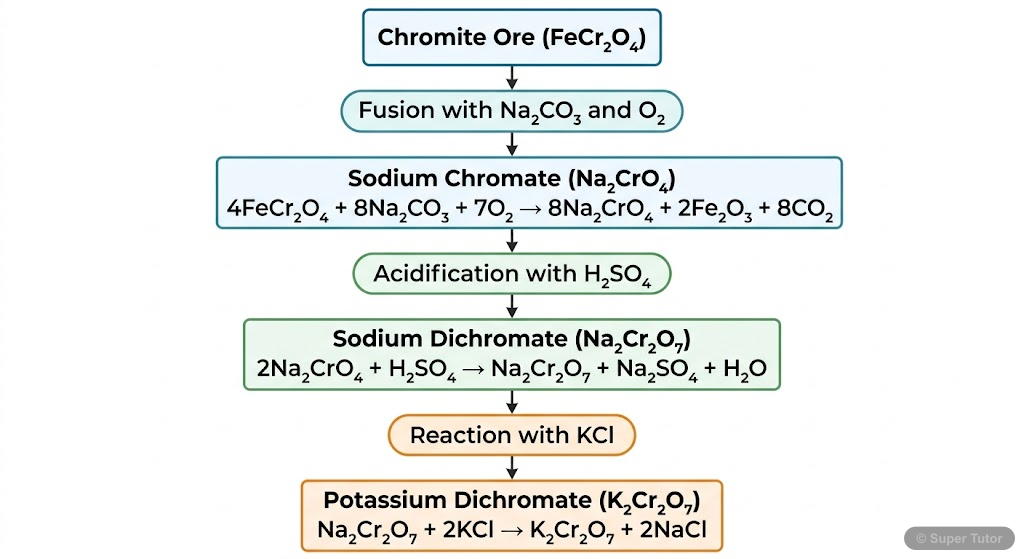
One of 4 illustrations for The d-and f-Block Elements in Super Tutor — alongside flashcards, concept maps and practice questions.
What is the general electronic configuration of d-block transition elements?
Answer
(n-1)d¹⁻¹⁰ns¹⁻² where (n-1) represents the inner d orbitals with 1-10 electrons and ns represents the outermost orbital with 1-2 electrons. Exception: Palladium has configuration [Kr]4d¹⁰5s⁰. This par…
Why is Chromium (Cr) written as [Ar]3d⁵4s¹ instead of [Ar]3d⁴4s²?
Answer
Chromium exhibits anomalous electronic configuration because of the extra stability of half-filled d orbitals (d⁵). The energy gap between 3d and 4s orbitals is small enough that one electron from 4s …
Why is Zinc (Zn) not considered a true transition element despite being in the d-block?
Answer
Zinc is not classified as a true transition element because it has a completely filled d¹⁰ configuration ([Ar]3d¹⁰4s²) in its ground state and all common oxidation states. According to IUPAC definitio…
Calculate the magnetic moment (μ) of Fe²⁺ ion using spin-only formula if it has 4 unpaired electrons.
Answer
Formula: μ = √[n(n+2)] where n = number of unpaired electrons Step 1: Identify n = 4 unpaired electrons in Fe²⁺ (d⁶ configuration) Step 2: μ = √[4(4+2)] = √[4×6] = √24 = 4.90 BM Answer: 4.90 Bohr magn…
What is the 'spin-only' formula for magnetic moment and what does it calculate?
Answer
Formula: μ = √[n(n+2)] where μ is magnetic moment in Bohr magnetons (BM) and n is the number of unpaired electrons. This formula calculates the magnetic moment arising solely from the spin angular mom…
Write the balanced equation for the preparation of potassium dichromate from chromite ore using fusion method.
Answer
4FeCr₂O₄(s) + 8Na₂CO₃(s) + 7O₂(g) → 8Na₂CrO₄(aq) + 2Fe₂O₃(s) + 8CO₂(g) This is the fusion reaction where chromite ore reacts with sodium carbonate in free access of air. This produces yellow sodium c…
Write the conversion reaction between chromate and dichromate ions in acidic and basic conditions.
Answer
Acidic Condition (formation of dichromate): 2CrO₄²⁻(aq) + 2H⁺(aq) → Cr₂O₇²⁻(aq) + H₂O(l) Basic Condition (formation of chromate): Cr₂O₇²⁻(aq) + 2OH⁻(aq) → 2CrO₄²⁻(aq) + H₂O(l) Both CrO₄²⁻ and Cr₂O₇²…
What is the standard electrode potential (E°) for the reduction of dichromate ion in acidic solution and what does it oxidize?
Answer
Half-reaction: Cr₂O₇²⁻(aq) + 14H⁺(aq) + 6e⁻ → 2Cr³⁺(aq) + 7H₂O(l) E° = +1.33 V With such a positive E° value, acidified K₂Cr₂O₇ is a strong oxidizing agent. It oxidizes: - Iodides (I⁻) to iodine (I₂)…
+27 more flashcards
Practise AllFrequently Asked Questions
What are the important topics in The d-and f-Block Elements for Punjab Board Class 12 Chemistry?
How many flashcards are available for The d-and f-Block Elements?
How should I revise The d-and f-Block Elements for the Punjab Board Class 12 board exam?
Sources & Official References
Content is aligned to the official syllabus. Refer to the board website for the latest curriculum.
More resources for The d-and f-Block Elements
For serious students
Get the full The d-and f-Block Elements chapter — start free.
Quizzes, flashcards, an AI doubt solver and a study plan for Punjab Board Class 12 Chemistry. Free to start, no card needed.