Solutions
Punjab Board · Class 12 · Chemistry
Most important questions from Solutions for Punjab Board Class 12 Chemistry board exam 2026. MCQs, short answer, and long answer questions with marks.
Interactive on Super Tutor
Studying Solutions? Get the full interactive chapter.
Quizzes, flashcards, AI doubt-solver and a step-by-step study plan — built for important questions and more.
1,000+ Class 12 students started this chapter today
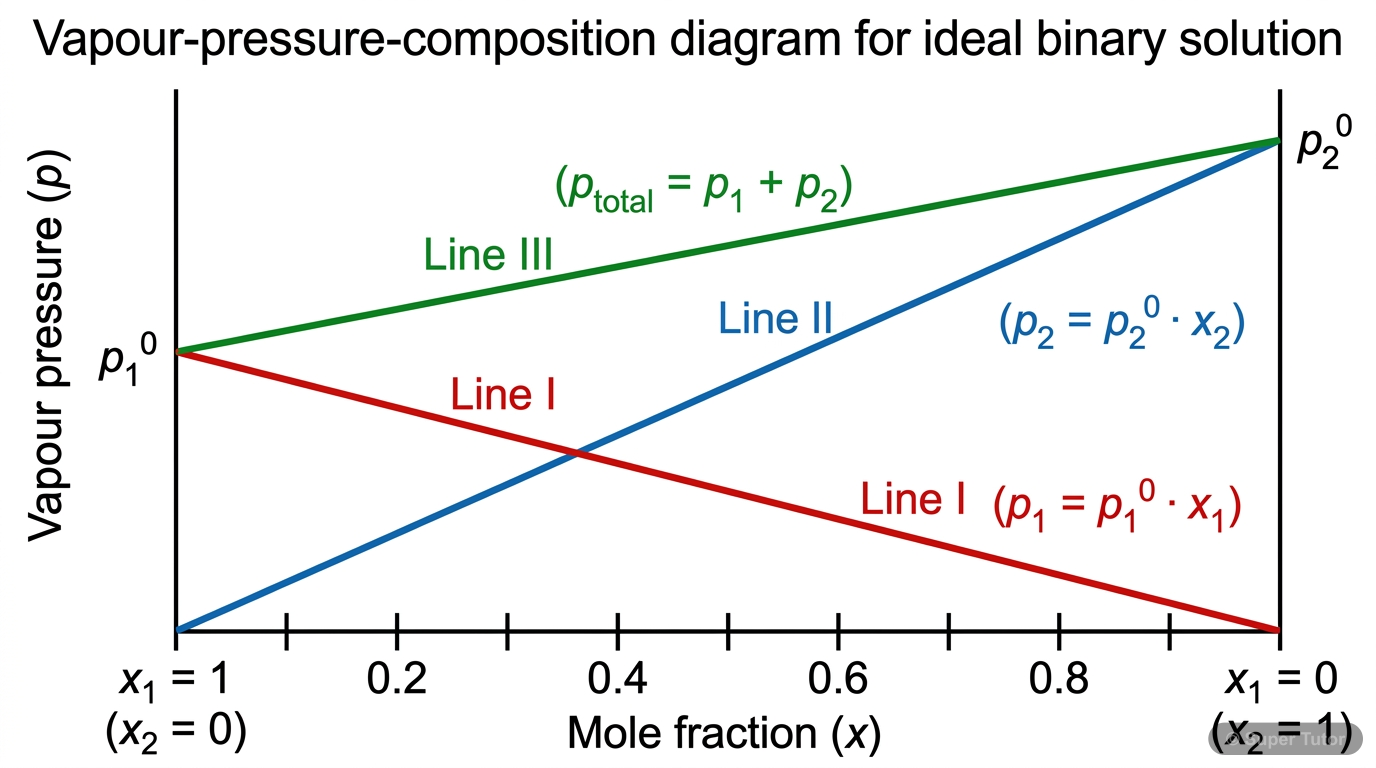
Super Tutor has 5+ illustrations like this for Solutions alone — flashcards, concept maps, and step-by-step visuals.
See them allSample Questions
Soft drink bottles are sealed under high pressure of CO₂ to:
Show answer
Increase the solubility of CO₂ in the drink
Step 1: According to Henry's law, the solubility of a gas in a liquid is directly proportional to the partial pressure of the gas above the liquid. Step 2: By sealing the bottle under high pressure of CO₂, the partial pressure of CO₂ above the liquid is increased. Step 3: This increases the solubility of CO₂ in the drink, keeping more gas dissolved and making the drink fizzy. Step 4: When the bottle is opened, pressure drops, CO₂ escapes as bubbles. Step 5: This is a direct application of Henry's law in everyday life.
According to Raoult's law, the partial vapour pressure of a component in a solution is:
Show answer
Directly proportional to its mole fraction in solution
Step 1: Raoult's law states: p₁ = x₁ × p₁⁰, where p₁ is partial vapour pressure, x₁ is mole fraction, and p₁⁰ is vapour pressure of pure component. Step 2: Since p₁⁰ is a constant at a given temperature, p₁ is directly proportional to x₁ (mole fraction). Step 3: It is NOT equal to pure component vapour pressure because x₁ is always less than 1 in a solution. Step 4: 'Inversely proportional' is incorrect — more moles means more vapour pressure, not less. Step 5: It is definitely not independent of mole fraction, as the equation clearly shows a direct relationship.
When a non-volatile solute is added to a pure solvent, the vapour pressure of the solution compared to the pure solvent is:
Show answer
Lower
Step 1: In a pure liquid, the entire surface is occupied by solvent molecules that can evaporate freely. Step 2: When a non-volatile solute is added, some surface is now occupied by solute molecules. Step 3: This reduces the fraction of the surface available to solvent molecules, so fewer solvent molecules escape into the vapour phase. Step 4: As a result, the vapour pressure of the solution is lower than that of the pure solvent. Step 5: This is the basic principle behind relative lowering of vapour pressure, which is a colligative property.
Which of the following is NOT a colligative property?
Show answer
Optical rotation
Step 1: Colligative properties depend only on the number of solute particles in solution, not on their nature (identity). Step 2: The four colligative properties are: (1) Relative lowering of vapour pressure, (2) Elevation of boiling point, (3) Depression of freezing point, and (4) Osmotic pressure. Step 3: Optical rotation is a physical property that depends on the nature (structure) of the solute, specifically chiral molecules. Step 4: It is not related to the number of solute particles, so it is NOT a colligative property. Step 5: The other three options — elevation of boiling point, depres
+41 more questions available
Practice AllFrequently Asked Questions
What are the important topics in Solutions for Punjab Board Class 12 Chemistry?
How to score full marks in Solutions — Punjab Board Class 12 Chemistry?
How many important questions are there in Solutions?
Sources & Official References
Content is aligned to the official syllabus. Refer to the board website for the latest curriculum.
More resources for Solutions
Practice Quiz
Test yourself with a quick quiz
Revision Notes
Key points for last-minute revision
Formula Sheet
All formulas in one place
Chapter Summary
Understand the chapter at a glance
Concept Maps
See how topics connect visually
Study Plan
Step-by-step plan to ace this chapter
Flashcards
Quick-fire cards for active recall
Syllabus
What topics to cover
NCERT Solutions
Every textbook question solved step by step
For serious students
Get the full Solutions chapter — for free.
Quizzes, flashcards, AI doubt-solver and a step-by-step study plan for Punjab Board Class 12 Chemistry.