Solutions — Chapter Summary
Punjab Board · Class 12 · Chemistry
Summary of Solutions for Punjab Board Class 12 Chemistry. Part of the Punjab Board Class 12 Chemistry syllabus.
Interactive on Super Tutor
Studying Solutions? Get the full interactive chapter.
Quizzes, flashcards, AI doubt-solver and a step-by-step study plan — built for chapter summary and more.
Free trial, no card needed.
An illustration from Super Tutor's Solutions chapter — alongside flashcards, concept maps and practice questions.
Overview
Solutions are homogeneous mixtures that form the basis of chemistry in daily life and industry. From the air we breathe to the medicines we consume, solutions are everywhere. This chapter explores how solutions form, how we express their concentration, and the fascinating properties they exhibit. Un
Key Concepts
Solutions are classified based on
Solutions are classified based on the physical states of solute and solvent. There are nine possible combinations: gas-gas (air), gas-liquid (oxygen i
Concentration can be expressed using multiple
Concentration can be expressed using multiple units: (1) Mass percentage: mass of component divided by total mass × 100; (2) Volume percentage: volume
Henry's law states that the partial
Henry's law states that the partial pressure of a gas above a solution is directly proportional to its mole fraction in the solution: p = KH × x. The
Raoult's law states that the partial
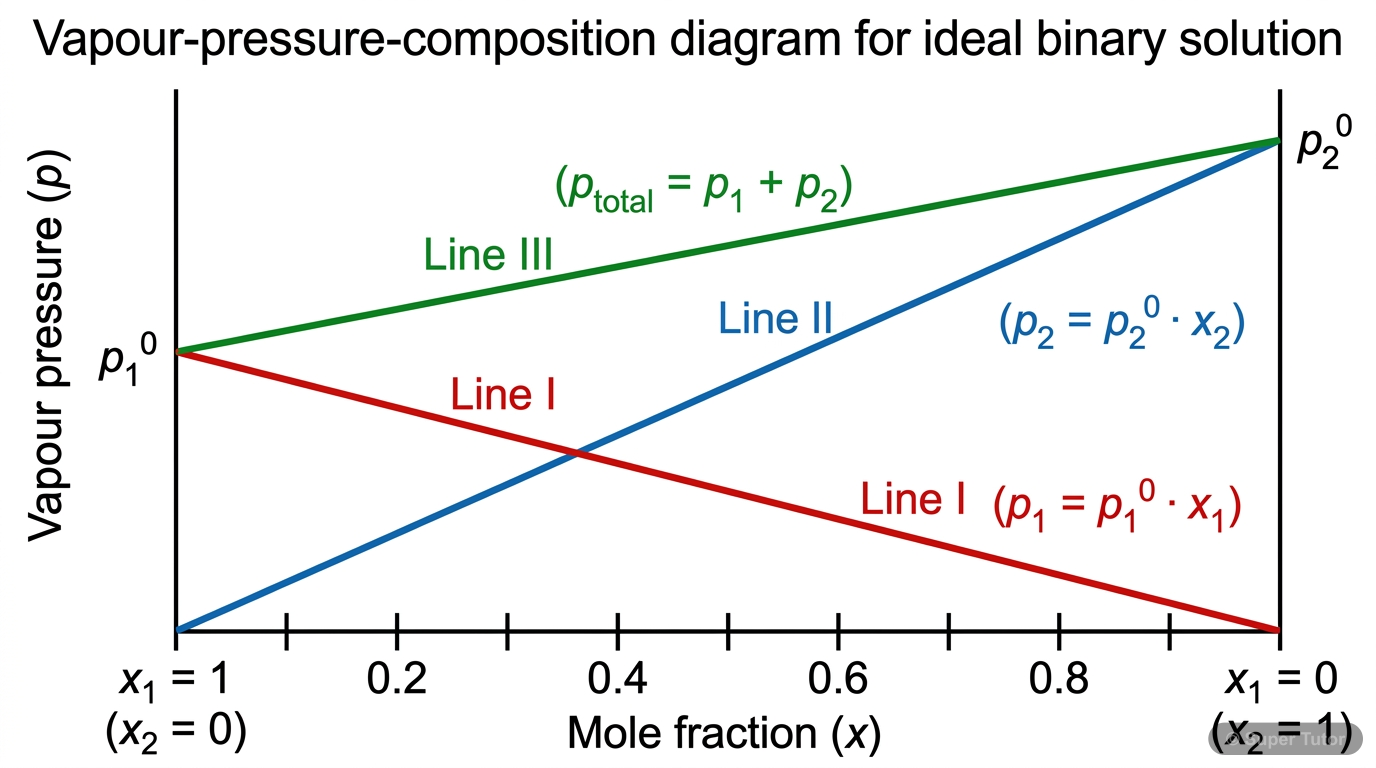
Raoult's law states that the partial vapour pressure of each volatile component is directly proportional to its mole fraction: p₁ = p₁⁰ × x₁. Total pr
Ideal solutions obey Raoult's law completely
Ideal solutions obey Raoult's law completely and have ΔmixH = 0 and ΔmixV = 0. This occurs when A-A and B-B interactions are similar to A-B interactio
Learning Objectives
- Describe the formation of different types of solutions and classify them based on solute and solvent states
- Express concentration of solutions using various units: mass percentage, volume percentage, ppm, mole fraction, molarity, and molality
- Apply Henry's law to calculate gas solubility and understand its real-world applications
- Apply Raoult's law to predict vapour pressure of solutions and distinguish between ideal and non-ideal solutions
- Explain colligative properties (vapour pressure lowering, boiling point elevation, freezing point depression, osmotic pressure) and use them to determine molar masses
Frequently Asked Questions
What are the important topics in Solutions for Punjab Board Class 12 Chemistry?
How should I revise Solutions for the Punjab Board Class 12 board exam?
Sources & Official References
Content is aligned to the official syllabus. Refer to the board website for the latest curriculum.
More resources for Solutions
For serious students
Get the full Solutions chapter — start free.
Quizzes, flashcards, an AI doubt solver and a study plan for Punjab Board Class 12 Chemistry. Free to start, no card needed.