Chapter 1 of 5
Revision Notes
Solutions — Revision Notes
Punjab Board · Class 12 · Chemistry
Solutions revision notes for Punjab Board Class 12 Chemistry: 4 topics in quick points. Part of the Punjab Board Class 12 Chemistry syllabus.
45 questions36 flashcards5 formulas & key relations5 concepts
Interactive on Super Tutor
Studying Solutions? Get the full interactive chapter.
Quizzes, flashcards, AI doubt-solver and a step-by-step study plan — built for revision notes and more.
Free trial, no card needed.
Super Tutor
An illustration from Super Tutor's Solutions chapter — alongside flashcards, concept maps and practice questions.
Key Topics to Revise
1
1. Types of Solutions
- A solution is a homogeneous mixture of two or more components.
- The component present in the largest quantity is the SOLVENT; it determines the physical state of the solution.
- Components other than the solvent are called SOLUTES.
2
2. Expressing Concentration of Solutions
- Concentration tells us how much solute is present in a given amount of solution or solvent.
- There are 7 main methods: Mass %, Volume %, Mass by Volume %, ppm, Mole Fraction, Molarity, Molality.
- TEMPERATURE INDEPENDENT units: Mass %, Volume %, ppm, Mole Fraction, Molality.
3
3. Solubility – Solids and Gases in Liquids
- Solubility = maximum amount of solute that dissolves in a specified amount of solvent at a given temperature and pressure.
- LIKE DISSOLVES LIKE: Polar solutes dissolve in polar solvents; non-polar in non-polar.
- NaCl and sugar dissolve in water (polar–polar); naphthalene dissolves in benzene (non-polar–non-polar).
4
4. Vapour Pressure of Liquid Solutions and Raoult's Law
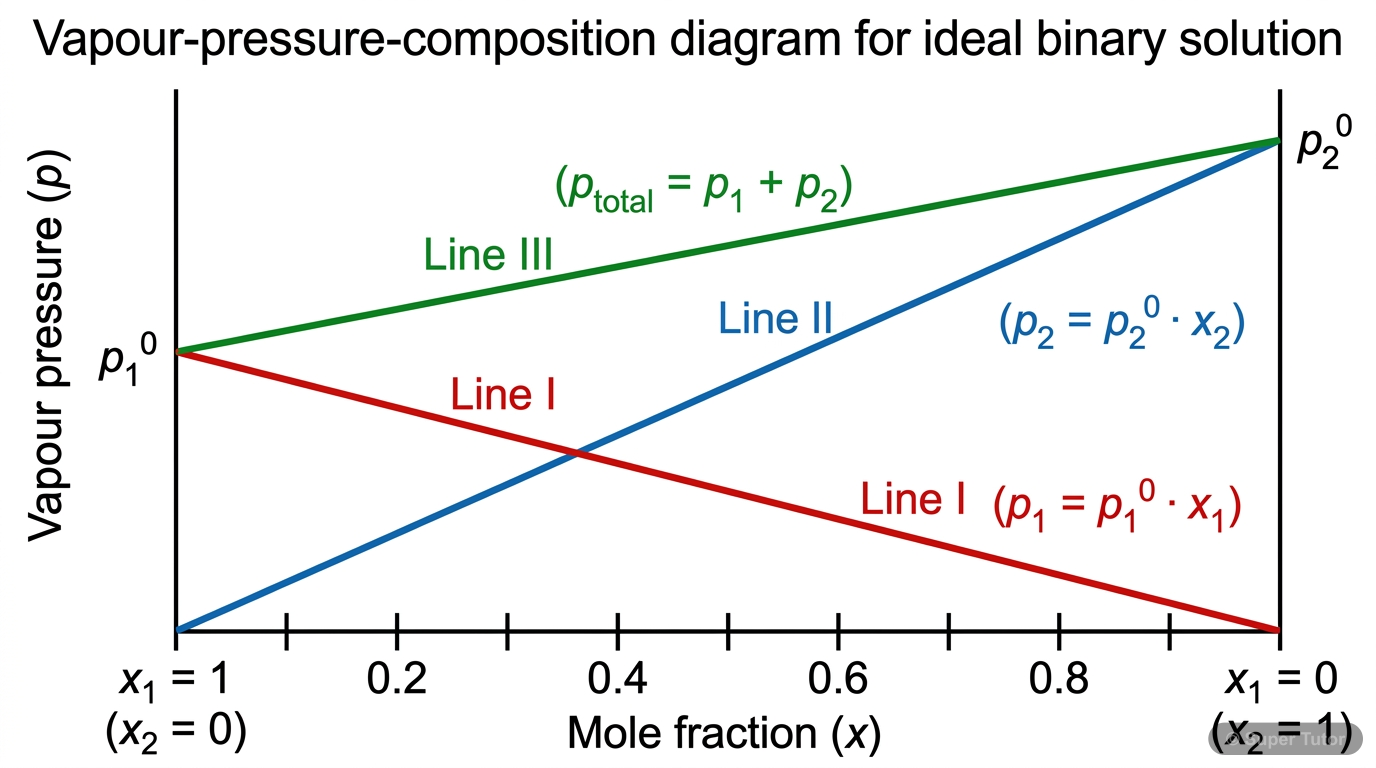
- Raoult's Law for volatile liquid-liquid solutions: partial vapour pressure of each component is directly proportional to its mole fraction.
- p1 = p°1 × x1 and p2 = p°2 × x2.
- Total pressure by Dalton's law: p_total = p1 + p2 = p°1×x1 + p°2×x2.
Get complete notes with diagrams and examples
Full NotesKey Concepts
Solutions are classified based onConcentration can be expressed using multipleHenry's law states that the partialRaoult's law states that the partialIdeal solutions obey Raoult's law completely
Frequently Asked Questions
What are the important topics in Solutions for Punjab Board Class 12 Chemistry?
Key topics in Solutions include Types of Solutions, Expressing Concentration of Solutions, Solubility – Solids and Gases in Liquids, Vapour Pressure of Liquid Solutions and Raoult's Law. Study these first, then practise questions on each for the Punjab Board Class 12 board exam.
How should I revise Solutions for the Punjab Board Class 12 board exam?
Learn the core ideas first, then work through the 45 practice questions on Solutions. Revise definitions regularly and use flashcards for quick recall before the exam.
Sources & Official References
Content is aligned to the official syllabus. Refer to the board website for the latest curriculum.
More resources for Solutions
For serious students
Get the full Solutions chapter — start free.
Quizzes, flashcards, an AI doubt solver and a study plan for Punjab Board Class 12 Chemistry. Free to start, no card needed.