Solutions — Flashcards
Punjab Board · Class 12 · Chemistry
36 flashcards for Solutions (Punjab Board Class 12 Chemistry) to test yourself on key terms and facts. Sample: "Define a solution and explain what"
Interactive on Super Tutor
Studying Solutions? Get the full interactive chapter.
Quizzes, flashcards, AI doubt-solver and a step-by-step study plan — built for flashcards and more.
Free trial, no card needed.
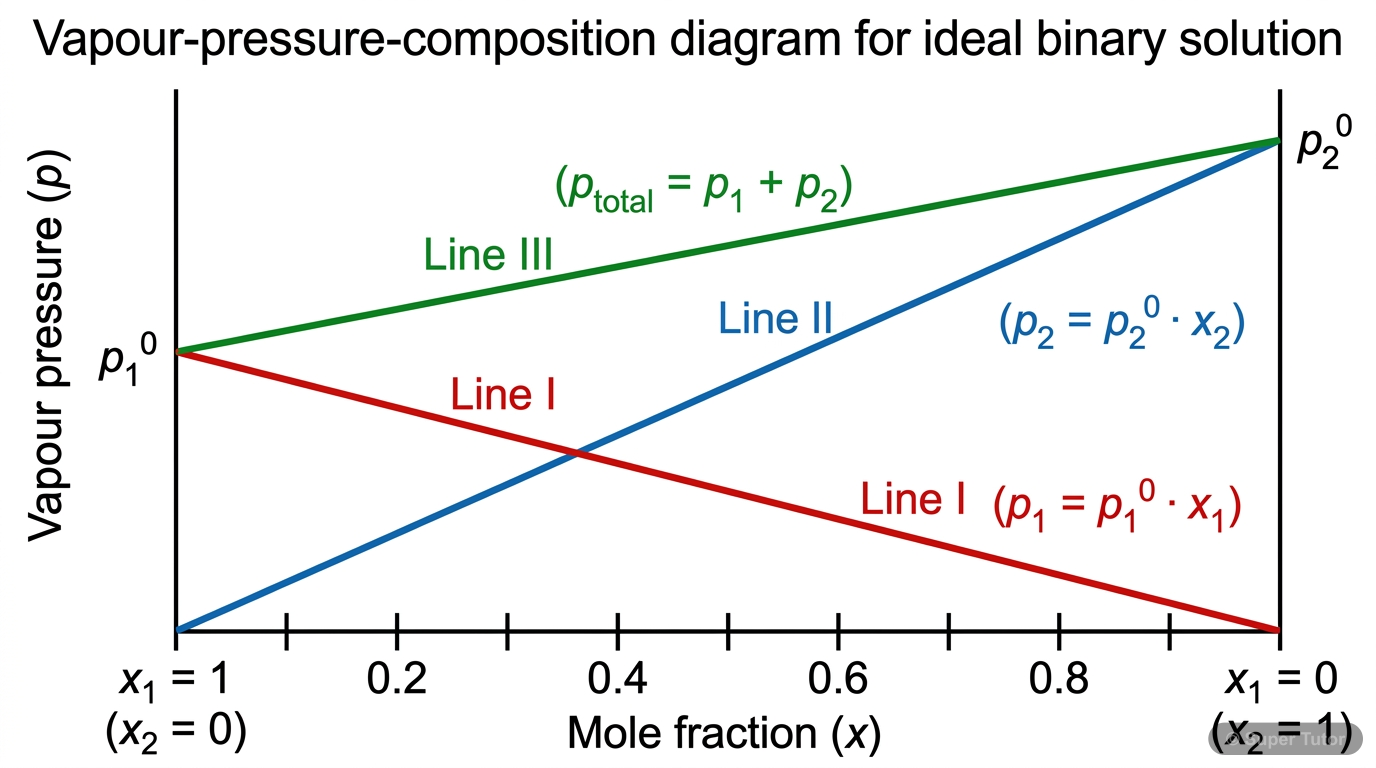
An illustration from Super Tutor's Solutions chapter — alongside flashcards, concept maps and practice questions.
Define a solution and explain what homogeneous mixture means.
Answer
A solution is a homogeneous mixture of two or more components that has uniform composition and properties throughout. The component present in the largest quantity is the solvent, and components prese…
What are the six main types of solutions based on the physical states of solute and solvent?
Answer
The six types are: 1) Gas in gas (N₂ and O₂ mixture), 2) Gas in liquid (O₂ in water), 3) Liquid in liquid (ethanol in water), 4) Solid in liquid (glucose in water), 5) Liquid in solid (mercury in sodi…
Calculate the mass percentage of glucose if 20g of glucose is dissolved in 80g of water.
Answer
Mass % = (mass of solute / total mass of solution) × 100. Step 1: Total mass = 20g + 80g = 100g. Step 2: Mass % of glucose = (20g / 100g) × 100 = 20%. Step 3: Mass % of water = (80g / 100g) × 100 = 80…
What is mole fraction? Calculate the mole fraction of ethanol in a solution containing 46g of ethanol (C₂H₆O) and 90g of water (H₂O).
Answer
Mole fraction (x) = moles of component / total moles of all components. Step 1: Molar mass of C₂H₆O = 46 g/mol, H₂O = 18 g/mol. Step 2: Moles of ethanol = 46/46 = 1 mol. Step 3: Moles of water = 90/18…
Calculate the molarity of a solution containing 5.85g of NaCl dissolved in 500 mL of solution. (Molar mass of NaCl = 58.5 g/mol)
Answer
Molarity (M) = moles of solute / volume of solution in liters. Step 1: Moles of NaCl = 5.85g / 58.5 g/mol = 0.1 mol. Step 2: Volume = 500 mL = 0.5 L. Step 3: Molarity = 0.1 mol / 0.5 L = 0.2 M. Answer…
What is molality? Calculate the molality of 2.5g of acetic acid (CH₃COOH) dissolved in 75g of benzene.
Answer
Molality (m) = moles of solute / mass of solvent in kilograms. Step 1: Molar mass of C₂H₄O₂ = 60 g/mol. Step 2: Moles of acetic acid = 2.5g / 60 g/mol = 0.0417 mol. Step 3: Mass of benzene = 75g / 100…
What does Henry's Law state? Write the mathematical expression and explain the constants.
Answer
Henry's Law: The partial pressure of a gas in vapor phase is proportional to the mole fraction of the gas in the solution. Mathematical expression: p = K_H × x. Where: p = partial pressure of gas, K_H…
N₂ gas is bubbled through water at 293K. If N₂ exerts a partial pressure of 0.987 bar and K_H for N₂ = 76.48 kbar, how many millimoles of N₂ dissolve in 1 litre of water?
Answer
Step 1: Apply Henry's Law: x(N₂) = p / K_H = 0.987 bar / 76,480 bar = 1.29 × 10⁻⁵. Step 2: For 1 litre of water, moles of water = 55.5 mol. Step 3: x(N₂) = n(N₂) / (n(N₂) + 55.5) ≈ n(N₂) / 55.5 (since…
+28 more flashcards
Practise AllFrequently Asked Questions
What are the important topics in Solutions for Punjab Board Class 12 Chemistry?
How many flashcards are available for Solutions?
How should I revise Solutions for the Punjab Board Class 12 board exam?
Sources & Official References
Content is aligned to the official syllabus. Refer to the board website for the latest curriculum.
More resources for Solutions
Practice Quiz
Test yourself with a quick quiz
Important Questions
Exam-style questions with answers
Revision Notes
Key points for last-minute revision
Formula Sheet
The chapter's formulas in one place
Chapter Summary
Understand the chapter at a glance
Concept Maps
See how topics connect
Syllabus
What topics to cover
For serious students
Get the full Solutions chapter — start free.
Quizzes, flashcards, an AI doubt solver and a study plan for Punjab Board Class 12 Chemistry. Free to start, no card needed.