The d-and f-Block Elements
Punjab Board · Class 12 · Chemistry
Most important questions from The d-and f-Block Elements for Punjab Board Class 12 Chemistry board exam 2026. MCQs, short answer, and long answer questions with marks.
Interactive on Super Tutor
Studying The d-and f-Block Elements? Get the full interactive chapter.
Quizzes, flashcards, AI doubt-solver and a step-by-step study plan — built for important questions and more.
1,000+ Class 12 students started this chapter today
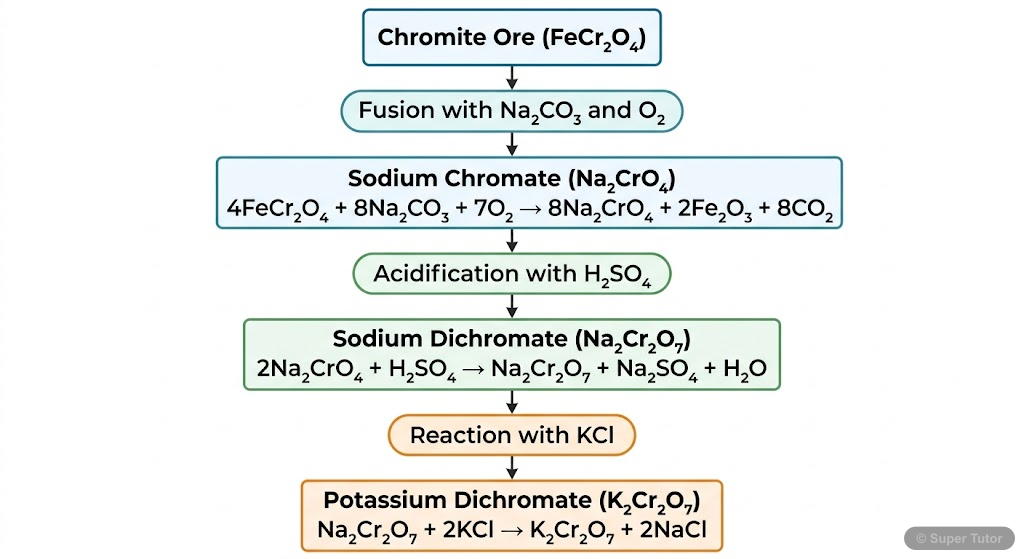
Super Tutor has 5+ illustrations like this for The d-and f-Block Elements alone — flashcards, concept maps, and step-by-step visuals.
See them allSample Questions
Why do transition metal ions appear coloured in aqueous solution?
Show answer
Due to d-d transitions where electrons absorb light from the visible region
Step 1: In transition metal ions, d orbitals are split into two energy levels when surrounded by ligands like water (this is explained by Crystal Field Theory). Step 2: An electron from a lower energy d orbital absorbs energy and gets excited to a higher energy d orbital. This is called a d-d transition. Step 3: The energy required for this transition corresponds to the frequency of visible light (wavelength ~400–700 nm). Step 4: The colour we observe is the complementary colour of the light absorbed. For example, Cu²⁺ absorbs red light and appears blue. Step 5: Ions like Sc³⁺ (3d⁰) and Zn²⁺ (
Potassium dichromate (K₂Cr₂O₇) is prepared from chromite ore (FeCr₂O₄). In the first step of its preparation, chromite ore is fused with Na₂CO₃ in the presence of air. What is the product formed?
Show answer
Sodium chromate (Na₂CrO₄)
Step 1: The first step in preparing K₂Cr₂O₇ is the fusion of chromite ore with sodium carbonate in the presence of air (oxygen). Step 2: The balanced reaction is: 4FeCr₂O₄ + 8Na₂CO₃ + 7O₂ → 8Na₂CrO₄ + 2Fe₂O₃ + 8CO₂. Step 3: The product is yellow sodium chromate (Na₂CrO₄), not sodium dichromate. Sodium dichromate is formed in the next step when the solution is acidified with H₂SO₄. Step 4: The overall sequence is: Chromite ore → Na₂CrO₄ (by fusion with Na₂CO₃) → Na₂Cr₂O₇ (by acidification) → K₂Cr₂O₇ (by reaction with KCl). Step 5: Potassium chromate and chromic oxide are not the direct products
In acidic solution, which oxidation state does Mn reach when KMnO₄ acts as an oxidising agent?
Show answer
+2 (Mn forms Mn²⁺)
Step 1: KMnO₄ (potassium permanganate) is a strong oxidising agent. The behaviour of MnO₄⁻ depends on the pH (acidity) of the solution. Step 2: In acidic solution, the half-reaction is: MnO₄⁻ + 8H⁺ + 5e⁻ → Mn²⁺ + 4H₂O (E° = +1.52 V). Step 3: Mn goes from +7 oxidation state (in MnO₄⁻) to +2 oxidation state (in Mn²⁺), gaining 5 electrons. Step 4: In neutral or faintly alkaline solution, Mn is reduced to MnO₂ (+4 state). In strongly alkaline solution, Mn is reduced to MnO₄²⁻ (+6 state). Step 5: The change from +7 to +2 is specific to acidic conditions. The solution changes from purple/pink (MnO₄⁻
The phenomenon where the radii of the 5d transition series elements are nearly equal to those of the corresponding 4d series elements is called:
Show answer
Lanthanoid contraction
Step 1: As we move along the lanthanoid series (Ce to Lu), the 4f electrons are being added. These 4f electrons shield the outer electrons from the nuclear charge very poorly compared to d electrons. Step 2: This poor shielding causes the nuclear charge experienced by outer electrons to increase gradually, pulling the electron cloud inward. The result is a regular decrease in atomic and ionic radii across the lanthanoid series. Step 3: This cumulative decrease in size across 14 lanthanoid elements is called Lanthanoid Contraction. Step 4: Due to lanthanoid contraction, the 5d elements that com
+41 more questions available
Practice AllFrequently Asked Questions
What are the important topics in The d-and f-Block Elements for Punjab Board Class 12 Chemistry?
How to score full marks in The d-and f-Block Elements — Punjab Board Class 12 Chemistry?
How many important questions are there in The d-and f-Block Elements?
Sources & Official References
Content is aligned to the official syllabus. Refer to the board website for the latest curriculum.
More resources for The d-and f-Block Elements
Practice Quiz
Test yourself with a quick quiz
Revision Notes
Key points for last-minute revision
Formula Sheet
All formulas in one place
Chapter Summary
Understand the chapter at a glance
Concept Maps
See how topics connect visually
Study Plan
Step-by-step plan to ace this chapter
Flashcards
Quick-fire cards for active recall
Syllabus
What topics to cover
NCERT Solutions
Every textbook question solved step by step
For serious students
Get the full The d-and f-Block Elements chapter — for free.
Quizzes, flashcards, AI doubt-solver and a step-by-step study plan for Punjab Board Class 12 Chemistry.