Electrostatic Potential and Capacitance — Practice Quiz
Punjab Board · Class 12 · Physics
Try a 4-question quiz on Electrostatic Potential and Capacitance for Punjab Board Class 12 Physics: tap an answer to check it and see why.
Interactive on Super Tutor
Studying Electrostatic Potential and Capacitance? Get the full interactive chapter.
Quizzes, flashcards, AI doubt-solver and a step-by-step study plan — built for practice quiz and more.
Free trial, no card needed.
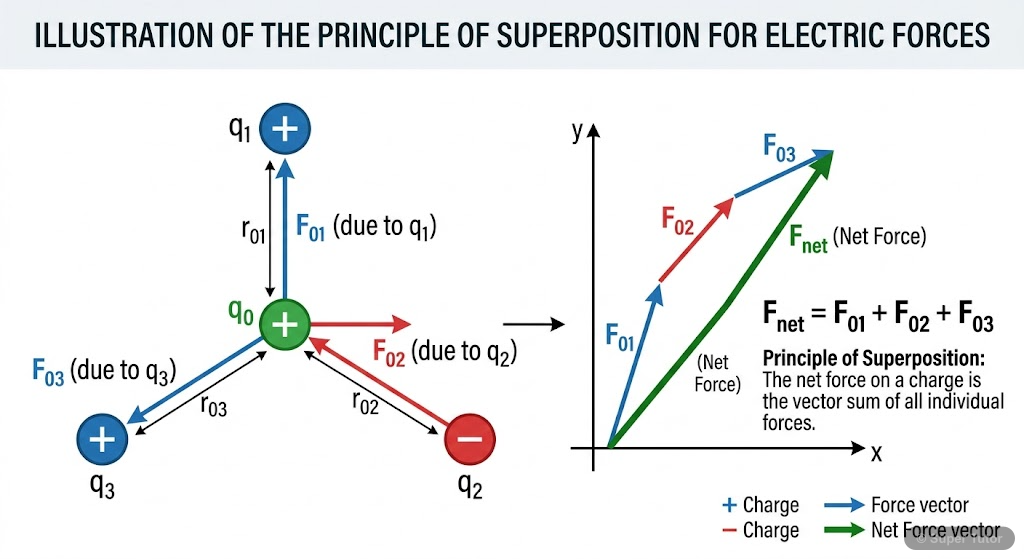
Learn better with visuals Super Tutor pairs illustrations like this with notes and quizzes for Electrostatic Potential and Capacitance.
Quick Quiz: Electrostatic Potential and Capacitance
0/4Tap an answer to check it instantly. No sign-up needed for these 4.
What is the SI unit of electrostatic potential?
A point charge Q = 4 × 10⁻⁷ C is placed at the origin. What is the electric potential at a point 9 cm away from it? (Take 1/4πε₀ = 9 × 10⁹ N m² C⁻²)
The electric potential on the equatorial line of an electric dipole is:
Which of the following statements about equipotential surfaces is CORRECT?
Sample Questions
The capacitance of a parallel plate capacitor with plate area A and plate separation d (with vacuum between plates) is given by:
Show answer
C = ε₀A/d
Step 1: For a parallel plate capacitor, the electric field between the plates is E = σ/ε₀ = Q/(ε₀A). Step 2: The potential difference V = Ed = Qd/(ε₀A). Step 3: Capacitance C = Q/V = Q × ε₀A/(Qd) = ε₀A/d. Step 4: This shows C increases with larger area A (more charge stored) and decreases with larger separation d. Option ε₀d/A is the inverse and a common mistake. Option ε₀Ad has wrong dimensions.
Two capacitors C₁ = 6 μF and C₂ = 3 μF are connected in series. What is their equivalent capacitance?
Show answer
2 μF
Step 1: For capacitors in series, 1/C = 1/C₁ + 1/C₂. Step 2: 1/C = 1/6 + 1/3 = 1/6 + 2/6 = 3/6 = 1/2. Step 3: Therefore C = 2 μF. Step 4: Note that in series, equivalent capacitance is always LESS than the smallest individual capacitance. Option 9 μF is incorrect (that's parallel addition). Option 18 μF results from multiplying instead of adding reciprocals.
Two capacitors C₁ = 4 μF and C₂ = 6 μF are connected in parallel. What is their equivalent capacitance?
Show answer
10 μF
Step 1: For capacitors in parallel, C = C₁ + C₂. Step 2: C = 4 + 6 = 10 μF. Step 3: In parallel, the same voltage is applied across both capacitors but they store different charges. Step 4: The total charge Q = Q₁ + Q₂, which gives C = C₁ + C₂. Option 2.4 μF is the series combination result. Option 24 μF results from multiplying rather than adding.
A capacitor of capacitance 500 pF is charged to a potential difference of 100 V. What is the energy stored in the capacitor?
Show answer
2.5 × 10⁻⁶ J
Step 1: Use the formula U = ½CV². Step 2: C = 500 pF = 500 × 10⁻¹² F = 5 × 10⁻¹⁰ F, V = 100 V. Step 3: U = ½ × 5 × 10⁻¹⁰ × (100)² = ½ × 5 × 10⁻¹⁰ × 10⁴. Step 4: U = ½ × 5 × 10⁻⁶ = 2.5 × 10⁻⁶ J. Option 5 × 10⁻⁶ J results from forgetting the factor of ½. Always remember U = ½CV².
+41 more questions on Electrostatic Potential and Capacitance (Punjab Board Class 12 Physics)
Practise AllFrequently Asked Questions
What are the important topics in Electrostatic Potential and Capacitance for Punjab Board Class 12 Physics?
How many practice questions are there for Electrostatic Potential and Capacitance?
Sources & Official References
Content is aligned to the official syllabus. Refer to the board website for the latest curriculum.
More resources for Electrostatic Potential and Capacitance
Important Questions
Exam-style questions with answers
Revision Notes
Key points for last-minute revision
Formula Sheet
The chapter's formulas in one place
Chapter Summary
Understand the chapter at a glance
Concept Maps
See how topics connect
Flashcards
Quick-fire cards for active recall
Syllabus
What topics to cover
For serious students
Get the full Electrostatic Potential and Capacitance chapter — start free.
Quizzes, flashcards, an AI doubt solver and a study plan for Punjab Board Class 12 Physics. Free to start, no card needed.