Chapter 2 of 5
Revision Notes
Electrostatic Potential and Capacitance — Revision Notes
Punjab Board · Class 12 · Physics
Electrostatic Potential and Capacitance revision notes for Punjab Board Class 12 Physics: 4 topics in quick points.
45 questions23 flashcards9 formulas & key relations5 concepts
Interactive on Super Tutor
Studying Electrostatic Potential and Capacitance? Get the full interactive chapter.
Quizzes, flashcards, AI doubt-solver and a step-by-step study plan — built for revision notes and more.
Free trial, no card needed.
Super Tutor
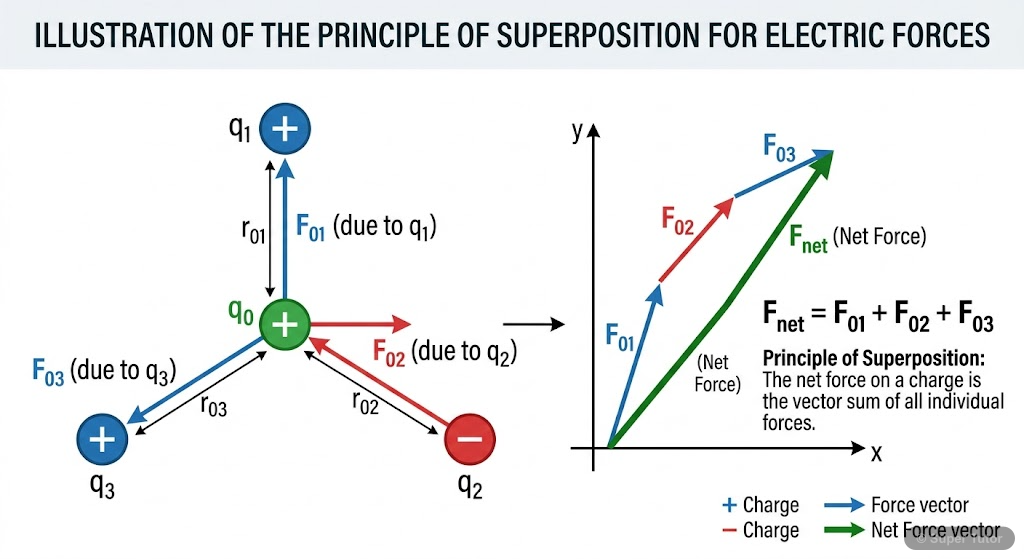
Learn better with visuals Super Tutor pairs illustrations like this with notes and quizzes for Electrostatic Potential and Capacitance.
Key Topics to Revise
1
1. Electrostatic Potential Energy and Electrostatic Potential
- The Coulomb force is conservative — work done is path-independent and depends only on initial and final positions.
- Potential Energy Difference: ΔU = U_P − U_R = W_RP (work done by external force in moving charge q from R to P).
- The reference point for potential energy is taken at infinity where potential energy = 0.
2
2. Potential Due to Point Charge, Dipole, and System of Charges
- Potential due to a point charge Q at distance r: V = kQ/r = Q/(4πε₀r). This falls as 1/r.
- Potential due to a dipole falls as 1/r² — faster than for a single charge (which falls as 1/r).
- Dipole potential depends on BOTH r (distance) AND θ (angle with dipole axis).
3
3. Equipotential Surfaces
- An equipotential surface is a surface on which the electric potential has the same value at every point.
- No work is done in moving a charge along an equipotential surface (since ΔV = 0, W = qΔV = 0).
- Electric field lines are ALWAYS perpendicular (normal) to equipotential surfaces — this is a fundamental property.
4
4. Potential Energy of a System of Charges and Dipole in External Field
- Potential energy of a system = work done by external agent in assembling the charges from infinity to their current positions.
- For two charges: U = kq₁q₂/r₁₂. Positive U means repulsive (like charges); Negative U means attractive (unlike charges).
- For three charges: U = k[q₁q₂/r₁₂ + q₁q₃/r₁₃ + q₂q₃/r₂₃]. Sum over all PAIRS.
Get complete notes with diagrams and examples
Full NotesKey Concepts
This is the work done byThe electrostatic potential at a pointFor a point charge Q atAn electric dipole consists of chargesThe total potential at a point
Frequently Asked Questions
What are the important topics in Electrostatic Potential and Capacitance for Punjab Board Class 12 Physics?
Key topics in Electrostatic Potential and Capacitance include Electrostatic Potential Energy and Electrostatic Potential, Potential Due to Point Charge, Dipole, and System of Charges, Equipotential Surfaces, Potential Energy of a System of Charges and Dipole in External Field. Study these first, then practise questions on each for the Punjab Board Class 12 board exam.
How should I revise Electrostatic Potential and Capacitance for the Punjab Board Class 12 board exam?
Learn the core ideas first, then work through the 45 practice questions on Electrostatic Potential and Capacitance. Revise definitions regularly and use flashcards for quick recall before the exam.
Sources & Official References
Content is aligned to the official syllabus. Refer to the board website for the latest curriculum.
More resources for Electrostatic Potential and Capacitance
For serious students
Get the full Electrostatic Potential and Capacitance chapter — start free.
Quizzes, flashcards, an AI doubt solver and a study plan for Punjab Board Class 12 Physics. Free to start, no card needed.