Electrostatic Potential and Capacitance — Concept Maps
Punjab Board · Class 12 · Physics
3 concept maps of Electrostatic Potential and Capacitance for Punjab Board Class 12 Physics, each also written out as a text outline.
Interactive on Super Tutor
Studying Electrostatic Potential and Capacitance? Get the full interactive chapter.
Quizzes, flashcards, AI doubt-solver and a step-by-step study plan — built for concept maps and more.
Free trial, no card needed.
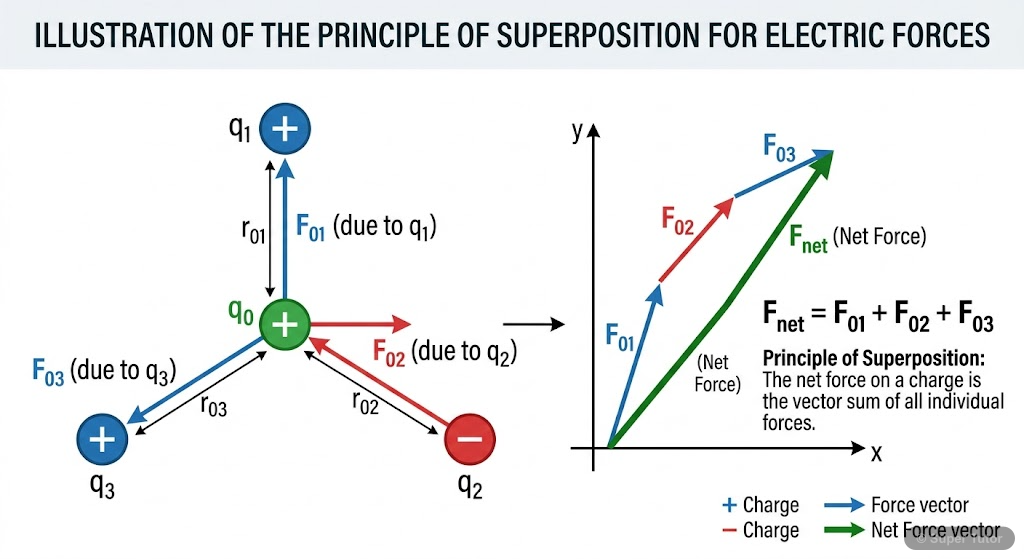
Learn better with visuals Super Tutor pairs illustrations like this with notes and quizzes for Electrostatic Potential and Capacitance.
Chapter Structure: Electrostatic Potential and Capacitance
The map in words
- Electrostatic Potential and Capacitance
- Potential Concepts
- Potential Energy
- Definition Work Done
- Conservative Force
- Path Independence
- Electrostatic Potential
- Work per Unit Charge
- Reference at Infinity
- Scalar Quantity
- Potential Calculations
- Point Charge
- Electric Dipole
- System of Charges
- Superposition
- Potential Energy
- Field-Potential Relations
- Equipotential Surfaces
- Constant Potential
- Sphere for Point Charge
- Perpendicular to Field
- Relation E and V
- E = -dV/dr
- Steepest Descent
- Field Direction
- Equipotential Surfaces
- Conductors
- Electrostatic Equilibrium
- Zero Field Inside
- Charges on Surface
- Constant Potential
- Properties
- Surface Field
- Shielding Effect
- Gauss Law Application
- Electrostatic Equilibrium
- Capacitors
- Definition and Properties
- Capacitance Formula
- Geometry Dependence
- Charge and Voltage
- Types and Configurations
- Parallel Plate
- Series Connection
- Parallel Connection
- Dielectric Effects
- Polarization
- Dielectric Constant
- Capacitance Increase
- Energy Aspects
- Energy Storage
- Energy Density
- Multiple Forms
- Definition and Properties
- Potential Concepts
Chapter 2: Electrostatic Potential and Capacitance — Complete Concept Map
The map in words
- Electrostatic Potential and Capacitance
- Electrostatic Potential
- Definition
- Work per unit positive charge
- From infinity to point P
- Unit Volt V
- Point Charge
- V = kQ divided by r
- Falls as 1 over r
- Positive for +Q
- Negative for -Q
- Electric Dipole
- V = kp cosθ divided by r squared
- Falls as 1 over r squared
- Axis: V = plus or minus kp over r squared
- Equatorial: V = 0
- System of Charges
- Superposition principle
- V = algebraic sum
- V is scalar
- Definition
- Equipotential Surfaces
- Constant V on surface
- E always perpendicular
- No work done on surface
- Point charge: concentric spheres
- Uniform field: parallel planes
- Closer spacing means stronger E
- E = negative dV over dl
- Potential Energy
- Two charges
- U = kq1q2 over r12
- Positive means repulsive
- Negative means attractive
- Three charges
- Sum over all pairs
- Three pair terms
- Dipole in external field
- U = negative p dot E
- U = negative pE cosθ
- Stable at θ = 0 degrees
- Unstable at θ = 180 degrees
- Two charges
- Conductors
- E = 0 inside
- E normal to surface
- Excess charge on surface
- Entire body equipotential
- Surface E = σ over ε0
- Electrostatic shielding
- Cavity E = 0
- Faraday cage application
- Dielectrics
- Non-polar molecules
- No permanent dipole
- Induced dipole in field
- O2 H2 CO2
- Polar molecules
- Permanent dipole
- Align in external field
- H2O HCl NH3
- Polarisation P
- P = ε0 χe E
- Dipole moment per volume
- Dielectric constant K
- K = ε over ε0
- K greater than 1 always
- Non-polar molecules
- Capacitors
- Definition C = Q over V
- Parallel plate
- C0 = ε0 A over d
- With dielectric C = KC0
- Combinations
- Series: 1 over C = sum of 1 over Ci
- Parallel: C = sum of Ci
- Energy stored
- U = Q squared over 2C
- U = half CV squared
- U = half QV
- Energy density: u = half ε0 E squared
- Electrostatic Potential
Electrostatic Potential and Capacitance — Chapter Mind Map
The map in words
- Electrostatic Potential and Capacitance
- Electrostatic Potential Energy
- Conservative Force
- Path Independent Work
- Work stored as PE
- Two Charge System
- U = kq1q2 divided by r12
- Positive for like charges
- Negative for unlike charges
- System of Charges
- Sum of all pair interactions
- Assembly work method
- Dipole in External Field
- U = negative pE cosTheta
- Stable at Theta = 0
- Unstable at Theta = 180
- Conservative Force
- Electrostatic Potential V
- Definition
- Work per unit positive charge
- From infinity to point P
- Unit: Volt
- Point Charge
- V = kQ divided by r
- Falls as 1 over r
- Electric Dipole
- V = kp cosTheta divided by r squared
- Zero on equatorial plane
- Falls as 1 over r squared
- System of Charges
- Superposition Principle
- Algebraic sum
- Definition
- Equipotential Surfaces
- E perpendicular to surface
- No work done on surface
- Never intersect each other
- Point charge: concentric spheres
- Uniform field: parallel planes
- Electrostatics of Conductors
- E = 0 inside conductor
- Charge on outer surface only
- V = constant throughout
- E = sigma over epsilon0 at surface
- Electrostatic Shielding
- Cavity has zero E field
- Faraday cage application
- Dielectrics and Polarisation
- Non-polar molecules
- Induced dipoles in field
- Polar molecules
- Alignment of permanent dipoles
- Polarisation P
- Dipole moment per unit volume
- Dielectric Constant K
- K = C divided by C0
- K greater than 1 always
- Non-polar molecules
- Capacitors
- Definition C = Q over V
- Parallel Plate Capacitor
- C0 = epsilon0 A over d
- With dielectric C = K epsilon0 A over d
- Combinations
- Series: reciprocals add
- Parallel: capacitances add
- Energy Stored
- U = Q squared over 2C
- U = half CV squared
- Energy density = half epsilon0 E squared
- Electrostatic Potential Energy
Explore these maps interactively
Explore DiagramsFrequently Asked Questions
What are the important topics in Electrostatic Potential and Capacitance for Punjab Board Class 12 Physics?
What do the concept maps for Electrostatic Potential and Capacitance show?
How should I revise Electrostatic Potential and Capacitance for the Punjab Board Class 12 board exam?
Sources & Official References
Content is aligned to the official syllabus. Refer to the board website for the latest curriculum.
More resources for Electrostatic Potential and Capacitance
Practice Quiz
Test yourself with a quick quiz
Important Questions
Exam-style questions with answers
Revision Notes
Key points for last-minute revision
Formula Sheet
The chapter's formulas in one place
Chapter Summary
Understand the chapter at a glance
Flashcards
Quick-fire cards for active recall
Syllabus
What topics to cover
For serious students
Get the full Electrostatic Potential and Capacitance chapter — start free.
Quizzes, flashcards, an AI doubt solver and a study plan for Punjab Board Class 12 Physics. Free to start, no card needed.