Electrostatic Potential and Capacitance — Chapter Summary
Punjab Board · Class 12 · Physics
Summary of Electrostatic Potential and Capacitance for Punjab Board Class 12 Physics. Part of the Punjab Board Class 12 Physics syllabus.
Interactive on Super Tutor
Studying Electrostatic Potential and Capacitance? Get the full interactive chapter.
Quizzes, flashcards, AI doubt-solver and a step-by-step study plan — built for chapter summary and more.
Free trial, no card needed.
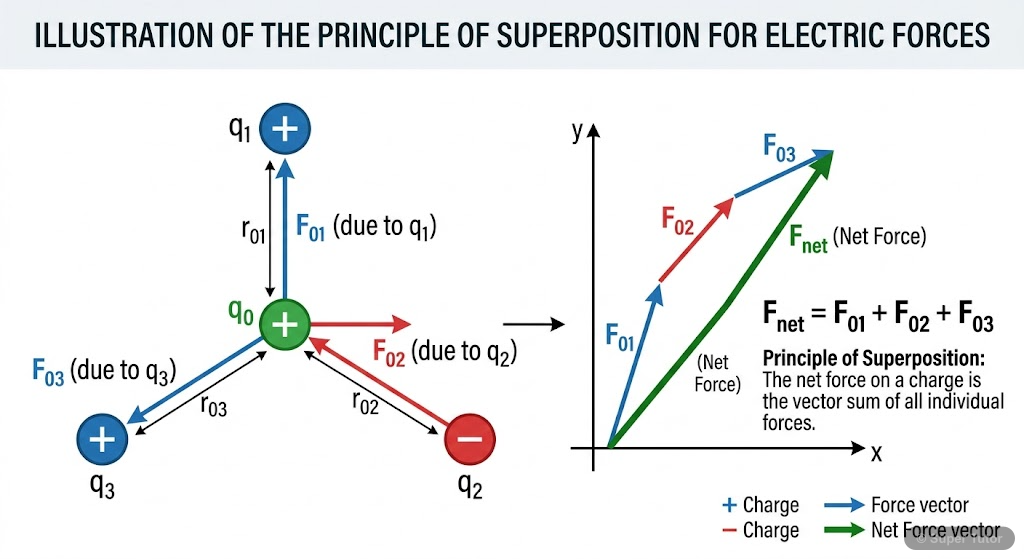
Learn better with visuals Super Tutor pairs illustrations like this with notes and quizzes for Electrostatic Potential and Capacitance.
Overview
Electrostatic Potential and Capacitance is a fundamental chapter in physics that extends our understanding of electric fields to the concept of potential energy and potential difference. This chapter bridges the gap between forces (covered in previous chapters) and energy considerations in electrost
Key Concepts
This is the work done by
This is the work done by an external force (equal and opposite to the electrostatic force) in bringing a test charge from infinity to a point in an el
The electrostatic potential at a point
The electrostatic potential at a point is defined as the work done per unit positive charge by an external force in bringing that charge from infinity
For a point charge Q at
For a point charge Q at the origin, the potential at distance r is: V(r) = (1/4πε₀) × (Q/r). This formula applies for any sign of Q: positive charges
An electric dipole consists of charges
An electric dipole consists of charges +q and -q separated by distance 2a, with dipole moment p = 2qa. The potential at a point P at distance r (where
The total potential at a point
The total potential at a point due to a system of charges is the algebraic sum of potentials due to individual charges: V = Σ (1/4πε₀) × (qᵢ/rᵢ). For
Learning Objectives
- Understand the concept of electrostatic potential energy and its relationship to conservative forces
- Define and calculate electrostatic potential due to point charges, dipoles, and charge systems
- Comprehend equipotential surfaces and their relationship to electric field lines
- Calculate potential energy of systems of charges in external fields
- Understand the behavior of conductors in electrostatic equilibrium
Frequently Asked Questions
What are the important topics in Electrostatic Potential and Capacitance for Punjab Board Class 12 Physics?
How should I revise Electrostatic Potential and Capacitance for the Punjab Board Class 12 board exam?
Sources & Official References
Content is aligned to the official syllabus. Refer to the board website for the latest curriculum.
More resources for Electrostatic Potential and Capacitance
For serious students
Get the full Electrostatic Potential and Capacitance chapter — start free.
Quizzes, flashcards, an AI doubt solver and a study plan for Punjab Board Class 12 Physics. Free to start, no card needed.