Electrostatic Potential and Capacitance — Flashcards
Punjab Board · Class 12 · Physics
23 flashcards for Electrostatic Potential and Capacitance (Punjab Board Class 12 Physics) to test yourself on key terms and facts.
Interactive on Super Tutor
Studying Electrostatic Potential and Capacitance? Get the full interactive chapter.
Quizzes, flashcards, AI doubt-solver and a step-by-step study plan — built for flashcards and more.
Free trial, no card needed.
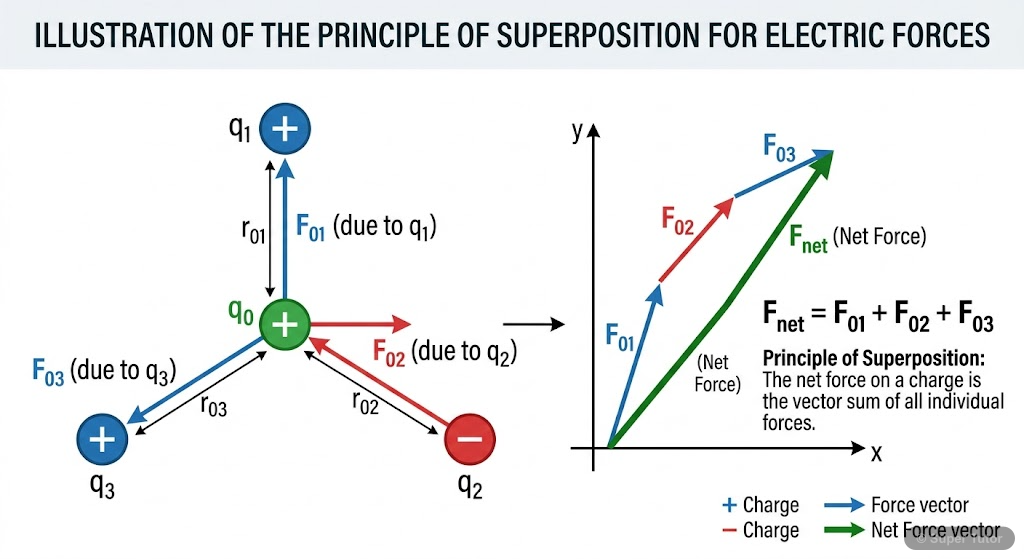
Learn better with visuals Super Tutor pairs illustrations like this with notes and quizzes for Electrostatic Potential and Capacitance.
Define electrostatic potential at a point. Why is only the potential difference physically significant?
Answer
Electrostatic potential (V) at a point is the work done per unit positive charge by an external force in bringing a test charge from infinity to that point. Only potential difference is physically sig…
A point charge Q = 5 × 10⁻⁶ C is placed at the origin. Calculate the potential at a point P located 20 cm away from the charge. (Take k = 9 × 10⁹ N·m²/C²)
Answer
Given: Q = 5 × 10⁻⁶ C, r = 20 cm = 0.20 m, k = 9 × 10⁹ N·m²/C² Formula: V = kQ/r Step 1: Substitute values V = (9 × 10⁹ N·m²/C²) × (5 × 10⁻⁶ C) / (0.20 m) Step 2: Calculate numerator Numerator = 9 …
Why is the electric field inside a conductor zero in electrostatic equilibrium? What does this imply about the potential inside the conductor?
Answer
Inside a conductor, free charge carriers (electrons in metals) continuously move until the internal electric field becomes zero. If any field existed, charges would experience a force and continue mov…
Two point charges q₁ = +3 × 10⁻⁸ C and q₂ = -2 × 10⁻⁸ C are located 15 cm apart. At what point on the line joining the charges is the electric potential zero?
Answer
Given: q₁ = +3 × 10⁻⁸ C, q₂ = -2 × 10⁻⁸ C, separation = 15 cm = 0.15 m Let point P be at distance x from q₁, where potential = 0 Formula: V_total = kq₁/x + kq₂/(0.15-x) = 0 Step 1: Set up equation …
State the formula for potential energy of a system of two point charges. What does a negative value indicate?
Answer
Formula: U = (1/4πε₀) × (q₁q₂/r₁₂) = kq₁q₂/r₁₂ Where: - q₁, q₂ are the charges - r₁₂ is the distance between them - k = 9 × 10⁹ N·m²/C² (Coulomb's constant) - ε₀ = 8.85 × 10⁻¹² C²/(N·m²) Unit: Joule…
Why does placing a dielectric material between capacitor plates increase its capacitance? Explain the mechanism.
Answer
Mechanism of Capacitance Increase: 1. Polarization: The dielectric molecules (polar or non-polar) align or deform in the external electric field - Polar molecules: Dipoles rotate to align with fie…
A parallel plate capacitor with area A = 100 cm² and plate separation d = 2 mm has vacuum between the plates. Calculate its capacitance. (ε₀ = 8.85 × 10⁻¹² F/m)
Answer
Given: A = 100 cm² = 100 × 10⁻⁴ m² = 10⁻² m², d = 2 mm = 2 × 10⁻³ m, ε₀ = 8.85 × 10⁻¹² F/m Formula: C = ε₀A/d Step 1: Identify the values with correct units A = 10⁻² m² d = 2 × 10⁻³ m ε₀ = 8.85 × 10…
What is the relationship between electric field and potential? How does field relate to the rate of change of potential?
Answer
Mathematical Relationship: E = -dV/dr (in one dimension) E = -∇V (in three dimensions, gradient) Physical Meaning: 1. Magnitude: |E| = -ΔV/Δl - Electric field equals the negative rate of change of…
+15 more flashcards
Practise AllFrequently Asked Questions
What are the important topics in Electrostatic Potential and Capacitance for Punjab Board Class 12 Physics?
How many flashcards are available for Electrostatic Potential and Capacitance?
How should I revise Electrostatic Potential and Capacitance for the Punjab Board Class 12 board exam?
Sources & Official References
Content is aligned to the official syllabus. Refer to the board website for the latest curriculum.
More resources for Electrostatic Potential and Capacitance
Practice Quiz
Test yourself with a quick quiz
Important Questions
Exam-style questions with answers
Revision Notes
Key points for last-minute revision
Formula Sheet
The chapter's formulas in one place
Chapter Summary
Understand the chapter at a glance
Concept Maps
See how topics connect
Syllabus
What topics to cover
For serious students
Get the full Electrostatic Potential and Capacitance chapter — start free.
Quizzes, flashcards, an AI doubt solver and a study plan for Punjab Board Class 12 Physics. Free to start, no card needed.