Is Matter Around us Pure? — Chapter Summary
Punjab Board · Class 9 · Science
Summary of Is Matter Around us Pure? for Punjab Board Class 9 Science. Part of the Punjab Board Class 9 Science syllabus.
Interactive on Super Tutor
Studying Is Matter Around us Pure?? Get the full interactive chapter.
Quizzes, flashcards, AI doubt-solver and a step-by-step study plan — built for chapter summary and more.
Free trial, no card needed.
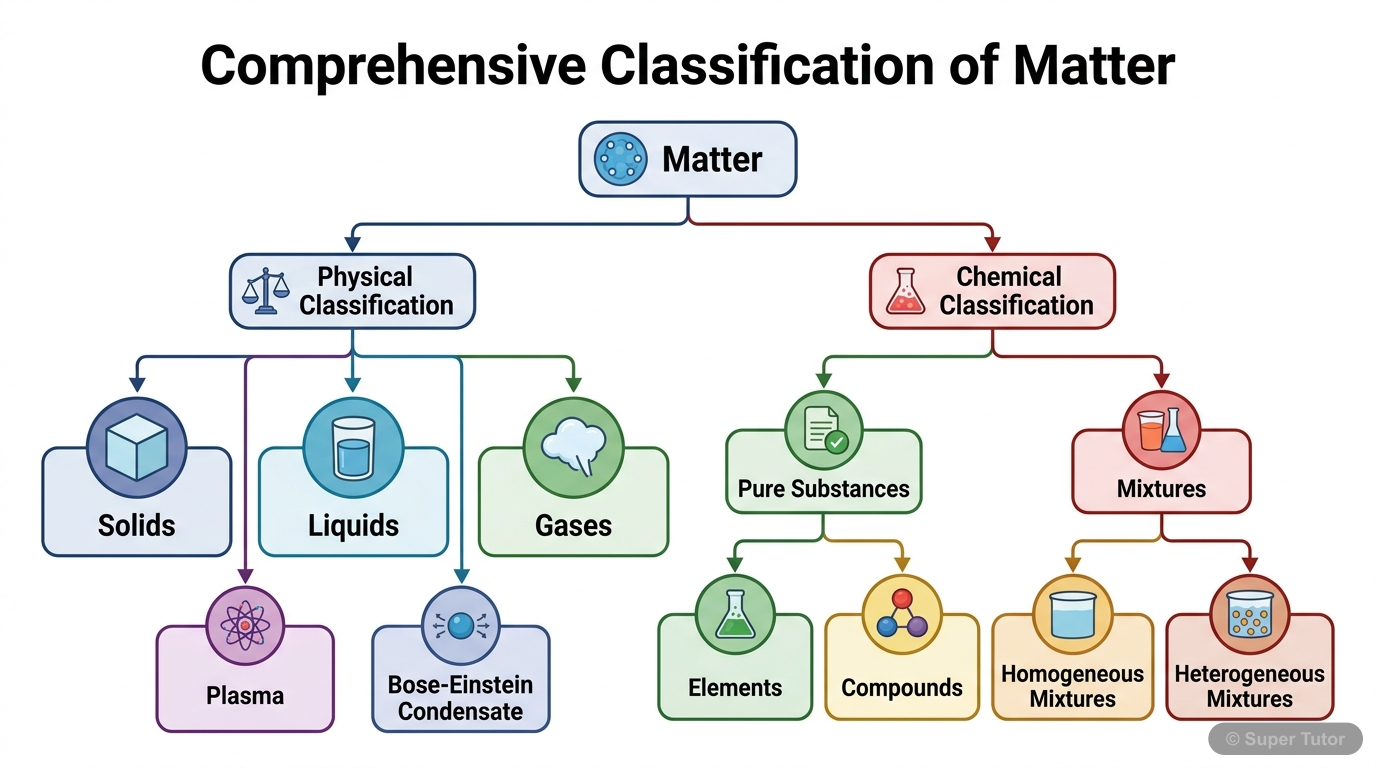
Learn better with visuals Super Tutor pairs illustrations like this with notes and quizzes for Is Matter Around us Pure?.
Overview
In our daily life, we encounter many materials like milk, salt, sugar, oil, and water. We often think of these as pure substances, but from a scientific perspective, most of them are actually mixtures of different substances. This chapter explores what makes matter pure or impure, how to classify di
Key Concepts
A pure substance contains only one
A pure substance contains only one type of particle with identical chemical composition throughout. In contrast, a mixture contains two or more pure s
Homogeneous mixtures have uniform composition
Homogeneous mixtures have uniform composition and appearance throughout. Solutions are the most common type of homogeneous mixture where one substance
Suspensions are heterogeneous mixtures where solid
Suspensions are heterogeneous mixtures where solid particles remain dispersed in a liquid or gas but do not dissolve. The particles are visible to the
Colloids are intermediate between solutions
Colloids are intermediate between solutions and suspensions with particle sizes between 1 nanometer and 1 micrometer. Examples include milk, fog, smok
The Tyndall effect is the scattering
The Tyndall effect is the scattering of light by colloidal particles suspended in a medium. When a beam of light passes through a colloid, the path be
Learning Objectives
- Understand the difference between pure substances and mixtures
- Classify mixtures as homogeneous and heterogeneous
- Learn about solutions, suspensions, and colloidal solutions with their properties
- Calculate concentration of solutions using different methods
- Distinguish between physical and chemical changes
Frequently Asked Questions
What are the important topics in Is Matter Around us Pure? for Punjab Board Class 9 Science?
How should I revise Is Matter Around us Pure? for Class 9 exams?
Sources & Official References
Content is aligned to the official syllabus. Refer to the board website for the latest curriculum.
More resources for Is Matter Around us Pure?
For serious students
Get the full Is Matter Around us Pure? chapter — start free.
Quizzes, flashcards, an AI doubt solver and a study plan for Punjab Board Class 9 Science. Free to start, no card needed.