Matter in Our Surroundings — Flashcards
Punjab Board · Class 9 · Science
40 flashcards for Matter in Our Surroundings (Punjab Board Class 9 Science) to test yourself on key terms and facts.
Interactive on Super Tutor
Studying Matter in Our Surroundings? Get the full interactive chapter.
Quizzes, flashcards, AI doubt-solver and a step-by-step study plan — built for flashcards and more.
Free trial, no card needed.
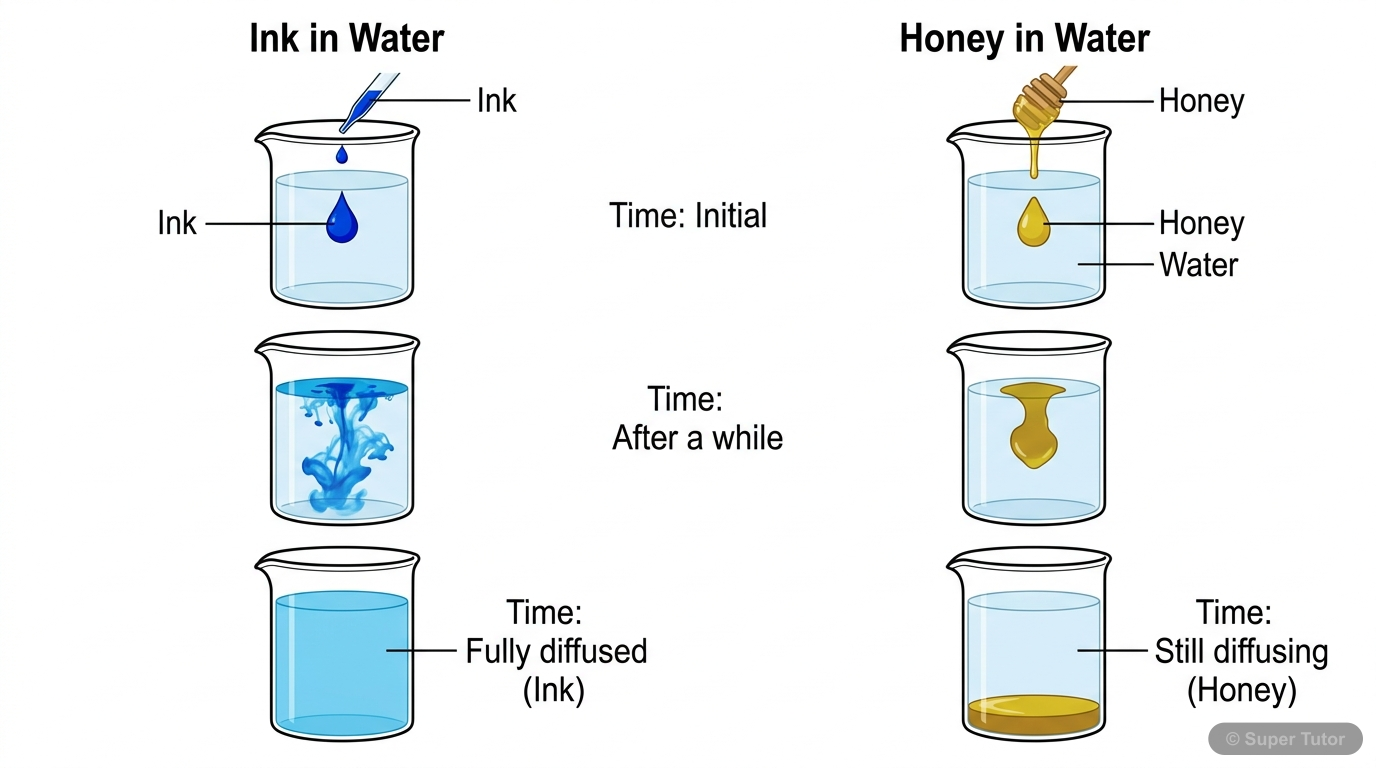
One of 2 illustrations for Matter in Our Surroundings in Super Tutor — alongside flashcards, concept maps and practice questions.
What is matter? Give two examples from your daily life.
Answer
Matter is anything that has mass and occupies space (has volume). Examples: The chair you sit on, the air you breathe, water you drink, the book you read, your pencil, etc. Everything in our surroundi…
A student dissolves salt in water. The salt seems to disappear, but the mass remains. Explain what happened to the salt particles.
Answer
The salt did not disappear; it broke down into tiny particles that spread throughout the water. This shows that matter is made up of small particles. The salt particles got into the spaces between wat…
In Activity 1.2, a few crystals of potassium permanganate color 1000 liters of water when diluted repeatedly. What does this tell us about particles of matter?
Answer
This demonstrates that particles of matter are incredibly small. Just a few visible crystals contain millions of tiny particles. When diluted repeatedly, the color still spreads because each particle …
List the three main characteristics of particles of matter.
Answer
1. Particles have spaces between them - This is why particles can diffuse and mix with each other. 2. Particles are continuously moving - They possess kinetic energy which increases with temperature.
Why do you smell the aroma of food cooking in the kitchen from a distance, but an unlit incense stick has to be brought close to smell it?
Answer
When food is cooked (hot), its particles have high kinetic energy and move rapidly. They spread through air quickly by diffusion, reaching your nose from a distance. An unlit incense stick (cold) has …
What is diffusion? How does heating affect the rate of diffusion?
Answer
Diffusion is the spontaneous intermixing of particles of two different types of matter on their own, as they move into spaces between each other. When heated, particles move faster because their kinet…
Perform this thought experiment: In Activity 1.6, students form human chains with different grip strengths. Which group represents solids, liquids, and gases based on force between particles?
Answer
The group locked arm-to-arm (maximum force) represents solids - particles held very tightly. The hand-holding group (medium force) represents liquids - particles with moderate attraction. The finger-t…
Define the three states of matter and give one characteristic property of each.
Answer
Solid: Fixed shape and fixed volume. Example: Chair, book, pencil. Liquid: No fixed shape but fixed volume. Takes shape of container. Example: Water, milk, oil. Gas: Neither fixed shape nor fixed volu…
+32 more flashcards
Practise AllFrequently Asked Questions
What are the important topics in Matter in Our Surroundings for Punjab Board Class 9 Science?
How many flashcards are available for Matter in Our Surroundings?
How should I revise Matter in Our Surroundings for Class 9 exams?
Sources & Official References
Content is aligned to the official syllabus. Refer to the board website for the latest curriculum.
More resources for Matter in Our Surroundings
Practice Quiz
Test yourself with a quick quiz
Important Questions
Exam-style questions with answers
Revision Notes
Key points for last-minute revision
Formula Sheet
The chapter's formulas in one place
Chapter Summary
Understand the chapter at a glance
Concept Maps
See how topics connect
Syllabus
What topics to cover
For serious students
Get the full Matter in Our Surroundings chapter — start free.
Quizzes, flashcards, an AI doubt solver and a study plan for Punjab Board Class 9 Science. Free to start, no card needed.