Magnetism and magnetic effects of electric current
Tamil Nadu Board · Class 12 · Physics
Most important questions from Magnetism and magnetic effects of electric current for Tamil Nadu Board Class 12 Physics board exam 2026. MCQs, short answer, and long answer questions with marks.
Interactive on Super Tutor
Studying Magnetism and magnetic effects of electric current? Get the full interactive chapter.
Quizzes, flashcards, AI doubt-solver and a step-by-step study plan — built for important questions and more.
1,000+ Class 12 students started this chapter today
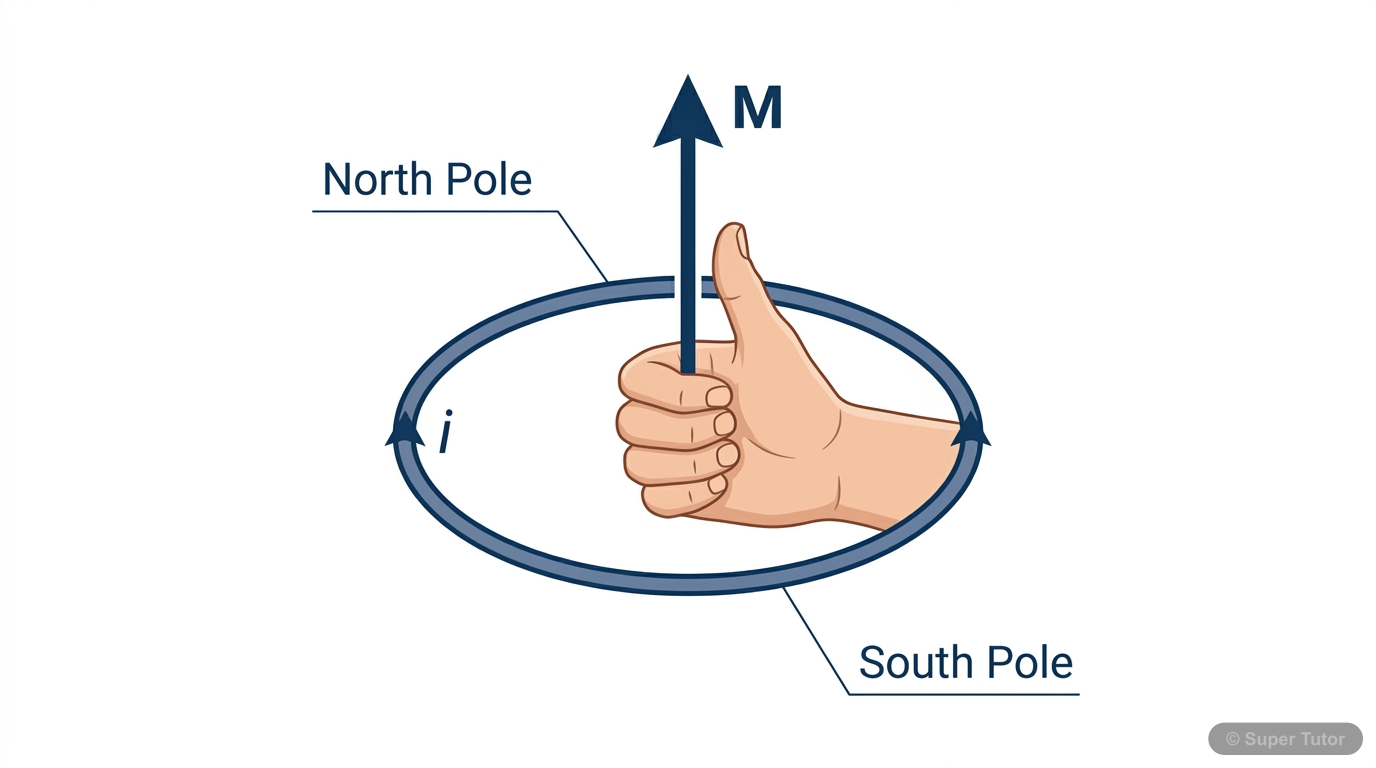
Super Tutor has 5+ illustrations like this for Magnetism and magnetic effects of electric current alone — flashcards, concept maps, and step-by-step visuals.
See them allSample Questions
The magnetic field at a point on the axial line of a short bar magnet at distance r from its centre is given by (pm = magnetic moment):
Show answer
Baxial = (µ0/4π) × 2pm / r³
Step 1: For a short bar magnet (r >> l), the magnetic field at a point on the axial line is derived using contributions from both north and south poles. Step 2: After simplification for r >> l, the formula is Baxial = (µ0/4π) × (2pm/r³). Step 3: Note the factor of 2 in the numerator — this is important. Step 4: On the equatorial line, the field is Bequatorial = (µ0/4π) × pm/r³ (no factor of 2). Step 5: So the axial field is exactly twice the equatorial field in magnitude.
When a bar magnet is placed at an angle θ with a uniform external magnetic field B, the torque acting on it is (pm = magnetic dipole moment):
Show answer
τ = pm × B × sin θ
Step 1: A bar magnet in a uniform magnetic field experiences two equal and opposite forces on its poles. Step 2: These forces form a couple (torque) tending to align the magnet along the field. Step 3: The magnitude of torque is τ = pm B sin θ, where θ is the angle between pm (dipole moment) and B. Step 4: In vector form, τ⃗ = p⃗m × B⃗. Step 5: When θ = 90°, torque is maximum (τ = pmB); when θ = 0° or 180°, torque is zero. The cos θ option would give maximum torque at θ = 0° which is physically wrong.
Which type of magnetic material has negative magnetic susceptibility?
Show answer
Diamagnetic material
Step 1: Magnetic susceptibility χm = M/H gives the response of a material to an applied magnetic field. Step 2: Diamagnetic materials develop magnetisation opposite to the applied field, so M is negative, giving negative χm. Step 3: Paramagnetic materials have small positive susceptibility (they weakly align with the field). Step 4: Ferromagnetic materials have large positive susceptibility (they strongly align with the field). Step 5: Examples of diamagnetic materials: Copper, Bismuth, Gold, Water.
According to Biot-Savart's law, the magnetic field dB produced at a point P due to a current element Idl at distance r is maximum when the angle between the current element and the position vector is:
Show answer
90°
Step 1: Biot-Savart's law states dB = (µ0/4π) × (Idl sin θ)/r². Step 2: The magnetic field depends on sin θ, where θ is the angle between the current element Idl and the position vector r̂. Step 3: sin θ is maximum when θ = 90°, giving maximum dB. Step 4: When θ = 0° or 180° (point lies on the conductor), sin θ = 0, so dB = 0 (minimum). Step 5: This is why the magnetic field is zero exactly along the direction of current flow.
+41 more questions available
Practice AllFrequently Asked Questions
What are the important topics in Magnetism and magnetic effects of electric current for Tamil Nadu Board Class 12 Physics?
How to score full marks in Magnetism and magnetic effects of electric current — Tamil Nadu Board Class 12 Physics?
How many important questions are there in Magnetism and magnetic effects of electric current?
Sources & Official References
Content is aligned to the official syllabus. Refer to the board website for the latest curriculum.
More resources for Magnetism and magnetic effects of electric current
Practice Quiz
Test yourself with a quick quiz
Revision Notes
Key points for last-minute revision
Formula Sheet
All formulas in one place
Chapter Summary
Understand the chapter at a glance
Concept Maps
See how topics connect visually
Study Plan
Step-by-step plan to ace this chapter
Flashcards
Quick-fire cards for active recall
Syllabus
What topics to cover
NCERT Solutions
Every textbook question solved step by step
For serious students
Get the full Magnetism and magnetic effects of electric current chapter — for free.
Quizzes, flashcards, AI doubt-solver and a step-by-step study plan for Tamil Nadu Board Class 12 Physics.