Magnetism and magnetic effects of electric current — Flashcards
Tamil Nadu Board · Class 12 · Physics
31 flashcards for Magnetism and magnetic effects of electric current (Tamil Nadu Board Class 12 Physics) to test yourself on key terms and facts.
Interactive on Super Tutor
Studying Magnetism and magnetic effects of electric current? Get the full interactive chapter.
Quizzes, flashcards, AI doubt-solver and a step-by-step study plan — built for flashcards and more.
Free trial, no card needed.
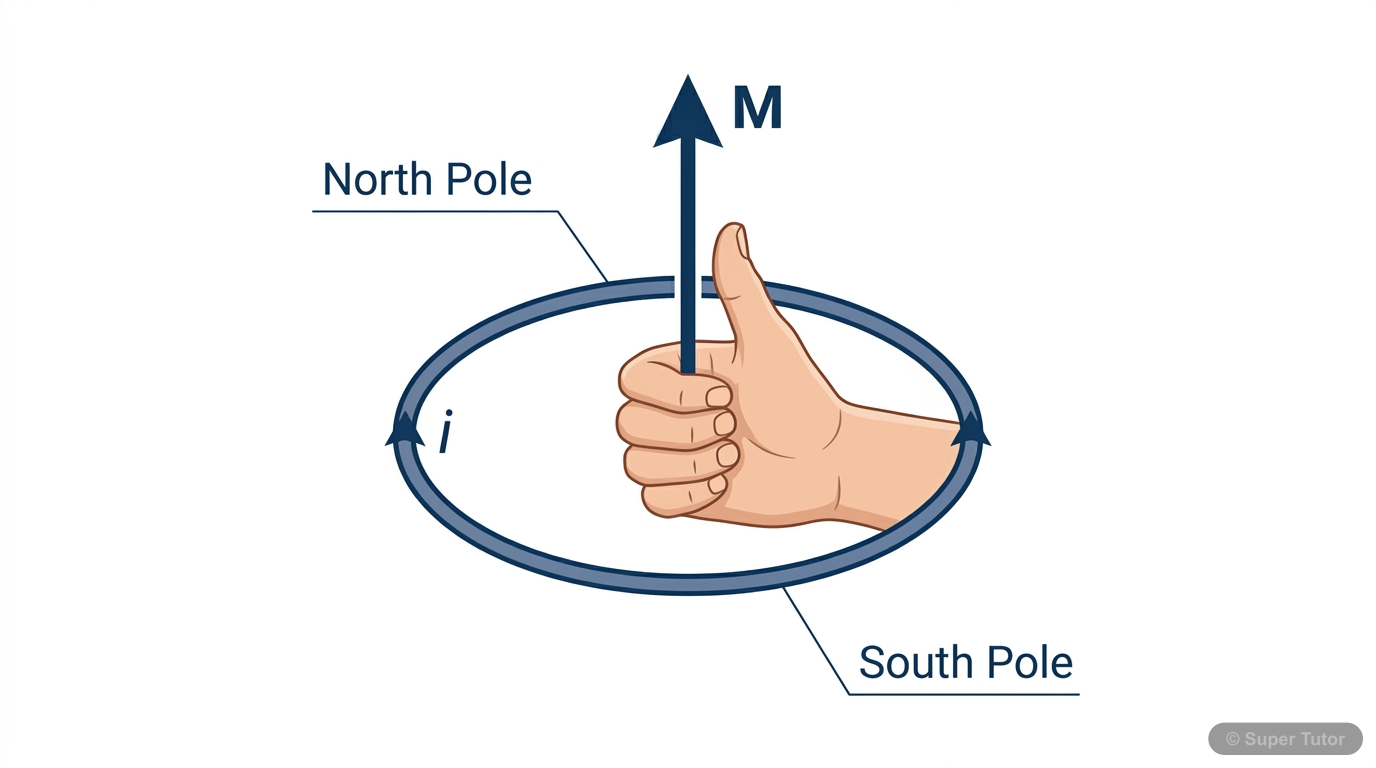
One of 3 illustrations for Magnetism and magnetic effects of electric current in Super Tutor — alongside flashcards, concept maps and practice questions.
Define magnetic dipole moment and give its SI unit.
Answer
Magnetic dipole moment (p_m) is defined as the product of pole strength (q_m) and magnetic length (2l). Formula: p_m = q_m × 2l. SI unit: A·m² (ampere-meter squared) or J·T⁻¹ (joule per tesla). Direct…
A bar magnet has a magnetic moment of 2.5 A·m². Calculate the magnetic field it produces at a distance of 0.2 m along its axial line.
Answer
For a short bar magnet on the axial line: B_axial = (μ₀/4π) × (2p_m/r³). Given: p_m = 2.5 A·m², r = 0.2 m, μ₀/4π = 10⁻⁷ T·m/A. Step 1: B = 10⁻⁷ × (2 × 2.5)/(0.2)³. Step 2: B = 10⁻⁷ × 5/0.008. Step 3: …
Why does a magnetic compass needle always align in the north-south direction?
Answer
A compass needle is a small magnet with its own magnetic dipole moment. The Earth itself behaves like a giant bar magnet with magnetic poles near the geographic poles. When freely suspended, the compa…
Calculate the angle of dip if the horizontal component of Earth's magnetic field is 0.18 G and vertical component is 0.32 G.
Answer
The angle of dip (inclination) I is given by: tan(I) = B_V/B_H. Given: B_H = 0.18 G, B_V = 0.32 G. Step 1: tan(I) = 0.32/0.18 = 1.778. Step 2: I = tan⁻¹(1.778) = 60.5°. Step 3: Verify with resultant B…
State Coulomb's law of magnetism and compare it with Coulomb's law of electrostatics.
Answer
Coulomb's Law of Magnetism: F = k(q_m1 × q_m2)/r², where q_m is pole strength in A·m, k = μ₀/4π = 10⁻⁷ T·m/A. Like poles repel, unlike poles attract. Comparison with Electrostatics: Both follow invers…
Two magnetic poles of equal strength 40 A·m are separated by 10 cm in air. Calculate the repulsive force between them.
Answer
Using Coulomb's law of magnetism: F = (μ₀/4π) × (q_m1 × q_m2)/r². Given: q_m1 = q_m2 = 40 A·m, r = 10 cm = 0.1 m, μ₀/4π = 10⁻⁷ T·m/A. Step 1: F = 10⁻⁷ × (40 × 40)/(0.1)². Step 2: F = 10⁻⁷ × 1600/0.01.
Why does the magnetic field on the equatorial line of a bar magnet point opposite to the dipole moment?
Answer
On the equatorial line (perpendicular bisector of a bar magnet), the magnetic field is: B_equatorial = -(μ₀/4π) × (p_m/r³). The negative sign indicates the field points opposite to the magnetic moment…
Calculate the torque experienced by a bar magnet with magnetic moment 0.5 A·m² when placed in Earth's magnetic field (0.35 × 10⁻⁴ T) at an angle of 30° to the field.
Answer
Torque on a dipole in magnetic field: τ = p_m × B × sin(θ). Given: p_m = 0.5 A·m², B = 0.35 × 10⁻⁴ T, θ = 30°. Step 1: τ = 0.5 × 0.35 × 10⁻⁴ × sin(30°). Step 2: sin(30°) = 0.5. Step 3: τ = 0.5 × 0.35 …
+23 more flashcards
Practise AllFrequently Asked Questions
What are the important topics in Magnetism and magnetic effects of electric current for Tamil Nadu Board Class 12 Physics?
How many flashcards are available for Magnetism and magnetic effects of electric current?
How should I revise Magnetism and magnetic effects of electric current for the Tamil Nadu Board Class 12 board exam?
Sources & Official References
Content is aligned to the official syllabus. Refer to the board website for the latest curriculum.
More resources for Magnetism and magnetic effects of electric current
Practice Quiz
Test yourself with a quick quiz
Important Questions
Exam-style questions with answers
Revision Notes
Key points for last-minute revision
Formula Sheet
The chapter's formulas in one place
Chapter Summary
Understand the chapter at a glance
Concept Maps
See how topics connect
Syllabus
What topics to cover
For serious students
Get the full Magnetism and magnetic effects of electric current chapter — start free.
Quizzes, flashcards, an AI doubt solver and a study plan for Tamil Nadu Board Class 12 Physics. Free to start, no card needed.